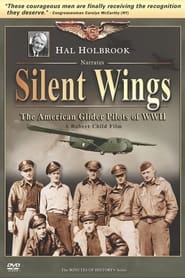
Silent Wings: The American Glider Pilots of World War II
Download English Subtitle
Release info
Tags
English subtitle preview
The first 200 lines.
(humming of planes - somber music - explosions)
Hal Holbrook: World War II was the most violent
and destructive armed conflict in the history of mankind.
It is believed that approximately 62 million people,
or 2.5% of the world's population perished in the war.
Its aftermath ushered in a new era of doomsday weapons,
and shifted the balance of global power
for generations to come.
The Second World War is considered the most
chronicle event in the annals of human history.
Thousands of books, films, and memorials have
been dedicated to the conflict, yet one unwritten
and unheralded chapter remains.
The story of Americas World War II glider pilots,
spearheading nearly every allied assaulter in the war.
They were a fearless band of 6,000 volunteer aviators
whose exploits and accomplishments endure as
a testament to their distinguished service.
These brave American pilots flew infantry and
vital supplies on silent, one-way transport missions
deep into enemy held territory with each hostile
fire choked landing potentially being their last.
What survives is a remarkable story vivid
in the memory of American glider veterans and
unforgettable to men who flew alongside them.
Walter Cronkite: At least when assigned to it I thought
well it will be a nice quiet way to die,
at least there's no big engine running right
outside the window and it will be quiet and
a nice peaceful way to go. Actually it
turned out to be anything but that.
Andy Rooney: The glider, I don't know whether everybody
understands it was a totally expandable piece of equipment.
It was never salvaged. I mean they came in and just,
it was an accident, a planned accident, and
you hoped to survive the accident.
Leo Cordier: We knew that we had a tough
road to hoe with the flying gliders and
initial invasion missions, D-Day missions
I was very fortunate to survive five of them.
If you survive one you were pretty lucky.
Hal Holbrook: At the start of World War II
Belgian Fort Eben-Emael defending the
Belgian-German border was widely regarded
as the strongest fort in the world,
impregnable to ground attack and manned by
nearly 1,000 Belgian artillery men.
By May, 1940, however it resided in the
crosshairs of one of the most deadly and
daring attacks in military history.
Rudy Opitz: It was actually a decision from
Hitler himself that the gliders were used
because everybody else thought that it's not possible.
Hal Holbrook: Operation Granite painstakingly
planned by Adolph Hitler was about to exploit
the forts single weakness, it's roof.
With a flat metal-like surface, the forts roof
created the perfect natural glider landing strip.
Just before dawn 40 German DFS 230 assault gliders
lifted off from airfields near Cologne.
Part of Germany's top secret glider program 11 of these
motorless aircraft were bound for Fort Eben-Emael.
Rudy Opitz: My people they told they were
you bring me there, you bring us here, you know,
and you don't have to do anything, you know,
we'll take care of, once we're on the ground
we'll take care of it, but you bring us here.
Hal Holbrook: The special forces paratroopers
on board were heavily armed with flamethrowers
and a top secret 110 pound hollow charge bomb.
The unsuspecting Belgians would soon experience
more destructive force than had ever been witnessed in warfare.
Releasing from their tow-ropes at 7,000 feet
still within Germany the first glider
strike force in history slowly descended towards its target.
Touching down silently on the forts grassy roof the
paratroopers quickly overpowered and neutralized the Belgian defenders.
Hal Holbrook: Before the smoke cleared from
the massive invasive explosions Eben-Emael was in Nazi hands.
Rudy Opitz: We did it with confidence and,
of course, because we did it with confidence it was a success.
Hal Holbrook: Hitler's gold gamble of using
gliders to spearhead and attack had paid off decisively,
and ushered in a new era in aviation warfare.
From the rubble of Fortress Eben-Emael German
forces would reach the French coast in just 10 days.
Rudy Opitz: The fort which was considered
impregnable that couldn't be taken it was gone in 20 minutes.
Adolph Hitler: "Heil Hitler!"
Hal Holbrook: The Nazis secret glider program
had evolved as an unintended result of
The Treaty of Versailles.
The agreement had restricted Germany's production
and use of powered aircraft.
Rudy Opitz: You wanted to fly, but you couldn't.
If you prevent people to do something, you know,
and you say they can't do it, you know,
they will find a way to do it, okay, and that
was the way in Germany we started to approach flying.
For us in 1927 when Lindbergh flew to Europe
and landed in France he was probably for us
a bigger hero than he was in the United States.
We flew gliders and that was permitted and
we did what we could do with gliders.
Hal Holbrook: In 1922 Hermann G█ring, a
World War I veteran who would later become
chief of the Luftwaffe called glider instruction
for the youth the first of three steps in
the redevelopment of German air power.
This 18 year head start in combat glider
development presented allied and American
military planners with a daunting challenge.
In less than a years' time design and construct
new motorless aircraft to match Germany's
highly effective new weapon and recruit and train
pilots to fly the motorless craft into battle.
In 1940 America was consumed by defensive
powered aircraft manufacture and was ill-prepared
to shift resources to glider development and training.
It would take until February 1941 when
Major General Henry "Hap" Arnold acquired a
keen interest in the successes of the German glider
core that the American Glider Program finally took off.
Known as the father of the United States Airforce
and a strong advocate or airborne envelopment
through technology innovation General Arnold
would make an American Glider Program a
central component of his strategy of technological advancement.
On February 25, 1941, he announced "In view
of certain information received from abroad
a study should be initiated on developing a
glider that could be towed by an aircraft."
Jerry Devlin: Hap Arnold was a visionary.
He foresaw the need that World War II was
coming and he tried to do his very best and
he did do his very best to see that the
United States was well prepared in the way
of having aircraft production boosted up and
he was also a big fan of the gliders, the
World War II gliders that the Americans
became so famous for. Quite an amazing guy.
Hal Holbrook: Arnold, in a classified
memo in March 1941 directed engineers at the
Army Air Corps Experimental Aircraft Test Center
at Wright Field to create designs and
solicit prototypes from manufacturers.
His memo, however, contained a clause that
glider production orders could only be
solicited from civilian manufacturers not
already producing powered aircraft.
Of the four companies that responded with
a glider prototype it was only the design
by Waco Aircraft of Troy, Ohio, which passed final testing.
Jerry Devlin: Waco was a pioneer in the manufacture
of small lightweight powered aircraft and about
that same time when the US Air Force mainly
at General Arnold's urging was pushing out
feelers to various civilian manufacturers
of aircraft said look how would you like to
get in the glider business? We're looking for
an eight seater glider and we're also looking
for a 15-place glider meaning two pilots,
12 troops, and how would you guys
like to get into the glider business?
The Air Force sent letters out to 16 different manufacturers.
When the prototypes were built it turned out
that Waco produced the very best that the
Air Force was looking for at that time and
so they wound up getting the contract to
build the very first eight seat gliders and
they also won the contract to produce the
larger CG-4A which held 15 people, two pilots, and 12 troops.
They produced the best contract, the best designs,
and when tested by Wright Field in Ohio
it was found that they were the very best, the very best ones.
Hal Holbrook: In all, 16 firms won bids to
build Waco's CG-4A design. Among them was
Cessna and automobile giant Ford motor company.
Ford's assembly line efficiency had reduced
the cost of each glider to about $15,400 each
while nearly all the remaining 15 approved
CG-4A manufacturers charged the government
a minimum of $25,000 a piece.
Outwardly silent in flight riding in the glider crew
compartment it was an entirely different story.
Walter Cronkite: The American Waco glider
was a glider with a canvas cover. Well, it
was like being inside of a drum.
And it made such a terrible, terrible racket
it was kind of like being inside the drum
at a Grateful Dead concert.
The roar, the noise was absolutely deafening.
You couldn't talk over it. It was just terrible
and that was the first major disappointment.
Then when the tow-rope was dropped the second
major disappointment the nose dropped and
we almost went straight down and I was saying
to myself well I knew these things wouldn't
fly by themselves they had to be towed and it
turned out that this was the technique for
Comments
No comments yet. Be the first to leave one.