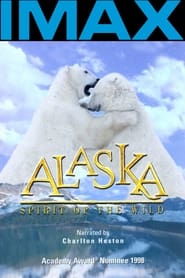
Alaska: Spirit of the Wild
Download English Subtitle
Release info
Tags
English subtitle preview
The first 173 lines.
Earth, 18,000 years before the present
it's a world locked in cold
at the height of the last great lce Age.
Across tens of thousands of years
unmelting snows have compacted into massive glaciers.
Buried under ice sheets averaging a mile thick
are lands where hundreds of millions live today.
As Earth's water is increasing locked up in ice
sea levels plummet more than a hundred meters.
Exposed sea floor nearly joins Australia to Southeast Asia
Japan becomes part of mainland Asia.
Across North America, ice fields and glaciers
envelop all of Canada and northernmost United States.
As the lce Age spreads, Alaska emerges as a crossroads.
Off it's Bering sea coastline
the retreating ocean exposes a great land bridge
a thousand miles wide connecting Asia to America.
Across this corridor, a river of living creatures would flow.
It was the genesis of a great wave of life
that would inhabit the Americas, and this was it's Eden.
Crossing into ancient Alaska
migrating herds find new forage and sheltering valleys
but they're followed from Asia by fierce carnivore...
saber-toothed cats, giant bears
and the greatest of all predators.
They arrive in small bands from Siberia
pressing east in pursuit of game
unaware they're discovering a continent.
The hunters are sustained by bison, moose, woolly mammoth
and the wild reindeer called caribou.
Where frozen tundra limits vegetation, meat is life.
Most of the year, it is kill or starve.
The hunters prosper here across millennia
but as the receding lce Age
opens the wall of glaciers to the south
most move on with the herds
into the virgin continents beyond.
Their descendants will become Apache and Sioux, Aztec and Maya
lnca and Amazonian.
yet some remain in Alaska.
For them, this is a world of mysterious forces and spirits.
To science, the Aurora Borealis is created
by streams of charged particles from the sun
colliding with the atmosphere.
To some Native Americans, the Northern Lights
were children not yet born at play in the heavens.
Here at the far edges of existence
the wildness of the ancient earth
never vanished.
Even today, the solitude of the past
is broken only occasionally by the sound of the present.
In Alaska, the last great lce Age survives.
Vast regions appear as lifeless as a frozen planet.
Sheer walls a mile deep loom as monuments to the power
of the glaciers which carved them.
Most of its rugged terrain can be crossed only with wings.
Massive snowfalls compress glacial ice
so dense in some places
only a single color of the spectrum is reflected...
an ethereal blue...
chilling and strangely beautiful.
Where the frozen rivers end
icebergs are born in a spectacle so mighty
native tribes call it "While Thunder"
Some blocks are the size of 30-story buildings.
It would seem a place too hostile for living things
but each year, after a winter that can last nine months
Alaska erupts with life.
Hundreds of thousands of birds
stream here from as far away as Antarctica
to breed in Alaska's protected cliffs and coves
and to feed on it's rich seas.
For one brief season of abundance
life flourishes.
lce-falls turn to waterfalls.
Grasses emerge, fueled by up to 24 hours of sunlight a day.
Animals hurry to store up nutrients
before winter returns.
Without the plenty of the warm season
life couldn't survive the long months of bitter cold.
Famished from half a year of hibernation
even the lordly brown bear
is content to graze in spring
sharing the meadows with caribou too fleet to be caught.
As bellies fill, play begins.
There is other business conducted
in the fields of fresh grass...
the age-old rite of spring.
They will remain a couple for only a day or two
sharing a rough affection.
Bear hugs will lead to the conception of new life
to be born in the hibernation den
in the dead of winter.
A world of extremes
Alaska is swept by enormous tidal fluctuations.
Low tide can drain an entire bay like a bathtub.
Taking advantage of the low tides
brown bears roam the exposed tidal flats.
to dig for clams.
Any protein is welcome in the effort
to replenish a body that can weigh 1,400 pounds.
Perhaps noticing the success
of mother and cub, an imitator arrives.
But clamming is not as easy as it looks.
For a red fox, survival is, in part, knowing when to give up
and just move on.
As summer's warmth deepens
Alaska's three million lakes turn to gathering places.
Beavers prepare
for the ravages of cold weather ahead
by repairing their lodges.
Moose feast on tender aquatic plants
hidden on lake bottoms.
Wolf pups gorge on mother's milk
to reach near-adult size before winter arrives.
But the serenity of summer
can be shattered by the approach of an intruder.
The black bear has a fearsome reputation
but it's the most playful of bear species
and with the coast clear and the water cool
even a bear may succumb
to the impulse merely to have fun.
Life along the coast, too, is eased by the warm season.
After a winter battered by North Pacific storms
sea lion colonies haul out to sun themselves
like vacationers enjoying a day at the beach.
A game of King of the Mountain ensues.
In the world of sea lions, size matters...
but patience succeeds.
Ungainly on shore, the sea lion moves in the sea
with the ease of a circus performer...
both acrobat and clown.
Like its meadows, Alaska's seas bloom with fertility
under the lengthening daylight.
So rich are the waters
humpback whales swim nearly 4,000 miles from Hawaii
to revel in Alaska's season of abundance.
Humpbacks fast for eight months
in the relatively sparse waters of the tropics
where they breed and give birth.
For survival, they depend almost entirely upon the krill
and small fish that concentrate here in summer.
To capture the immense quantities
of food they need
some humpbacks have devised an extraordinary technique
of cooperative feeding.
Diving in unison
they surround a school of herring
while one or more sings a ritual feeding song.
Simultaneously, a whale blows a circular net of bubbles
around the fish.
Then, as the trap is completed
the entire group rockets upward through the bubble bath.
Each species finds a way to survive.
Humpbacks have learned to invent
and, more importantly, to cooperate.
In summer, a miracle arrives from the sea
in wave after wave
salmon return from the open ocean
and embark on a final migration inland
to spawn in the same streams of their birth.
Silver bodies transfiguring for the act of spawning...
a phenomenal sense of smell guiding them...
they sweep into Alaska by the millions
in a vast flood of life.
They face a marathon journey upstream
sometimes hundreds of miles long
yet they persist
even in the face of impossible obstacles.
For brown bears, the arrival of salmon
is the most important feeding event of the year.
It's the last opportunity to add the bulk they need
for the months of winter hibernation ahead.
Alaska: Spirit of the Wild subtitles in other languages
More English subtitles for Alaska: Spirit of the Wild
- Imax Alaska Spirit Of The Wild 720p Bluray x264-hV · 53 downloads · 2010-10-06
- Alaska Spirit of the Wild 1997 · 49 downloads · 2008-12-15
Comments
No comments yet. Be the first to leave one.