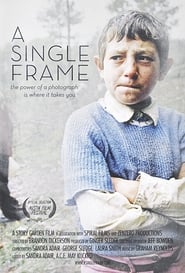
A Single Frame
Download English Subtitle
Release info
Tags
English subtitle preview
The first 200 lines.
And so, this is it, you know?
"We don't remember the kid," he says.
You know, the power of a photograph
isn't the photograph itself,
it's the relationship with other people
that form with that photograph
that can really change things.
Six years ago, I was in Dubrovnik with my family,
and one morning, my daughter came to me and she said,
"Hey Dad, I heard there's an exhibition of photographs
"all taken by female war photographers.
Do you want to go?"
And I said, "Sure, let's go."
I just remember walking in front of it.
I described it to a friend as like a car wreck in my chest.
*
I'm not even aware of the other people around me,
I'm just fixated on this image.
- I remember exactly where it was.
You know, you turn a corner
and then the photograph is on this wall,
and he's standing in front of it
with his arms crossed and looking at it.
Seeing his reaction to that photograph, you know,
is the first time that I have ever seen him be in pain.
- A kid stuck in the middle of a war.
It was as though that boy
was really standing there, shivering.
There's a profound sense of powerlessness.
This child is trapped in a very adult world.
I just connected with some sense of that,
that being powerless or being the subject of forces
that are much larger than you.
- You hope when you're working in places like Kosovo
that what you're photographing
is something that will resonate with people outside,
that the events that are taking place need,
demand attention.
Two years later, Gracie gave me
a print of the photograph as a gift.
I frame it and I hang it in my office.
It was the only picture I had at home
of someone other than my family.
I saw this photograph almost every day.
And I had no idea who this boy was
or what happened to him or what he'd gone through.
After all of those quiet moments over a long period of time,
I came to a place where I wanted go find him.
I wanted to know what happened to this boy.
The day I got it, I started looking up Alexandra,
who took this.
In fact, is it on the back?
Maybe it's on the back.
Let's see.
Yeah.
So on the back, there was this certificate.
And so, from getting this to looking her up online,
I learned she died and in fact that she had
a brain aneurysm, like two and a half weeks
after we went to see the picture for the very first time.
As interested as I was at the gallery,
I'm more interested now.
First, I wanted to know more about Alexandra's photography,
so I went to Sipa Press
to see if they would let me look at her archives.
You think she's in there?
I know she's in here.
Here we go.
Actually, this starts out with a quote of Alexandra herself.
"Between '91 and '99, I spent a lot of time in Yugoslavia.
"While I was visiting the country,
"a Serb spoke to me of a custom.
"It was thought wise to slip a weapon
"under the pillows of children before they fell asleep.
"And while I was listening to him,
"I imagined these parents
"and the childhood of these children,
"then their adolescence, and a whole life influenced
"by this gesture.
"Then I slipped into the sleep of these children
"and it was like a dream, a nightmare that shook
this Balkan region during the 10 years that followed."
This is just for the negative,
black and white and color.
We have the...
Oh wow.
Unbelievable.
You know what, his whole family may be in here.
Central Kosovo, an isolated refugee camp
in the central mountains.
Ten thousand ethnic Albanians had been driven
out of their homes by Yugoslav security forces,
October 1998.
Central Kosovo, C32.
- This one. - Right.
Exactly, exactly.
The story-- this one.
Ah yeah, I remember this boy.
Do you really?
Yeah.
Yeah.
What'd she say?
Alexandra Boulat was born in Paris in 1962.
She started out as a painter,
and eventually found her way
into the male-dominated world of war photojournalism.
She got her start on assignments in Croatia,
Kosovo, and Bosnia,
with images appearing in National Geographic, Time,
Newsweek, and Paris Match.
She joined Sipa Press when she was 29 years old.
I called Alexandra's mother Annie and she said,
"If you really want to know my daughter,
"you need to go meet Gary Knight.
They worked together during the war in the Balkans."
I'm on some journey because of her.
I'm just curious, what was she like?
- I first met Alex in the restaurant
of the Holiday Inn in Sarajevo.
You had terrible, sort of, Cold War-era architecture.
It was the middle of the siege of Sarajevo.
You had to dodge snipers when you left.
It was a very, very miserable place.
And I remember when Alex came in, you know,
this really sophisticated, beautiful French girl
came into the room.
It was extraordinary, you know?
It was almost as if she was lit.
- My earliest memories of Alexandra
are her trademark expression, which is "Ooh la la."
And that would introduce a sentence
but it might be ridiculous,
like "Ooh la la, we are in Kosovo, oh my God."
We called her Bou La La,
'cause she would always say 'Ooh la la,'
and, yeah, so the nickname that she has is Bou La La.
I named my boat Bou La La after her, actually, yes.
- There was always energy around her.
She'd brighten us up in unexpected ways
and we're waiting for something
for hours and hours and hours
and wasting our time getting frustrated
and Alex was there to lighten--
lighten us up with her 'Ooh la la.'
One of the most important things about Alex
was her dedication to her work.
She was so hardworking
and so smart about what she was doing.
We became fast friends, and we worked together quite a lot.
Then Alex, myself, and five others founded VII.
There's a lot of stuff that she and I were together for.
This...
this.
For this...
for this.
Um...
At that time, were you and she traveling together?
We were.
Okay.
Were you with her at this exact date?
I don't know.
We would go back every day to the area
to document what was going on.
This was a very obviously important part
of the story at the time of people taking refuge.
They were being expelled from their villages
and they were hiding in the mountains.
And it's quite possible that
this kid could be over here
and she just turned around and I didn't see him
or didn't photograph him or whatever.
- Alex was very, very interested in the lives of others
and exploring the lives of others
and communicating about those lives
and challenging the way that we all think about the world.
And I think Alex had already,
even at this age and this stage in her career,
lived a pretty full life.
I mean, she'd gone through a lot of love, a lot of loss,
a lot of fear, a lot of anxiety,
a lot of pain, a lot of joy.
And all of those things would've informed her photography.
The success of the picture for me isn't the picture,
it's where the picture takes you.
For starters, she's photographing an ordinary person
doing something very ordinary at an extraordinary time.
This is somebody who is extremely anxious and concerned,
and he would've been in late 1998, or early '99,
in Kosovo, for sure.
I went back to War Photo Limited
to meet Wade.
I hadn't met him on our first visit to the gallery.
He told me that the original print of the boy
was still on display upstairs.
And he was exhibiting his own photos from the Balkan wars
for the very first time.
You know, so many of his images are of young people.
- So, just to know it's a story of everyday life,
this guy still insists on covering his car.
But when you see how many holes that are already in it,
More English subtitles for A Single Frame
- A Single Frame 2015 1080p WEBRip x264-RARBG · 9 downloads · 2020-08-20
Comments
No comments yet. Be the first to leave one.