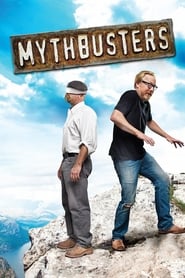
MythBusters
Download English Subtitle
Download English Subtitle Files for Mobile (4)
English subtitle preview
The first 200 lines.
Do not try any of the experiments
you are about to see at home.
You heard him. Don't do it.
Narrator: On this episode of "Mythbusters"...
One.
...duck, cover, and hang on,
because we've got a killer cocktail of lethal littering...
My weapon of choice... a potentially lethal slush drink.
...and high-flying action-movie action.
Get to the chopper, Grant!
And first up...
Looks harmless enough, doesn't it?
Could be deadly.
Narrator: Can a soda cup thrown from a car
really kill an oncoming driver?
Time to inspect the wound.
Narrator: Then, from helicopter heaves to fingertip grips,
can film fall-guys really hang on Hollywood-style?
I would love to see the action hero
that can hang on to that!
Narrator: Who are the Mythbusters?
- Adam Savage... - Here comes chaos.
...and Jamie Hyneman.
Relax. This won't hurt a bit.
Between them, more than 30 years of special-effects experience.
Bye-bye.
Joining them... Kari Byron...
High explosives and electricity. Whoo!
...Tory Belleci...
Crashes and fires. This is awesome.
...Grant Imahara...
Burn!
Narrator: And featuring Jessi Combs.
That was awesome!
Narrator: They don't just tell the myths.
They put them to the test.
Close your eyes.
I'm gonna paint you a picture with words.
Okay.
I'm driving down the highway at highway speeds.
I'm just gone to a drive-in,
and I've gotten a soda in a styrofoam cup,
and it's the wrong soda.
Oh! You hate that!
I know.
So, I hurl the soda out the window, being a jerk,
and it hits a car going the opposite direction,
also at highway speeds, pierces the windshield
right in front of the driver and kills her.
A styrofoam cup does that?
I know!
That is crazy!
Narrator: As if simply littering wasn't bad enough,
the villain of this myth
allegedly killed the driver of an oncoming car
with a styrofoam soda cup.
Whilst traveling at highway speeds,
our trash-happy perpetrator
tossed his unfinished drink out of the window,
which supposedly pierced the windshield
of an innocent drive-by bystander
with enough force to take them out permanently.
Okay, now I want to paint you a word picture.
I'm not gonna close my eyes, though.
That's fine. This is a quick one.
We make a cannon that shoots a cup of soda, huh?
Really?
I somehow pictured two cars
going at each other, jousting-fashion,
tossing cups out the window.
No, no, no... I figure we'll get exactly to that place,
but first we need to know what the cup is filled with.
Is it soda? Is it soda and ice?
Is to ice alone? Is it the slush drink?
We have to determine what filling has the most power,
and what's better for that than a cannon?
Well, all right, then.
I thought you'd like it.
Narrator: So, before the highway trash-jousting can begin...
I think that was a hit!
Narrator: The guys are going to arm themselves
with an indoor air cannon
the size of the Large Hadron Collider.
Well, almost.
I'd say that ought to do it.
Their goal is to discover
which of the various possible combinations of cup contents
will impart the most force on impact.
And speaking of the Force, here's the Yoda of soda.
So, there you have it...
our potentially deadly styrofoam cup.
Now, for the purposes of our experimentation,
I'm gonna want to know
exactly how much energy this cup imparts to something it hits,
whether it's empty or filled with different substances.
How am I gonna do that? With this... a lode cell.
This little button here can tell me,
when I hit it with something,
exactly how much energy is transferred
from the object to the lode cell.
But here we got an object that's too big
and a lode cell that's too small,
so I'm going to increase the surface area of my lode cell
by placing it between these two nice, heavy steel plates.
Now when this cup hits this first steel plate,
that will transfer the energy to the button
and tell me exactly how much energy
this potentially lethal cup might have.
It's ready.
Narrator: With the force plate in place,
the guys will be able to accurately compare
the impact of each cup fired from the cannon.
Off at a rakish angle. I like it.
So, this is how this works.
We've got our specially made pressure tank
with a built-in fast-acting valve.
Now, when we open that valve,
all that air comes out at high speed,
heads straight down the barrel.
Our cup comes out the end, hits this plate,
pushes on the lode cell... Bob's your uncle.
Narrator: So, Robert's your mother's brother...
Every target needs a motivation.
Yeah!
Narrator: And Jamie is the light at the end of the tunnel.
So, Fall Guys,
what are we, testing myths about '80s TV shows?
Ooh, can we do "A-Team" next?
Yes and no.
Yes, we can get to the "A-Team,"
and, no, we are not testing myths about '80s TV shows.
We're actually gonna test the myths about falling,
or, more accurately, not falling.
So, you're talking about, like,
the classic Hollywood scenario
where somebody's hanging on to a high edge
using nothing but their fingertips.
- Exactly. - This sounds awesome!
Narrator: To cling on by your fingertips
is a classic silver-screen cliché.
Apparently, in any action movie,
the hero can hang on indefinitely.
But are any of the many variations really viable?
To find out, the team will take on two of the most common.
First, can you really just hang on until help comes along?
Then, hauling yourself into a helicopter...
is it fact or film fiction?
You guys, I have the perfect place to test this.
There's a fire-training tower in Pleasanton.
It's got ledges all around, easily accessible rooftop,
and it's pretty tall.
Well, as far as the hang-time test goes,
there's one thing I'd like to add,
and that's edge thickness,
and see how that affects how long you can hold onto.
What are we waiting for?
So the team head on out to hang out
at the perfect place to, you know, hang out.
Tory: When we talked about this in the blueprint room,
it seemed pretty straightforward.
Whoa! This is high!
I mean, we just grab onto an edge
and see how long we can hang on.
But now, standing on top of this 75-foot building,
I'm wondering, "Is this really necessary?"
I mean, can't we just test this hanging off a doorframe?
Narrator: With the team's nerves suitably primed,
let's find out what's on the agenda.
Grant: So, the first thing we're gonna test
is how long you can hang onto a ledge.
And to do that, I've built this... the ledge-o-matic.
It's fully adjustable
so we can block off a controlled amount of ledge each time.
And we'll get progressively smaller and smaller
until we can no longer hang on.
Then we'll have a good idea of how long
an average Joe can hang onto a ledge.
Narrator: But before the action begins,
let's meet the man who will be pulling the piñata strings.
Anybody got a bat?
Aaron, a professional climber,
is not only helping the team with their safety protocols...
You're gonna come over the edge,
and then what I want you to do is say "tension."
He's set up the belay system
so it won't support the climber's weight,
at least until they fall.
Good?
Yeah, it feels real good.
Tory, you're the guinea pig.
Now, in the movies,
people hang off of all shapes and sizes of ledges,
and we are gonna do the same.
The goal is to come up with a set of data
that correlates ledge thickness to hang time.
Hook me in.
Grant: And to start off with, we're gonna use a nice, fat ledge.
I'm gonna double-check it, just in case.
Narrator: Yep, the ledge width will be starting at 4 inches.
Which should be plenty of room, even for "fat finger" Belleci.
MythBusters subtitles in other languages
More English subtitles for MythBusters
- Season 2003/Smyth S2003E01 Jet Assisted Chev eng · 6794 downloads · 2025-02-22
- Mythbuster S01E03 · 147 downloads · 2020-03-22
- Mythbusters S01E02 · 141 downloads · 2020-03-22
- Mythbusters S01E01 · 235 downloads · 2020-03-22
- MythBusters S12E04 iNTERNAL HDTV x264-WNN · 130 downloads · 2015-04-02
- Mythbusters S12 Zombie Special REPACK HDTV x264-KILLERS · 147 downloads · 2015-04-02
- Mythbusters S14E03 Commercial Myths HDTV x264-W4F · 85 downloads · 2015-02-07
- Mythbusters S14E02 Household Disasters HDTV x264-W4F · 81 downloads · 2015-02-07
Comments
No comments yet. Be the first to leave one.