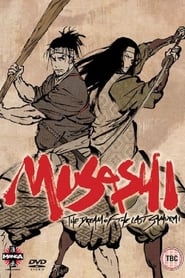
Musashi: The Dream of the Last Samurai (Miyamoto Musashi: Sôken ni haseru yume)
Miyamoto Musashi: Sôken ni haseru yume
Download English Subtitle
Release info
Tags
English subtitle preview
The first 188 lines.
Miyamoto Musashi is a master swordman that everyone knows by his name.
Musashi never spoke about this duel on Ganryu Island against Sasaki Kojiro which made him famous.
The life of Miyamoto Musashi that everyone knows and talks about...
He is a unbeatable swordman with a trained mind.
A seeker of truth.
But those are false images drawn after his death.
A false image of having wild days of youth.
A false image of learning zen.
A false image of being an art enthusiast.
And a false images of the swordsmen who dueled against Musashi.
He traveled to the captal at age of twenty-one,
met with the greatest fighter,
and went through several duels,
and always came out victorious.
After that, he travelled around the country,
he challenged fighters everywhere,
and continued his duels until he was passed age of sixty.
He never lost in the entire time.
Everyone knew his name in the history,
yet his life is largely unknown.
Such cases are common,
and Miyamoto Musashi was one of such cases.
Shinmen Musashi No Kami Fujiwara No Genshin, also known as Miyamoto Musashi,
has been documented in countless literatures, proving his existence.
But on the other hand, he has always been surrounded by various false images.
It may be a sign of how complex the impression of this swordman is in the minds of the Japanese population.
To eliminate these false images and to come up with the true image of Miyamoto Musashi.
That is the thesis of my research, and the main topic of this film.
He had the strongest mind, and best combat skills.
He admired the religeon, but never believed in them.
But on the other hand, he was a cold-hearted fighter who did not hesitate to kill a child in order to bring victory on his hand.
What is the key to explain these contradictory sides of him?
We cannot explain it without talking about Battle of Sekigahara.
It's the battle to decide the next ruler.
Will it be the knowledgeable general Tokugawa Ieyasu of East who will rule after Hideyoshi?
Or will it be Mitsunari of West?
It's a ground-shaking big battle.
In this spark-inducing war, Ieyasu comes out victorious,
and settled his shogunate capital in Edo.
Musashi was then seventeen years old.
He was at the front of Ishida Mitsunari's army.
He was against Tokugawa Ieyasu's main force, led by Fukushima Masanori.
He was looking for a great recognition at the war ground.
He was trying to become a warlord on horse back.
There was a man by Musashi's side.
Musashi and he has promised to rise to the power together and fled from Miyamoto Village together.
He's Musashi's childhood friend, Hikoya.
Black smoke rose from every which way.
It was dark even during the day.
People and horses are suffering in pain.
Blood shed everywhere.
Rifles, arrows, and swords, all are taking away people's blood.
Enemies and allies are everywhere, turning everyone including your friend into corpses.
The battle is over, and the rain stops too.
He looks at the piles of corpse of his lost army.
What was going through Musashi's mind then?
Musashi stated that he served in six battles, including Battle of Sekigahara.
Even after his reputation as a great swordman, he insisted in serving in battles.
But in any of those cases, Musashi was treated lowly.
Even though he was a peerless fighter,
he could not do much more than running around as a soldier on the war ground.
His heart was controlled by his obsession of mixed feeling of love and hatred toward those generals on the horse back throughout his life.
More accurately, he was obsessed with horses.
It must be hard to believe that this feteshism for horses that led to his two-sword style.
What did it mean to mean a bushi in this time of Japan?
Before we delve in to that topic, we should remind ourselves about western knights.
As you may know, and just like the bushi we will talk later,
the key to their existence lied in the horse.
The force formed by the nobles who are not in the laber force,
the elite force of the cavalry soldiers came into existence in Achaemenid Empire in the Persian region.
The cavalry force faces a big turning point during in the agricultural empire of Sasan.
It was caused by the epoch-making inventions that made anyone able to ride the horses--
saddle and stirrup.
Especially in close quarter combats, having stirrup preventing falling of the riders was vital to the cavalry soldiers.
At the same time, they were essential to handling of various weapons on the horse,
especially for accurate aim of the bow and arrow.
This is my assistant, Miss Iori.
Later, during the time of Crusades,
three items became a part of knighthood that later became the symbols of them.
Those were armors, horse, and crests.
That does this mean?
It was a symbolism that said knights never die.
During the time of Crusades, many of the knights were captivated.
Later, they returned home alive in exchange for ransome.
The crests signified that the owner had the financial power to pay the ransome.
Conversely, foot soldiers without armors were killed upon capture.
Knights had the footsoldiers use bows and crossbows, but they never used them themselves.
It was because it's a weapon of little control that will kill knights and foot soldiers.
Knights were to never kill other knights.
So they used blunt weapons such as mace and flail.
If they were hit over the armor, they only gave concussion and other non-fatal blows.
But against unarmored saldier, these weapons gave deadly blows.
So the training menus of western knights did not consist of horseback archery or horse handling used by Japanese bushi,
but consisted of muscle building to be able to carry the weight of the armor
by means of repetition of swinging great swords, axes and clubs.
Being on the horse meant they had great survivability on the war ground.
It also was a sign of their power, being in the noble class.
This is off topic,
but when the modern Olympic Games were established in the late 19th certury,
the competitions included fencing, wrestling, weight lifting and such,
but did not include any archery related sports.
That tells how the spirit of the knighthood was carried into the athleticism of the western noble class.
And another side story.
In the English public schools,
they attempted teaching of gentlemanly, which is the modern version of knighthood.
But ironically, it lead to their army producing piles of deads during the trench battles in World War I.
In the mordern battle ground where high-speed bullets fly around,
knightly manner was extremely risky.
They learned their lessons from that,
and they attempted to bring back the immortal image of the knights.
As a result, they produced an heavily armored vehicle called a tank.
Now that I've shown you the brief history of birth of Western knighthood,
let's shift our focus from West to East.
The first cavalry force in China was seen in the state of Zhao.
This lead to extinction of chariots which was the main power during the Spring and Autumn Period.
But even with the financial power of Han Empire,
they were unable to support enough cavalry force of the time, the light-armored, horse-back archers, to drive the Xiongnu in the North.
Having the cavalry force also meant that the horses consuming their portion of agricultural products,
and on top of that, there was a risk of the forces forming military factions.
The central government wanted to keep the cavalry forces close to the capital city,
but that will give opportunity for the nomads to strike first.
Their solution to this dilemma was the crossbow.
The best part of crossbow was the fact that cost of training was nengligible.
Skills of spears, archery, and horse handling deteriorates quickly when they stop the training.
Therefore, the soldiers handling such tools had to be hired full time.
Conversely, the crossbow archers could return to their farm land as soon as the expedition is over.
Inclusion of crossbow archers meant optimal cost performance.
As such, there was no European style knight class with special treatment.
Their cavaliers were mere riding soldiers having no high ranks.
And their style of wearing light armors unlike the European style heavy armors,
and using bow and arrow as their main weapon,
was also brought to Japan as well by way of China.
That had a tremendeous effect on establishing the style of bushi.
But why was the Chinese style crossbow not brought over?
Actually, during the Yamato period,
they used crossbow to fight against the forces in Ebisu in the North.
But, having the hot and humid climate,
the composite bows, with gelatin used as glue, deteriorated in their performance fast,
and were never able to deliver quality performance.
Also, the wargrounds often had mountaneous land with thick forestation,
which were not very fit for clash of large armies.
And thus, Japanese bushi carried the style of wearing light armor and handling bows and arrows on the horse back,
but as their cast system having four divisions in the society,
they were placed in the higher social ranks, much like the European knights.
And, at the core of Miyamoto Musashi's swordman style was the bushi on the horseback.
Now, before we get back to our main point, with having Miss Iori gone, let's take a break.
I will be introducing you to one of the better know opponent of Musashi...
His name is Shishido Nanigashi.
He is a chainsickle master.
Musashi drew his short sword,
saw that Shishido was taken aback by that move,
and dashed toward his enemy.
The existence of Shishido Nanigashi in the history has not been proven or disproven.
But what is truly interesting is the fact that people like to talk about this fighter who mastered this unique weapon to prove how Musashi's two-sword style was useful.
How this two-sword style, which, on the surface, seems like a suicidal style, become useful?
It becomes clear by reading through a certain literal work.
Yes, that is The Book of Five Rings.
Miyamoto Musashi said
"I name my style of fighting Niten Ichi-ryu."
"I am putting what I have learned in writing for the first time."
It was early October in 1943.
He climbed up Iwatono Mtn in Higo region of Kyushu.
He worshiped the sky,
he bowed to Guanyin,
and he faced the Buddha statue.
Book of Five Rings is the book teaching fighting style that Miyamoto Musashi wrote.
But until the Edo period, it was known as Five Books of Fighting Style, or Teachings of Fighting Styles.
The name, Book of Five Rings, became common only after the Meiji peirod.
And later, the word "gorin" was used to mean the Olympics by a certain newspaper writer,
which made the word know more commonly.
What's more,
Book of Five Rings was only a draft,
so the modern rumor of Musashi dying right after finishing the writing of this book is a baseless false fact.
Book of Five Rings never had an autograph manuscript to start with.
What we can read are all just copies.
And there are numerous different copies.
The number of copies floating around or hidden everywere in the country is simply uncountable.
Such circumstance has lead to the situation that some topics that Musashi has written can be taken in complete opposite ways.
But let us read through these books to with our focus on the core value of the fighter named Musashi.
If you can win against a single enemy in any way you want,
you can win against anyone in the world.
"Winning" means the same thing whether you face one person or ten million people.
How a general leads an army to victory with his teaching of personal fighting style
is the same thing as constructing a large Buddha statue using a small model.
A one-on-one battle and army-on-army are the same thing.
Now, the reason Musashi had to write this book was because he had no intention of staying an insignificant fighter.
He mentions the same thing in various places throughout the book, not trying to make his style sound more authoritative,
but to the battle of army to army was what he ultimately dreamt about.
Musashi: The Dream of the Last Samurai (Miyamoto Musashi: Sôken ni haseru yume) subtitles in other languages
More English subtitles for Musashi: The Dream of the Last Samurai (Miyamoto Musashi: Sôken ni haseru yume)
- [FrostiiFlakes] Miyamoto MusashiSouken ni Haseru Yume BD H264AC3 1504x640 [9C0E028E] · 46 downloads · 2011-07-16
Comments
No comments yet. Be the first to leave one.