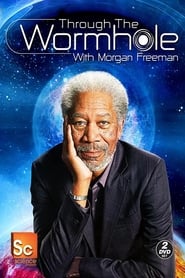
Through the Wormhole
Download English Subtitle
Release info
Tags
English subtitle preview
The first 200 lines.
Since the dawn of our species,
humanity has never stopped moving forward.
First, we mastered fire.
Today, we play with the fabric of space and time.
Now technology is about to advance
beyond our wildest dreams.
We may soon know the future...
And learn to move matter at the speed of light.
Could we mortals ever gain power over the entire universe?
Will we become God?
Space, time, life itself.
The secrets of the cosmos lie through the wormhole.
The Bible says
that God is the master of all things in heaven and on earth,
that God created us and guides the world we live in.
But a total mastery of the universe
may not be just a divine power.
It could be our destiny.
Will we someday not only play God...
But be God?
And what will we do with our omnipotence?
I played cowboys when I was a kid.
The sneak attack was my trademark move.
In the world I created, bullets couldn't harm me.
I was invincible.
I could do anything I wanted.
Could these God-like powers one day be a reality
in the real world?
U.C. Berkeley bioengineer Adam Arkin
believes we are very close to one divine ability --
creating new forms of life.
Want evidence?
He's sitting right on top of it.
Well, these very organic-looking pieces of furniture
are actually formed out of a fast-growing fungus.
The artist's name is Philip Ross.
He calls this type of work mycotecture,
because the study of fungi is mycology,
and so they're like architecture of fungus.
The artist crafted these tools
by feeding wood chips to mushrooms.
As the mushrooms feast, they grow fibers that interlock,
forming a substance that is stronger than concrete.
We are learning how to shape life to fit our needs.
But Adam wants to take this idea a step further,
to have living objects shape themselves
according to our design,
just as the Bible says God shaped Eve from Adam's rib.
What we would like to do as engineers
is to program the cells
to self-organize into shapes like this,
or into more complicated, articulated shapes
than even this is.
Adam's dream is to create living organisms
that can sense their surroundings
and change their shape on demand.
Instead of a mushroom chair always being a chair,
it would know when Adam got tired...
Wow. And then, organically,
morph itself into a mushroom bed.
To do this, he needs to learn
how to control the movement of molecules
inside living cells.
Well, imagine the dancer is a molecule
that's going inside her cell.
Molecules are what make the cell act.
They bounce into each other,
they bind, they pull, they stretch,
and in doing so, make the cell do, you know,
do all these amazing acrobatics,
all of which we can exploit for our own needs.
Every movement a cell makes
stems from instructions in its D.N.A. code.
Adam had been subtly altering this code
to change how the molecules in a cell
are programmed to perform.
As cytoengineers, what we're able to do these days
is to take D.N.A., engineer it,
and put it back inside cells so it can direct
the dancer you're seeing here,
and so we can, on a computer,
program what we expect to see happen,
make that into D.N.A., put it into the cells,
and then watch to see if they follow our instructions.
If Adam can control the behavior of one cell,
imagine what he can do with many.
He could program cells to grow into whatever he wants.
He could create an apple...
a tree,
or maybe something even God never considered,
like a living bicycle.
In the case of the bicycle, each part has to work together.
There's gears and wheels and steering, and the like.
And so, each cell has to be aware of its surrounds
and work with other cells, each one different,
each one with its own job.
And part of our instruction set is to make that happen.
Adam's work could be the foundation
for creating a modern garden of eden,
where we, not God,
get to decide what kind of life grows inside of it.
I think humans want to feel in control over their world.
We are animals that build things and control things
and change things, and I think
it's part in process with who we are.
The Bible says,
"God's ultimate creations were man and woman --
beings with their own free will."
We have already crafted new life-forms,
but could our creations ever have conscious souls?
Most scientists consider conscious experience
to be an elusive property
that may never be fully understood,
much less artificially created.
But neuroscientist Melanie Bolling,
from the University of Wisconsin-Madison,
doesn't think it's so mysterious.
In fact, she thinks it can be boiled down to a single number.
What we try to do in our work is to quantify consciousness.
By the quantity, we say,
"How much understanding there is?
How much consciousness there is in a system?"
One way to understand consciousness
is to observe what happens when it fails.
Different brain injuries
have dramatically different consequences.
We learn from neurology
that there are some brain lesions
that make you unconscious and some that don't.
When damage occurs in the cerebral cortex,
body organs like the heart and lungs
may continue to function.
However, a patient won't show any awareness
of his or her environment.
But a person with injuries only to the cerebellum
could still be perfectly awake and alert.
Even though the cerebellum has many more neurons
than the cortex, it doesn't play a vital role in consciousness.
So when you look at what makes the difference
between the cortex and the cerebellum,
you will see that the difference is not in the number of neurons.
What is making the difference is
the way the different brain areas talk to each other.
Imagine that each neuron throughout the brain
is a light bulb.
What would happen if every single one had its own switch?
So if I turn this light on,
it won't make any difference to the rest of the system.
Melanie believes
that consciousness arises in the cortex,
because the neurons it stems from
are not isolated bulbs.
They form an interconnected network that communicates.
If we had a set of lamps that are connected to each other,
then actually turning the lamp on or off
would make a lot of difference to the rest of the system.
And there, we would say
that the information is shared or integrated.
Now the lights are talking.
When one turns on, it signals another to turn off.
When one turns off, it signals another to turn on, and so on.
Together, they create a dynamic symphony
of thoughts and emotions,
leading to the feeling of being alive.
So, this interconnectedness is thought to be important
for consciousness to arise in the brain.
This idea led Melanie to develop a formula
that will allow us to measure consciousness.
It calculates the degree of interconnectedness of neurons
in any system.
The answer is a number represented
by the Greek letter, Phi.
The more conscious something is, the greater its value of phi.
The human brain, with trillions of neuroconnections,
has a large value of phi.
An earthworm's phi is exponentially smaller,
but it's still not zero.
So one of the implications of the theory
is that consciousness is not necessarily only in humans.
We could use phi as a way
to measure the level of consciousness
in a lot of different cases,
being living beings or computers.
If Melanie and her colleagues have found a way
to measure consciousness,
how long could it be before we design and build
systems that are self-aware,
just as God populated earth with sentient beings?
In the Bible,
God solved the consciousness equation in one day.
This puzzle master
thinks he can solve any equation and any problem.
If he's right,
divine wisdom could be right at our fingertips.
If you're a salesman or maybe an actor,
and you have to travel to 15 cities around the world,
what's the shortest route you could take
to visit each one only once?
Well, there are an awful lot of possibilities --
87 billion, in fact.
Through the Wormhole subtitles in other languages
More English subtitles for Through the Wormhole
- Through the Wormhole S02E06 Are there parallel universes · 51 downloads · 2018-02-08
- through the wormhole s08e04 is gun crime a virus internal 720p HDTV x264-DHD · 67 downloads · 2017-05-17
- through the wormhole s08e03 can we hack the planet internal 720p HDTV x264-DHD · 56 downloads · 2017-05-10
- through the wormhole s08e02 can we cheat death internal 720p HDTV x264-DHD · 64 downloads · 2017-05-04
- through the wormhole s08e01 is the force with us internal 720p HDTV x264-DHD · 69 downloads · 2017-04-26
- Through the Wormhole S07E04 Can We All Become Geniuses 720p WEB-DL x264-Sleepless · 72 downloads · 2016-10-10
- Through the Wormhole S07E04 Can We All Become Geniuses 720p HDTV x264-DHD · 50 downloads · 2016-09-22
- Through the Wormhole S07E04 720p HDTV x264-DHD Can We All Become Geniuses? · 54 downloads · 2016-09-21
Comments
No comments yet. Be the first to leave one.