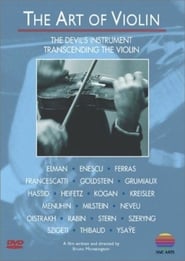
The Art of Violin
Download English Subtitle
Release info
Tags
Download English Subtitle Files for Mobile (2)
English subtitle preview
The first 172 lines.
"The Art Of the Violin"
Yehudi Menuhin, Berlin, 1963 Mozart, Concerto in G major
With the passing away on March 12, 1999
of the last true legendary violinist, Yehudi Menuhin
The final page of the history of violin and 20th century was turned
Fabulous enriched era came to a close.
Part 1 - The Devil's Instrument
David Oistrakh, Moscow, 1958 Mendelssohn, Concerto in E minor
If you compare violinists of today
and violinists of, let's say, the 1920s, 30s, 40s, and 50s
In my mind, or into my ear
I don't feel that one of them sounded like the other
I feel they were all individuals.
Let's talk about Kreisler,
Elman
Heifetz
Francescatti
Milstein
Menuhin
Oistrakh
Stern, Everybody sounded different.
Isaac Stern, Paris, 1967
Christian Ferras, Paris, 1963
Fritz Kreisler, 1927 Recording 1935
Nathan Milstein, Stockholm, 1966
Yehudi, Heifetz, Huberman, Francescatti...
Szigeti... Enescu...
With them, each piece Seemed a different work.
When someone says, "Now that's the benchmark performance!..
0r.."That's how it should be played"
It's an insult to music.
It implies that the music is very poor indeed,
if there is only one way to play it.
Yehudi Menuhin, Monte Carlo, 1979
Yehudi Menuhin, Hollywood, 1947 Conducted by Antal Dorati
No one can say what makes one sound differ from another
This is, in my opinion, the individuality of the person:
The strength of the pressure, the pressure of the bow on the strings
the pressure of the actual fingers on the violin, the whole position...
Arthur Grumiaux, Nice, 1961
Jascha Heifetz, 1952
Boston Symphony orchestra Conducted by Charles Muench
Recording 1959
Mischa Elman, London, 1962
The problem really is the difficulty of playing the violin
It's very very difficult
it's very difficult, and you can tell the difficulty because
How long does it take for a beginner, average beginner,
to make a decent sound on the fiddle
and how long does it take for a average beginner to make a decent sound on the piano
no comparison
you know, you play Twinkle Twinkle Little Star on the piano right away
It will sound decent, can't do that on a violin, unless of course you are some sort of genius.
The genius of Paganini, his satanic image
and his demonic virtuosity light of source of contempoary art of violin
Paganini, Caprice No, 24 Alexander Markov
All the giants of the 20th century
We will not deal here with chamber music, jazz, or the Gypsy violin
are in a one way or another, decendents of Paganini
Paganini, Concerto No, 2, "Campanella" Ivry Gitlis, Paris, 1966
I think there is "before Paganini" and "after Paganini"
and I think the whole music, the whole writing of music
has been changed through Paganini
Paganini to me, was not a development
In the sense
Viotti, Correli, Tatini, Then Paganini, then on
I think there was all these, and then...
There was Paganini
Paganini, Variations on "God Save the King" Ruggiero Ricci, 1973
The evolution in the style...
of playing between contempoary violinists and
violinists of in the 40s
It has to do with what they did with the music
Something to do with shifting or slides, if you wanna call it
there were different slides
they were, some of these old fiddle players,
would slide back and forth, back and forth
and these days, you know, it is taboo
you don't slide back and forth
cause you will be called "old fashioned"
and, I wish I had more of those "old fashioned" things...
Josef Szigeti, Hollywood, 1 944 Drdla, "Souvenir"
You know, when you listen to somebody like Szigeti
you know for me...
was the most contempoary sounding fiddle player musically...
He actually didn't sound like what we were talking about old
You know, the old fashion...
He was, what makes him so amazing, he was actually if you were to hear him today
You would not feel that...
his musicianship and the way he perform the Beethoven sonata
has aged at all
Now Szigeti, Who was a kind of long noodle,
a kind 0f Spaghetti...
I can't stand up with all your equipment around...
He was very tall, he had very long arms.
Seeing him play, people would say
that he looked as if he was playing in a phone box...
But when you hear his recordings, are they dated? No!
He was criticized sometimes for the
very wide vibrato that he had
but it was so focused...
I would say he was the Aristocrates of the violinsts...
Mr. Joseph Szigeti
We are going to play the "Bee" by Franz Schubet
Josef Szigeti, Hollywood, 1 944 Franz Schubert,The Bee,
Some of the older players
were very aware what's going on around them
and others on the clip that I saw
were not doing anything to help the orchestra whatsoever
They would just play with their playing
and hope the orchestra, not even hope,
just assume the orchestra will be with him, and they don't need to show anything at all
and they were just distant themselve from everything around
and just play
We have...when I say we I mean the old generation
we have the right to think the way we think
I wouldn't say that...the old generation are better, but
let's be very frank
if the young generation are as good as they are
I think they owe us a kind of gratitude
Mischa Elman, Hollywood Bowl, 1 932 Tchaikovsky, Concerto in D major
What impressed me about Elman
and I remember seeing a video of him play among other things
Humoresque of Dvorak, was his incredible bow division
that everything was in such order, and of course
now comes the great debate about the "Elman sound"
and what made the Elman sound
Mischa Elman, 1926 Dvorak, "Humoresque"
If you look at Elman, he's a really really small guy
With very thick fingers
And..he plays...he puts his fingers in a way I've never seen other people play with their fingers
Like, he has nails on his left hand
It looks like a guitarist hand, you know
So he has...he sort of glued his nails to give him some support
So when he put his fingers down flat
His fingers have a lot of meat anyway, I couldn't do it but
You know, he can put it down flat and get a full vibrato swing
It's really interesting to see that
Because he plays with the violin up, his fingers flat and he's really short
So his arms are very short, so he plays like this
And he has to lower the scroll just to get the high position
Elman was so incredibly concerned with the way his violin sounded
Becaus he was so sensitive to the sound
That he would actually go, I don't know, once or twice a week to the violin adjuster
And move the sound post
I think I probably do practise every morning with my pianist Mr. Seiger
But two hours, two and a half hours
And one of the stories go like this
upon their rehearsing
Mischa told Joseph, "Joseph"
I can see that, "Joseph, you're not playing in time!"
"Let's do it again!"
So they do it again. He stops him again and he says "You're not playing in time"
But "I'm playing in time". He says, "Maybe you're playing in time, but not in my time"
The plague of his life was Heifetz
Because OK, Heifetz was younger, that's OK
And before Heifetz he was, you know, sold more records than anybody else
Elman suffered from Heifetz disease, that was his problem
And, fortunately or unfortunately, when Heifetz came into the scene, everybody suffered from the same kind of disease
There is Heifetz
You know, all of a sudden, everybody had to compare themselves to this incredible... phenomenon
Jascha Heifetz, 1952 Paganini, Caprice No, 24
I remember listening to him and I couldn't close my mouth for like a week
I couldn't believe what I was listening to
It was...and he of course looked very cool on the stage
You know, he didn't move much He just moved what was necessary
And that was, in my estimation, the reason that people called him very cold
And people say for example for Heifetz, he was cold
Close your eyes and listen
What you heard, from me I could describe it like a tornado
Moving in one place, just staying with the most incredible heat coming out
The thing was in the playing
Comments
No comments yet. Be the first to leave one.