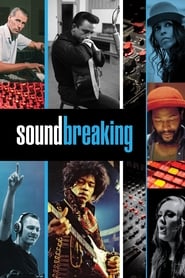
Soundbreaking
Download English Subtitle
English subtitle preview
The first 159 lines.
-I never thought of myself as a record producer.
Somebody else named me that.
I was just a guy who was making records
and was good at helping people.
-When you're at the front end of a medium,
you get this adrenaline rush,
or you think, "Oh, my goodness, I think we've touched
on something here that's never been heard before.
-When it comes to making a hit record,
one of the biggest mysteries is the role of the producer.
-I've heard of Phil Spector. I heard of Andrew Loog Oldham.
I heard of Jimmy Miller with the Stones.
I didn't know what they did.
-When I would see old footage of George Martin,
I knew that guy was the important guy to watch.
Nobody wants his autograph, but he's the guy in charge.
-Producers were people who understood how recording worked.
"Here's this whole new set of possibilities.
We're gonna find out what they can do."
-The digital wave of music gave us a whole orchestra
of instrumentation in front of our hands.
-But technical skill is only part of the job.
The real challenge is to bring out the best in a performer.
-There's a connection you have to make in producing,
and it's gotta be love and respect.
-I think the most important thing a producer can do
is to create a vibe of safety in the room,
like, it's okay to go out on a limb.
-That it's cool to go to a very vulnerable space
where, if it doesn't work right, it could be embarrassing.
Don't be afraid to fail.
Okay, then. Okay.
It'll be an F for you.
Here we go.
Just one more time.
-Right after I say, "Are you sure?"
Da da da -- yeah.
Oh.
-Hal, here's how I want to do it. Takes like this.
-All right, it's fun time. Fun time.
Here we go.
-Oh, really? -17, take one.
-This will be the keeper. -
Here we go.
One time, everybody, please.
[ The Rolling Stones's "Start Me Up" plays ]
-My first meeting with the Rolling Stones
was I ended up on a sofa with Mick Jagger sitting here
and Keith sitting here,
and they were both talking at the same time.
Mick was suggesting things
that a producer could do for the Stones
and Keith was telling me why he didn't need a producer.
And Keith said, "You sure you want to be the meat
in this sandwich?"
-The producer has got to be able to say
to somebody like Mick Jagger,
"Can you just do that again, right?"
-He should have tact. He should have diplomacy.
He should know how to handle an artist.
-Even if it means saying that song's not as good as that one.
This melody needs to be better.
-And it's hard, man, 'cause it's very intimate, you know.
Very, very intimate.
And you're going straight from your heart,
and you're saying, "We're not there yet."
Or "That's a perfect, perfect take. One more time."
-Plenty of great songs have gotten lost in bad production,
so, you have to appreciate when you have those pairings
of a Michael Jackson and a Quincy Jones,
when you have a great songwriter and a great producer.
-The two of you together are making music
completely from scratch,
and it's your job to try and help find the right sounds
that makes everybody's hair stand on end.
[ Tom Petty's "Free Fallin'" plays ]
It might take many weeks
of just sitting and playing with nothing happening.
And then one day, something happens.
I sat down and played a lick, like...
and Jeff Lynne,
who's one of the greatest record makers ever, I think,
went, "Wait, wait, wait, wait, wait,
don't put that bit on the end there."
What? What do you mean?
"Just go..."
[ Hums "Free Fallin'" chord changes ]
"And start the phrase again, but don't put that other bit in."
And I hadn't even really thought it was a song, you know,
but he was excited by it.
The first two verses were adlibbed, you know --
I was just kind of tryin' to make Jeff smile.
He goes, "Free Falling."
That's all he said, you know.
-That's the whole point of having someone
that will sit in the booth, hearing something
that you might play, that you would just discard,
and he'll say, "Hang on a minute, that was really good.
Go back to that."
-Ultimately, what being a producer is
is having a point of view.
It's easy to make sound. Really, anybody can make sound.
But not everybody can make music.
[ Up-tempo rock-'n'-roll music plays ]
-Well, hello and welcome to the cradle of rock 'n' roll.
-Sam Phillips was 3 days short of 27
when he opened the doors to the Memphis recording service.
He started the label Sun 3 years later.
-So many earlier producers, like Sam Phillips,
they're basically operating in an A&R capacity,
looking for promising talent, bringing them into the studio,
and crafting a unique sound for them.
-From Sam Phillips's point of view, if you weren't doing
something different, you weren't doing anything.
He was looking for individualism in the extreme, as he would say.
-When I wanted to open up my recording studio,
I didn't tell too many people about what I had in mind
because I didn't know whether I'd be able to pull it off.
I didn't have enough money
to buy the equipment that I wanted
and I didn't know whether I could pay the rent,
but I knew that I was gonna get me some black folks
in that studio, one way or the other.
I recorded Roscoe Gordon, BB King,
the Howlin' Wolf, Little Junior Parker.
-Memphis in the mid-'50s was a "black cats" town.
It was about soul.
Nashville didn't rock.
Memphis did.
[ Up-tempo rock-'n'-roll music plays ]
Sam Phillips was so smitten
with the sound of black music and black blues,
but he knew that he'd need a white guy to put it out there.
And he found a guy called Elvis Presley, ha.
-With Elvis, I knew when he walked in the door, baby.
If anybody can do this,
I believe this is the person who can do it.
-It was something that he heard in this kid,
something that was unique about him.
But, as the session begins,
Elvis starts singing all these country songs and pop standards.
And Sam realizes, "Hey, this is not gonna work."
He has a wonderful voice, but it's so insecure.
-So I went in and talked to him and said,
"Hey, we still are not where I believe we should be,
and I think we all agree on this," and so I turned around,
went back in the control room, and, next thing I know,
Elvis cut out on "That's All Right Mama."
-And, man, the minute I heard that thing,
I said, "Lord, hey, if we aren't gonna make it on that, honey,
there was nothing I could do, ever."
-I used to hear Elvis and they would be singing and playing,
and they sounded good, but they was playing white music.
When he did that, I said, "Ohhh, wait a minute.
This is this is all right."
How do you categorize "That's All right"?
It's just a magic moment,
and it's truly original in that it doesn't sound
like anything else in the marketplace.
More English subtitles for Soundbreaking
- Soundbreaking E08 I Am My Music · 30 downloads · 2016-11-24
- Soundbreaking E06 The World is Yours · 27 downloads · 2016-11-24
- Soundbreaking E07 Sound and Vision · 25 downloads · 2016-11-24
- Soundbreaking E04 Going Electric · 28 downloads · 2016-11-24
- Soundbreaking E05 Four on the Floor · 26 downloads · 2016-11-24
- Soundbreaking E03 The Human Instrument · 34 downloads · 2016-11-24
- Soundbreaking E02 Painting with Sound · 21 downloads · 2016-11-24
Comments
No comments yet. Be the first to leave one.