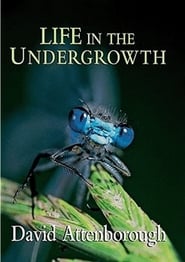
Life in the Undergrowth
Download English Subtitle
Release info
Tags
Download English Subtitle Files for Mobile (5)
English subtitle preview
The first 200 lines.
An eye from another world,
A smell-detector, investigating the path ahead.
We don't often see a snail that way.
And that's because we've only recently had the tiny lenses and electronic cameras
that we need to explore this miniature world.
But when we meet its inhabitants face to face,
we suddenly realise that their behaviour can be just as meaningful to us
as the behaviour of many animals more our own size.
Look at this, for example.
It's an earwig, yes.
But it's also a female and a mother.
And like so many mothers, she's guarding her young.
These two ants are not quite sure whether they like one another.
Stroking antennae is the equivalent of a cautious chat over the garden fence.
When big animals go courting, they show off.
And so do damselflies.
Courtship signals for a male wolf spider are rather more frantic
because if his female doesn't understand why he's approaching her,
she'll eat him.
This ant is a farmer
and these aphids, the cows which it milks for a drink of honeydew every day.
Other ants are eternally on the march.
Powerfully armed soldiers guard the flanks of their column as they travel,
protecting the workers who are carrying their helpless young.
When it comes to craftsmanship, few can beat this wasp.
Using mud to construct an elegant jar in which to store her eggs.
Mud is also used by termites.
They build tower blocks that, in proportion to their size,
are taller than New York skyscrapers.
These two worlds, ours and theirs, influence one another to an extraordinary degree.
If we and the rest of the backboned animals were to disappear overnight,
the rest of the world would get on pretty well.
But if they were to disappear,
the land's ecosystems would collapse.
For the fact is, they were the pioneers.
The first animals of any kind to colonise the lands of the earth.
To tell their story we must go back to a time
when the world was a very different place.
Some 400 million years ago,
the lands of planet earth were totally without life.
They were bare, naked rock,
roasted by sun during the day, freezing cold at night
and swept by terrible storms.
But in the waters of the world conditions were much more stable.
Life had begun there some 2,000 million years earlier still.
For a long time it remained microscopic, but eventually larger animals appeared.
Jellyfish and corals, starfish and snails,
and animals with segmented bodies.
All needed food.
Many would have eaten unguarded eggs given the chance.
And then, around 400 million years ago, some enterprising creatures
found it safer to lay their eggs out of the sea, up on the beach.
They still do.
Every spring, on a few special nights along the Atlantic coast of North America,
thousands of horseshoe crabs emerge from the sea.
And here in the wet sand, they spawn.
They may only stay for a few minutes or hours,
but animals like these may well have been the first of any kind
to leave the sea and venture onto land.
Although these creatures spend virtually all their lives at sea,
they can survive surprisingly well on land.
It's almost as if they were pre-adapted.
They have shells, external skeletons,
and that means that their legs are rigid and jointed.
And at the back they have a series of plates, called book lungs,
which extract oxygen from seawater,
but can also do the same thing, if they're kept reasonably moist, from the air.
So creatures like this can in fact spend about a week on land.
And it only requires minimum modifications
to enable them to live up there permanently.
It was difficult to abandon the sea altogether until the land became green.
But eventually it did.
Simple plants, algae and then mosses and liverworts
began to advance over the mud and rock to clothe the earth.
And into these first green tangles came animals looking for food.
Some had armour
for that, in the sea, had protected them from their enemies.
Now it would help them conserve moisture.
They were the ancestors of today's millipedes.
Small holes had developed along the underside of their bodies
that led to internal tubes with which they could absorb oxygen from the air.
Their rigid,jointed legs, however, were largely unchanged
and worked very well on land even without the support of water.
Battering-ram heads enabled them to bulldoze their way through the vegetation
to collect the rotting plants on which they fed.
They grew big, increasing the number of segments in their bodies.
Some had over 300, each with two pairs of legs.
Some that didn't curl up, reinforced their armour with plates along their backs.
Crustaceans like shrimps came, too.
They were the ancestors of woodlice.
So, today there is a huge and varied population of animals
living on the land with bodies that are little different from those of their ancestors
who lived in the sea so long ago.
And they are extraordinarily successful.
Some are the most numerous of all land-living species.
But we seldom see them. This pin will give you an idea of why.
They're tiny.
This minute little creature is a springtail.
It's less than a half a millimetre long. The size of a full stop.
In one square metre of soil, there may be over 10,000 of them.
Drying out is a very real danger for them.
And some waterproof themselves regularly with a droplet of special grooming fluid.
You might even say that they have turned bathing into an art form.
They even have two inflatable tubes
that enable them to get to those hard-to-reach places.
To help them get around through the leaf litter,
these springtails, as their name suggests, have a rather novel way of jumping.
They have a tiny two-pronged lever beneath their abdomen.
One small flick from it can catapult them six inches,
some 15 centimetres, into the air.
It's the equivalent of a human being jumping over the Eiffel Tower.
And if they happen to land upside down,
well, they have a special way of righting themselves.
They use their grooming fluid dispenser to stick onto the ground
so that they can pull themselves back onto their feet.
So the foundations were laid for the ecosystems that now flourish on earth
and on which we ourselves depend.
It has to be said, however,
that sometimes some of us regard a few of these pioneers
more as our enemies than our friends.
Many of the molluscs in the sea develop shells to protect themselves from predators.
But on land those shells serve just as well to keep the occupant nice and moist.
So without any major change to their anatomy, molluscs were able to creep up out of the water
and graze in the forests of algae and mosses that were then spreading over the land.
And given the right conditions, they still do.
With rain and the coming of night a secret army comes out of hiding.
These are the conditions they like best.
Dark and, best of all, wet.
Gliding along a carpet of slime
works just as well on land as it does underwater.
And a rasping tongue scrapes algae off rocks wherever they are.
In times of drought, snails may be unable to move around for months on end.
So when conditions are right, they eagerly set off to find food.
Their upper pair of tentacles carry those eyes with which they look around.
The lower ones smell what's beneath.
They breed by means of a small pouch
on the right hand side of their body just within the shell
which, because it's permanently moist, is able to absorb oxygen.
This is what they're seeking, a succulent green leaf.
No time to be lost.
Dawn will bring a change in conditions.
So they have to return to their shelters and clamp down their shells once more
so that they retain their moisture.
The ancient forests were colonised by all kinds of plant eaters
long before there were any frogs or lizards, birds or insect-eating mammals.
But there were, nonetheless, hunters prowling through the vegetation.
This was one of the first.
Fossils very like it have been found in rocks that are 540 million years old.
This is a velvet worm.
It, too, has scarcely changed since it lived in the sea
and today it's only found in wet, humid forests.
It usually hunts at night, but infrared cameras can reveal it in action.
Soft, stumpy legs enable it to move in total silence
and it finds its way with long, sensitive feelers.
It's a master of stealth.
This cricket has huge eyes but it's difficult to see what's going on around it.
Though the velvet worm has fangs,
it will attack its prey when it finds it with a very special weapon.
Anxiously, the cricket probes around in the darkness
with its long antennae.
The velvet worm will only know if it's found its prey when it touches it.
So when it does, it has to react immediately.
There!
And the cricket is trapped.
A slow motion camera shows the remarkable way in which the velvet worm attacks.
Two nozzles beneath its feelers squirt twin streams of glue.
The more the cricket struggles, the more it becomes entangled.
With the prey immobilised, the velvet worm reclaims its glue by eating it.
And then it starts on the cricket.
There were other hunters, too, in the ancient forests,
relatives of the horseshoe crabs,
and they were even more formidable.
This is a whip spider.
Like its ancestors, it has a hard external skeleton.
Two of its limbs have been turned into highly mobile, sensitive feelers.
It uses them to probe around delicately both in front and behind.
Any prey within a foot of it will be immediately detected.
It's extremely territorial and it has no hesitation in attacking one of its own kind.
The width of its claws is a good indicator of strength
and a smaller animal will quickly back down.
But these two are equally matched and they will fight.
The loser retreats.
But even whip spiders were not the most formidable hunters in these forests.
There were others with an even more venomous weaponry.
This centipede has powerful jaws, poison fangs
and is very, very fast.
It's a very good hunter.
But it's only half as long as my little finger.
There are centipedes in the world, however, that are as big as my forearm.
This is one of these alarming giants.
It's over 13 inches, 35 centimetres, long
and with the muscular strength of a small snake.
And the poison in its black-tipped fangs is lethal.
It hunts in the dark, bat-haunted caves of Venezuela.
Like the whip spider and the velvet worm,
it uses its antennae to feel for its victims.
The beetles that swarm on the rocky floor of the cave are of no interest to it.
It's after bigger prey.
And it knows it can find that by climbing.
Its many legs give it a secure hold on the vertical rocks.
Life in the Undergrowth subtitles in other languages
More English subtitles for Life in the Undergrowth
- Full Parts From 1 to 5 · 53 downloads · 2007-04-28
- BBC Life In The Undergrowth 2005 DualAudio DVDRip XviD-EaGlE, this is INCOMPLETE This is only for parts 1 & 2 and the Extras I'll probably never get the other ones, but if I do, I'll replace this one · 31 downloads · 2006-09-25
Comments
No comments yet. Be the first to leave one.