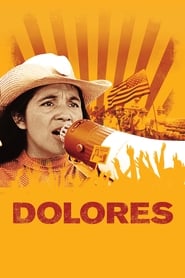
Dolores
Download English Subtitle
Release info
Tags
English subtitle preview
The first 200 lines.
I'm going to bring her out here right now.
Dolores.
While the Reverend Martin Luther King, Jr.
Was leading the charge in the South,
one California woman was fighting on the front lines
for workers' rights.
And while her name is rarely mentioned in the history books,
she may just be
the most vocal activist you've never heard of.
Come along, brothers. We are waiting for you!
Dolores Huerta helped lead a worldwide grape boycott
that forced growers to agree
to some of the country's first farmworker contracts.
Viva la cause!
Viva la huelgal.
She's the first general that I followed into war.
The workers are on the rise.
Dolores Huerta, who is an old friend of mine...
What she is, she's an insult to the farmworker.
Why are the growers and the teamsters so against her?
Because they're threatened.
We're never giving up.
Dolores is an icon.
Dolores Huerta has said
Republicans hate Latinos.
She also writes
the alternative to capitalism is democratic socialism.
She's not afraid
to speak truth to power.
She's a clown.
We thank you for all you have done
and all you still do
to promote the dignity and human rights
of America's family.
She's a civil rights hero.
She's been beaten up and she's gone to jail.
She's a very volatile individual.
We always like to say
that we didn't cross the border, the border crossed us.
The FBI knew
how dangerous Dolores was.
Conservatives on the Texas Board of Education
removed the legendary farmworker organizer Dolores Huerta
from the state social studies curriculum.
I got to tell you, I never heard of this woman.
We've really got
to set the record straight.
I mean, women cannot be written out of history.
You were a young girl,
growing up in America in the '40s.
You must have had a dream.
I guess my only dream was just to be accepted.
I think that's what a lot of young children feel,
just to be accepted for what you are and that's not possible.
Tell me when you were first aware
of having a social conscience.
I think that I felt it very deeply
as a teenager and it was mostly because of the police brutality
against Mexicans and blacks,
the kids that I grew up with,
and you find out that the justice, it's not there.
The equality isn't there.
If you were coming of age in the 19505
in California in the San Joaquin Valley,
you were coming of age in a time of conformity.
Everybody was being fit into a mold,
and if you were Dolores Huerta,
there was no mold.
My mom, she grew up in the '40s,
you know, like the dances, the bebop, the big band,
the swing, you know.
She's an American girl, you know.
Back in those days, all of the Latina women
got married very young... 15,16,17 years old.
My first husband, we had a lot in common.
We were both into jazz,
but I don't think that we were ready for marriage yet.
Then my second husband, we had kind of a culture clash
because of the way that I grew up
and the way that he grew up.
My mother was a single parent, she was a businesswoman,
and like her, I worked all the time.
You know, my mother-in-law could never understand why
I didn't just stay home with the children.
And so, Dolores talks about her life as a young mother
and as a married woman
and not feeling that was quite enough,
that she needed to do more than that.
That's when she met Fred Ross.
When I met Fred Ross and he talked to me
about how people could get together
in an organization and really start changing things,
to me it was just a revelation.
LORI de LEON: Fred Ross was a community organizer
with the Community Service Organization
who developed house meetings.
You're on the ground,
identifying individuals who are willing, you know,
to do the work to make the communities better.
I still remember my first house meeting.
Fred showed us pictures of the improvements
that they had done in East Los Angeles,
like bringing in street lights and sidewalks,
bringing in health clinics.
But the one that really hooked me
was when he showed us press clippings of police
that they had sent to prison
for beating up Mexican-American kids.
And I thought, any organization that can do that,
I want to belong to that organization.
I think that my mom experienced
enough of that injustice or discrimination to where
she just could not keep it down.
She could not keep quiet.
In 1959, I became the political director
for the Community Service Organization,
and helped draft a lot of the legislation
that we ultimately got approved in Sacramento.
I was only 25 at this time, or 26 years old.
I was very young.
There were very, very few Latinos-
and I'm talking about men...
In the legislature in California in the '50s and '60s.
It was all white men,
and here you have someone
like Dolores Huerta, that was just...
People just didn't do that in those days.
We had one piece of legislation to take away the requirement
that you had to be a U.S. citizen
to get public assistance.
I took parents whose kids had served in World War II
to this one senator who was key for us to get that legislation,
sat them in his office
with the pictures of their kids in uniform.
They couldn't speak English,
Senator Kolbe couldn't speak Spanish, but I told them,
"Just stay here until he says yes,
that he'll vote on that bill."
What kind of a lobbyist is she?
Oh, she's a great lobbyist.
She's indefatigable.
She's unorthodox.
You know, Dolores will bring in hundreds of people
and they'll camp outside your office.
So when Dolores is in Sacramento,
everybody knows she's in Sacramento.
Fred Ross was always talking about
this great organizer, Cesar Chavez,
so Fred introduced us.
Cesar was very shy.
I remember one time
that he was sitting down by himself at a table
and so I rushed over and sat down
and started trying to talk to him
and he immediately got up and walked away.
Fred would always tell Cesar how he met this woman,
she's dynamite, great organizer.
He was a little bit jealous
when Fred would talk to him about her.
He was a little bit jealous about that.
I gave my report on the legislative work
that we were doing up in Sacramento.
He and Fred Ross came over and invited me
to have lunch with them
so I was very thrilled, because I thought,
"Oh my, Cesar's finally paying attention to what I'm doing."
They were having a meeting and they needed a Chicano legislator
to do some things and he was arguing why it couldn't be done.
And it was when my mother began telling him
all the reasons why he needed to get done
that Cesar took a step back and he goes,
"Now I see what Fred was talking about."
All this work that we were doing,
Cesar organizing the farmworkers in Oxnard,
my organizing farmworkers in Stockton,
was under the auspices of the Community Service Organization.
But when it came time then to make it a union,
the CS0 decided not to support us.
That's when Cesar called me to come over to his house
and he said, "We have to organize a union."
He put it this way, he said, "Unless you and I do it,
it's never going to happen."
And then he said in the next breath,
"But we will not see a national union in our lifetime
"because the growers are too rich, they're too powerful,
and they're too racist."
One of the really tragic contradictions
about the United States of America is that
it has presented itself before the world
as a beacon of independence and liberty and human rights.
Of course,
the real stain on this mythology is slavery
and with it, the potential for the enslavement of others.
This was a very real threat for all Mexicans
living in California.
After 1848,
it was a continuing threat for all of the immigrants
that came from China, Japan, the Philippines, Vietnam.
Racism has been endemic to American history.
The feudal wage slavery of agribusiness
More English subtitles for Dolores
- Dolores 2017 LiMiTED ENSub DVDRip x264-LPD · 23 downloads · 2018-04-22
- Dolores 2017 LiMiTED ENSub DVDRip x264-LPD · 22 downloads · 2018-04-22
- dolores 2017 limited dvdrip x264-lpd HI · 43 downloads · 2018-04-21
- dolores 2017 480p hdtv x264 rmteam (HI Removed) · 21 downloads · 2018-04-06
- dolores 2017 480p hdtv x264 rmteam · 29 downloads · 2018-04-06
Comments
No comments yet. Be the first to leave one.