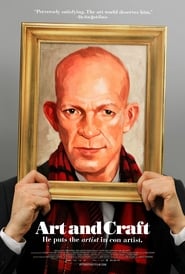
Art and Craft
Download English Subtitle
Release info
Tags
English subtitle preview
The first 200 lines.
Nothing's original under the sun, you know?
Everything goes back to something.
Yes, my name's Mark Lanois.
My recently deceased sister left your archives a page from the book of hours...
that they purchased from Christie's back in 1982.
I wanted to know if I could, uh, uh, bring it by to you this afternoon.
Okay. It depicts the crucifixion. It's circa 1540,
and I'd like to tell you a little bit about Emily and her husband.
And, uh, you know, they worked for World Bank in Europe and everything.
Well, good. Then we'll look forward to seeing you, uh--
When? When might you like to come by?
Uh, I th-- Uh, let me see.
I-I-I guess we could probably get there a little--
Probably-Probably early this afternoon.
I think I have everything.
I'll only--
I'll only hit the stuff just before I face...
whatever it is at the place, okay?
Not when I'm driving.
Connecting to OnStar.
Your approximate travel time is two hours, seven minutes.
Start out going south--
Oh, yeah, here--
Lester Sullivan.
Uh-- Yes, sir.
I'm Lester Sullivan. This is Irwin Lakov.
How you doing?
All right. Look, I'm writing--
Excuse me. a little biography of--
Oh, thank you. of Mother.
Excuse me. I mean, of my sister.
Oh, this was your sister? Yes.
Oh, my. Well.
Oh, and now look. I'm going to bring the, uh-- the catalog to you.
That's the auction and everything, all right?
Oh, isn't that nice?
I-I believe it'll-it'll-it'll look well and--
Oh, you know it. Is that a form--
an early form of color printing of some sort?
Well, it's all hand done and colored.
No. It's hand done, but it's not as good as the earlier ones.
It's still insured with Huntington Block.
Now I'm writing a little biography of Emily.
Of the lady who left this to us?
Yes. My sister, Emily.
That would be the sister. I made her up.
But I-I said that was my sister.
And I actually did that.
And why'd you make her up?
Oh, well, I was in the habit of-- of saying I had a sister...
so that I could...
throw awkward questions and problems in their lap.
You've got my phone number and everything.
No, sir. You gave me no data.
Oh. I thought it might have shown up.
Oh, well. Do you have a card or--
Uh, I'm pretty much out of them.
And I'd like you to show me about where would it be...
where you would think of putting it.
Well, there would not be a permanent display. I've got others.
No, not permanent, but whenever you--
You see these cases we've just vacated here?
We have an exhibit very much relating to our religious history here.
She certainly knew what she was doing. Hmm.
Well, I'm glad you're helping to realize her wish.
I've been following Landis for going on four years now.
I've got old-- older copies of my dossier in here.
What's so strange about Landis is that he's not in it for the money.
He likes to dupe museum professionals.
He likes to see the stuff on display.
I met him in 2008.
I was registrar at the Oklahoma City Museum of Art.
He showed up as Mark Landis,
and he started pulling all these works out.
This was the first piece that I looked up online...
'cause we were getting ready to take this watercolor by Signac...
and make it part of the collection.
Well, as anybody should, I did my due diligence,
looked this up online, and it showed up in a press release...
at the Savannah College of Art and Design.
Artists, they'll do the same subject matter over and over again, like Monet.
Or he'll do-- You know, he would do these buildings,
but he'd do it at different times of day so you'd see the subtle differences.
But it wasn't until that I went on to this oil-on-panel by Stanislas Lépine...
I looked this one up, and it showed up in a press release...
at the St. Louis University Museum of Art.
And then I found the same one at three more museums.
I mean, these are no small potatoes.
This Alfred Jacob Miller piece-- this is in six or seven museums.
But they look-- They just look so good and so real.
You know, the guy is a skilled artist.
I just became obsessed with it, just like he is obsessed with making these paintings.
And, um, I was just out to--
He messed with the wrong registrar is what he did.
Hi, Mr. Mark. Hi, hi.
How are you doing? You'll sign here for me? Yes, yes, yes.
Mark?
Hi. Nice to see you again. Nice to see you too.
Tell me about your mood? What's it like?
Been all right.
- Any suicidal thoughts? - No.
What about wanting to hurt anyone else? No.
Okay. Are you hearing any voices or seeing things?
No. Okay.
What do you do for fun every day?
Well, I've done an awful lot of three girls having a--
Three-- Of the three girls...
sitting on the grass reading.
I've done a lot of those.
This one's really tedious.
You get better with practice.
But that's how the-- The back's easy if you just pour coffee on it.
Oh.
Here's another one.
Put it in one of those Walmart frames, looks like a million doll--
It does look like a million dollars,
'cause actually that's worth about a million--
Well, maybe not quite that much, but close.
And these frames are so cheap, and all you have to do...
is just go over 'em some with arts and crafts stuff and they look really good.
Don't you think that looks good?
The Sotheby's label would have said "Black chalk, brown"--
You know how those thing-- "Black chalk, brown wash, red chalk."
I just use color pencils, you know, 'cause they can't tell.
I just like to copy things 'cause it's what's--
It's reassuring, and I remember it from when I was growing up.
You know, I would do it at night to occupy myself.
You can see the veins under the skin.
That's so beautiful.
I have this sort of gimmick for being able to remember something...
just long enough to get it onto paper.
It's something they were very interested in at the Menninger Foundation.
I was there for more than a year when I was 18.
I insisted on leaving.
See, people that follow the advice of those places,
they're mental patients all their lives.
You know, they'll be old someday, and what can they say?
I've been through a lot lately. I have these bad dreams.
It's like Mother's there.
And then I wake up and I realize she's not,
and my heart's banging real bad.
See, this grass and stuff is-is nothing.
See, it's practically done just like--
Well, you know, they told Mother at the Menninger Foundation,
they said I was a bright little boy.
They said, "He's a bright little boy."
They said that to Mother.
But they said I was inclined to be mischievous--
from time to time.
Museums-- they don't like to be duped.
They don't like to get forgeries or fakes into their collections.
Oklahoma City actually put one of 'em on display because we thought that it was real.
We had received a watercolor by Louis Valtat.
Yeah, I mean, when we found out...
that we had had this thing on display for five months,
we immediately went into the gallery and took it off the wall.
And then that's when I started letting people know.
Sent a message out to the Registrars listserv,
and within the first hour, my phone was ringing off the hook,
and my e-mail box was getting full.
And I think within the first hour, I had talked to, like, 20 institutions.
'Cause I'd say to 'em, I'd say, "Well, what do you have?" and they would tell me.
I said, "Well, this museum has that, and this museum has that,"
and they didn't believe me.
It took me three times talking with the director...
at the University of Kentucky Museum of Art before I could convince her...
that the pieces that they had received were forgeries.
He's been doing it over 30 years,
and I've found 46 museums in 20 states...
with more than a hundred pieces that he's offered up to these institutions.
Well, I just remember the time that I spent with Landis personally.
Here's this great collector that has a lot of money,
and, you know, the director wanted me to take him into storage,
wanted me to take him through the museum.
Um, so he per-- He wasted a lot of my time.
But I just keep building my case...
because I don't think that he's gonna stop.
He brought with him two briefcases-- satchels, really.
In one of the satchels, he had the small Koran...
that he had sent us an image of and the auction record.
Uh, the hammer price was somewhere close to a hundred thousand dollars,
sold anonymously, and he represented that that's what his mother had purchased.
There was some generational welfare.
I don't think he used that term, but he certainly implied...
that there was a great deal of money-- and old money-- there.
His mother had a home in Paris.
And I think-- believe his sister-- Emily was her name--
was in Paris at that moment, uh, settling her estate.
One of the things that he brought up very quickly...
was that there were more paintings...
and possible endowments from the family's estate.
He knew right where to hit us.
Our soft spot-- art and money.
He was very interested in the museum.
He was knowledgeable about the museum.
He was, um, you know, friendly, if a little--
a little odd, but we--
You know, we're southern. We're used to eccentrics.
This is the piece. It's a nice pastel.
I should've looked at it more closely,
Comments
No comments yet. Be the first to leave one.