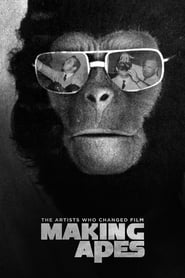
Making Apes: The Artists Who Changed Film
Download English Subtitle
Release info
Tags
English subtitle preview
The first 200 lines.
What is the power of makeup?
For me... it's everything.
It's magic.
It's to fool your audience into believing
that what they're seeing is 100% reality.
The power of makeup is the power of transformation.
If you're the wearer of the makeup, it sort of gives you permission
to be a different character.
Makeup effects and makeup allows actors
to tap into different parts of their personality.
Whether it's a zombie, or a princess,
or a Frankenstein monster,
it's what enables an actor to actually emote.
Want to hear something scary?
Makeup and hair are the most dangerous people on a set
because they get the actors first thing in the morning
and they're right in their face.
I've seen hairdressers and makeup people just fuck movies.
So you always want to be on their good side.
Good makeup helps create a good character.
Characters are what make a movie interesting.
If the makeup is ineffectual,
it's going to destroy the whole movie.
It has the power to heal, it has the power to inspire,
and it also inspires and creates imagination
to be able to tell stories.
Makeup has given artists
and filmmakers incredible freedom.
But all that innovation and invention can be traced back to a moment in time
when one film proved nothing was impossible.
Makeup in film has existed
since the turn of the 20th century.
Early artists were actors who experimented on themselves.
The successful ones were then asked
to work on other actors.
One of the first breakout artists was Cecil Holland.
An early attempt at creating a simian makeup
was Holland's work on The Lost World.
To me, Cecil Holland was the genesis of it all, the beginning of,
maybe even the first makeup effects person.
Meanwhile, at Universal Studios,
the horror genre began to thrive,
and with it rose the fame of actor
and self-taught makeup artist, Lon Chaney Sr.
To me, it all begins with him.
There is a bridge between theatrical makeup
and movie makeup.
He starts it.
He did makeups that no one else had ever attempted
and some of them became, you know, legendary.
Watching the original Hunchback with Lon Chaney,
that was one of those moments where I thought that's,
that is something that I would love to try and emulate.
My favorite Lon Chaney makeup
was The Phantom of the Opera.
I thought that was just the most amazing
transformation I've ever seen.
Known as the man of 1,000 faces,
Chaney propelled the horror genre to new heights.
But his untimely death in 1930 created a void
in the makeup world that was quickly filled
by another actor turned makeup artist, Jack Pierce.
If he had done nothing but create Frankenstein's monster,
Jack Pierce would have a place in, uh, you know, the movie pantheon
of heroes and legends.
That makeup is so indelible, it's so recognizable,
it's been so much imitated.
There have been so many inferior knockoffs of it,
but he did it.
As he did The Wolf Man, another extraordinary piece
of makeup that didn't have today's technology behind it,
just a lot of hard work and a lot of imagination.
Whether he's enhancing the mouth of Conrad Veidt
in The Man Who Laughs, or doing The Monkey Talks,
which is a beautiful precedent to Planet of the Apes,
in a way, the key comes from studying the face of the actor.
And saying, "Okay, What do I need to build,
what do I need to take down?"
I remember seeing the episode of This Is Your Life with Boris Karloff,
and Jack Pierce had come out, and he's there with the bolt and all.
It was the first time I heard Jack Pierce's voice,
and it was similar to what I thought his voice would be,
you know, kind of like this scrappy guy.
It's wonderful to see you.
The best makeup man in the world.
-Thank you. -I owe him a lot.
First person that I idolized was Jack Pierce,
'cause he's the Frankenstein's monster,
The Wolf Man, The Mummy. Classic universal horror films.
And those were the films that really inspired me to want to do this.
As time progressed,
makeup became more sophisticated
but the quality of films began to deteriorate.
In the years following World War II, science fiction became a popular genre
and there were some notable films
like The Day the Earth Stood Still
and The Thing from Another World.
Very few serious filmmakers had really approached
science fiction, and there were a couple of attempts in the 50s
to make some expensive science fiction pictures
that didn't really make enough money.
After a little while, those films got cheaper,
and tackier, and really became B-movies and kiddie fodder.
Nobody will believe theInvasion of the Saucer Men.
In the early 1960s,
20th Century Fox producer, Arthur P. Jacobs, was searching
for a project that would astound audiences around the globe.
Planète des singes, orMonkey Planet,
was originally published in France in January 1963.
Natalie Trundy who was then Arthur P. Jacobs' girlfriend,
had read the book and suggested it to Arthur.
By June of 1964,
the book had been translated into English
and published in America.
What a book, right? This whole thing where
apes have taken over society
and humans have devolved into being sort of a lower form
of life than the apes, was sort of ahead of its time.
Richard Zanuck, the head of 20th Century Fox,
helps Arthur Jacobs obtain the option for Boulle's novel.
Jacobs hires Rod Serling ofTwilight Zone fame
to write a treatment titledPlanet of the Apes,
in hopes of turning it into a full motion picture screenplay.
I was a man, a man from Earth,
a reasoning creature who made it a habit
to discover a logical explanation
and not a beast hunted down by highly developed apes.
Rod Serling, he was a genius.
They didn't give you the script.
You sat down in a meeting...
and they'd start to tell you a little about...
So by the time they were done,
they really had you hooked.
Planet of the Apesis just
the biggest sheet cake version
of a Twilight Zone episode you can find.
Serling was busy rewriting the screenplay.
He later claimed to have written over 40 drafts.
Somewhere in the universe,
there has to be something better than man.
Rod Serling highlighted a lot of the, uh, contradictions
of our society, in many cases, uh, the nihilism of our society.
And the original script was actually very different
from the final version of the script,
which was then worked on by Michael Wilson.
Zanuck and the Fox board calculate a budget
of $2 million, a risky bet
given Fox's financial situation at the time.
The problem, I think, intrinsically was
that it was such new groundbreaking motion picture-wise,
the studio was very, very uneasy with it.
And the only one that really had faith in the whole thing
was Richard Zanuck.
20th Century Fox was not in good shape financially.
It's been blamed on Cleopatra and apparently unfairly blamed on Cleopatrain many cases.
They used it as an overall excuse
for some bad decision making.
The screenplay eventually wound up
in the hands of one of Hollywood's biggest stars,
Charlton Heston.
I think that this film would not have happened
had, uh, Charlton not wanted to do it.
He was just the right actor for that part.
His physicality was ideal
and he had the gravitas to match the physicality.
It was his project.
He helped greenlight it, so it was very close to him.
Charlton Heston recommended
director, Franklin J. Schaffner,
who he was currently working with onThe Warlord.
With a trimmed budget,
commitments from Heston and Schaffner,
and Edward G. Robinson coming on board
to portray the orangutan, Dr. Zaius,
Jacobs convinced Fox to greenlight a 10 minute screen test
in March 1966.
Ben Nye was the department head of makeup
at 20th Century Fox, and he was getting ready to retire
but he agreed to do a screen test.
Good evening, Mr. Thomas.
Everything fine, I hope.
Considering I've been kept in a cage for six weeks, I'm fine, yes.
Prior to this, when you saw a gorilla in a movie,
it was either played by a guy in a gorilla suit or it was played by a monkey.
But the approach here was a little different because the idea was
that these ape characters were being played by recognizable actors,
and so there needed to be a way to allow them to emote.
When you see, uh, original ones and, uh, do the makeup test,
it's not there.
Even though that's nowhere close
to what the makeup actually wound up being,
the scene was effective.
No one was laughing, everyone took it seriously,
and the project was, uh, I think, much more tangible
as something that could resonate dramatically
with an audience.
But Ben Nye decided to retire
rather than take on this huge project.
Though the screen test proved it was possible
to portray talking simians in a serious manner,
More English subtitles for Making Apes: The Artists Who Changed Film
- Making Apes The Artists Who Changed Film 2019 1080p WEBRip x264 AAC5 1-[YTS MX] · 20 downloads · 2021-03-19
Comments
No comments yet. Be the first to leave one.