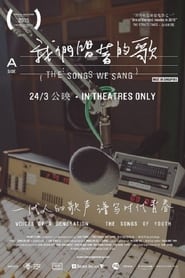
The Songs We Sang (我们唱着的歌)
Download English Subtitle
Release info
Tags
English subtitle preview
The first 200 lines.
The Best Newcomer of the 12th Golden Melody Awards goes to...
Stefanie Sun.
Congratulations, Stefanie Sun!
You've won the Best Newcomer Award!
Congratulations, Stefanie Sun!
Without xinyao,
there wouldn't be Billy Koh, there would be no Kit Chan.
Without Tan Kah Beng, there would be no Mavis Hee.
Without Li Wei Song and Li Si Song, there would be no Stefanie Sun.
When the sky is dark, I recall that song
I look forward to that quiet rain
Granny had sung the truth for me
That even when it rains we must bravely carry on
I was exposed to Mandarin songs only after I started attending Li Wei Song's school.
I wish I were back home
When the Li Brothers talk about music,
they can picture the song in their heads.
it's just like a painting.
The dialect wasn't foreign to me, because we lived with my granny.
The sky is dark, the rain is coming.
The sky is dark...
I face the crossroads every day
When I sang that song, I felt the melody was very simple.
But there was something in it I could relate to.
So lonesome
The award for Top 10 hits of 2004,
Hong Kong and Taiwan, goes to JJ Lin for "River South"!
The wind that blows here becomes a trap
That captures the thoughts of those who pass
Sing along!
Xinyao had a great influence on me
through its songs, and in my learning process as a songwriter.
This side!
Fate brought you to my side
A destiny written on the Rock of Three Incarnations
Sing along!
When I started learning music and the instruments,
it was just simple solo practice,
playing xinyao songs on the piano or guitar.
Which is why xinyao brings back memories of my childhood
and years of growing up.
Together now!
As a Singaporean songwriter,
I believe I can create Singaporean music for the world.
We who know not how to express tenderness
Believing that star-crossed lovers exist only in ancient folklore
The pain of separation
The intensity of this pain
Of dreams that are lost amidst the misty rain of the River South
Can only be understood after our hearts have been broken
Please share your umbrellas.
-Will the sun come out soon? -Yes!
Will it?
Yes!
Will you leave?
No!
Let me hear you!
What brings you here today?
Xinyao!
Long live xinyao!
What a lovely evening
With the cattle grazing freely
On this scenic mountain
The cows are so carefree
Sisters and brothers
Are you as innocent as the cows?
The sun will set in the blink of an eye
Come on out to the rolling hills
In those days, Chinese songs in Singapore came from overseas.
Songs from mainland China were mostly the rousing revolutionary type.
Not our cup of tea.
Songs from Hong Kong were the mainstream, mainly Cantopop
and theme songs from TV drama series.
As for Taiwan, in the '70s,
many of their songs were influenced by Japan and movies.
At Nanyang University, many students sang at Yunnan Lake in the evenings.
But they were usually foreign songs.
What about our own songs?
We felt that something was missing.
I was President of the Nanyang University Poetry Society then,
and my good friend Ken Chang was Head of the Music Society.
One day, while chatting we decided
to write our own songs!
Inspired, I wrote a poem, and gave it to him.
I asked him to set it to music and said we would sing it together after class.
And so, our very first verse song
was written in class.
I thought the poem was pretty good!
So I wrote a tune for this poem called "Story."
Pan Cheng Lui
You are a shooting star
You are a shooting star
I am a ferry boat
Ferrying beautiful stories
Members of the Poetry Society contributed their poems
which were collated by Cheng Lui.
He also invited some of the lecturers
to contribute their poems.
Bravo!
In 1976, when I entered Nanyang University, society was changing.
Most subjects, except Chinese Studies,
were switched to be taught in English.
The switch to a less familiar language
was stressful for the students.
Everyone was busy looking up words in the English dictionary.
Yet, despite these stressful times thrown into such an environment,
studying was no longer the priority in our university life.
As young undergrads at Nanyang University,
there were opportunities to participate in all kinds of activities.
From early in the morning till late at night,
we were busy with campus activities.
Studying was just one part of university life.
The environment on campus was amazing.
Two guitars, one harmonica and the choir,
plus, some recycled props as decor,
and we're ready for tonight's presentation.
They organized their first concert in 1978, at the Faculty of Arts.
I attended the performance that evening.
It was packed!
The lecture hall was full.
Even the corridors were filled with people.
At the beginning, the rise of verse songs came from Literature.
As undergrads, we were passionate about creative writing.
So the merger of poetry and music came to us naturally.
Secondly, it was the times we were in.
When verse songs first appeared in 1977,
it was then Nanyang University was facing its imminent closure.
After four months of private discussions,
the debate between the government
and members of the Nanyang University Council was brought out into the open.
Mr. Lee Kuan Yew was in favor of merging
the Nanyang University with the University of Singapore
in order to save Nantah from an inevitable death.
He based his arguments on the overwhelming preference of good students
for the University of Singapore.
We were halfway through our degrees at Nanyang University
when we learnt that the university was slated to be closed down.
It was earth-shattering news.
Frankly, we were not motivated to study.
Our strength was in writing and composition.
We spent most of our energies on that.
As long as we could graduate, wasn't that good enough?
Organizing activities gave us exposure
that we, as demoralized students,
would never have experienced in the classroom.
ME AND THE LITERARY ESSAY CONTEST AWARDS CEREMONY
The song "Outdoors" should be familiar to many of you.
Professor Wong Yoon Wah dedicated this poem to the graduating class.
One of the verses goes, "Three years...
Spring came, yet there were no flowers."
How do the students feel?
Let's hear it from them.
I am a camellia
Budding for three years
Spring came
Yet, there were no flowers
I ran for President of the Student Council in my third year.
CONFERENCE THE VISION OF OUR MUSIC INDUSTRY
I wanted to organize an ASEAN students' festival
to give us, Chinese-educated Nanyang undergrads, a platform
to showcase the leadership of
Chinese-educated youths on a global stage,
to gain recognition.
The choir from the Poetry Society was honored
to be invited to the ASEAN festival
to perform our own compositions.
"Nanyang and Singapore University Merged as National University of Singapore"
Regarding Nanyang University,
the issue was not about the closure of the university itself,
but rather a cultural one.
That was why, during that period, as students at Nanyang University,
we felt very strongly about the matter.
Look across the sky
Not see the wind and moon
In the verse song "Yellow River,"
I used a lot of metaphors,
such as "looking up at the Big Dipper," "a moving superstition,"
"I am a dragon light," "dancing a path of hope
to the end of the land."
I am a dragon light
Dancing a path of hope
To the end of the land
"Big Dipper," "Dragon light," these are strong cultural images.
The key imagery is the "Yellow River," which is the song title.
These images were inspired by the cultural climate of that time...
WHERE IS THE FREEDOM OF SPEECH?
...in expressing conviction towards one's ethnic language and cultural roots.
Just like the lyrics of the poem,
"Going towards the uninhabited east."
The east may be uninhabited, but we, being part of the river,
will still flow east.
Because the river must flow eastwards.
Hence, it was about cultural identity.
On the 7th of July, the National University of Singapore came into being.
There was little sentiment among graduands
at the last convocation of the University of Singapore.
Speechmakers hardly gave any prominence
to the significance of the historic occasion.
In contrast, the 21st convocation ceremony of Nanyang in August
marked its final end.
The Songs We Sang subtitles in other languages
Comments
No comments yet. Be the first to leave one.