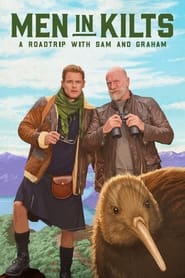
Men in Kilts: A Roadtrip with Sam and Graham
Download English Subtitle
Release info
Tags
English subtitle preview
The first 193 lines.
-Forward! -Uh-oh.
-No. -Come on!
-Come on. -Come on!
Come on. Come on.
- -Ugh.
- -Yeah.
Edinburgh City.
One of the most beautiful cities in the world.
One of my favorite, favorite places in the world.
Yes, we've just walked past the Edinburgh Castle there
in The Old town.
Well, The Old Town are never in The New Town.
The New Town being a strange name for a place
that was built in the late 18th, early 19th century,
-which is pretty incredible. -Strange.
Edinburgh, which is also steeped in tradition,
and I think Scottish people, they love being Scottish.
Don't we? We hold on to these traditions.
Celebrate it, yeah, yeah.
-Yeah. -They do.
Few counties rival Scotland
when it comes to tradition.
In fact, most of Scotland's ancient traditions
are still celebrated today.
Whether it's working the land
and all it has to offer,
speaking Gaelic,
a language as ancient as the mountains themselves
and at one time
seen as a language of rebellion...
Or embracing Harris Tweed,
a fabric so important to Scottish style
that a parliamentary act
actually defines its standards.
You see, Scotland is a land of many delights.
But nearly all of them can be traced back
to a single idea:
tradition.
And of course, there's nothing more traditional
than a well-dressed Scotsman.
That's why we're here at Stewart Christie.
Oldest tailors in Scotland.
Established 1720.
That's 26 years before Culloden, that makes it old.
That's a couple of years before you were born, hmm?
-After you. -Thank you.
No, actually, after me.
Age before beauty.
Ah.
Thank you.
Afternoon, gentlemen.
-Afternoon. -Welcome.
Thank you for inviting us
into your utterly stunning shop.
It's like stepping back in time.
I was gonna say it's like stepping back in time.
We are 300 years old.
I dream of having a wardrobe like this.
I mean, this is like paradise for me.
What would it have been like
coming to Stewart Christie in 1720, I wonder?
Actually, the original shop was on the Royal Mile
across from St Giles' Cathedral.
I imagine the Jacobites coming up the-the Royal Mile...
-Totally, mm-hmm. -...and passing the store.
So we've really looked after a lot of nobility
and gentry and--
-And these-are there for-- -We still use them.
-And we have them-- -For discipline?
They're yard sticks.
What would be measured in a yard,
apart from a yard of ale?
Uh, tartan a-and tweed for the-for the kilts.
-Of course. -Nine yards.
It's wonderful. It's so non-digital.
Yeah, I like to keep everything
very much the traditional methods.
Everything here made in Scotland?
Yeah, we're really proud
to try and support local economy.
A lot of our mills and weavers are across Scotland,
and we're one of the handful of tailors
that still makes on the premises.
We make full bespoke suits upstairs.
There's a sort of move away from this fashion
that's sort of discarded, you know, and cheap.
You know, people are wanting to invest more in--
Well, it's just the beast, isn't it?
The fast fashion sort of beast,
and we're trying to just slow it down a little bit.
And I think when you come in here,
you really appreciate the cut, make, and trim of garments.
Well, what do you say we get ourselves some suits?
Ah. Looking great so far.
Thank you.
I feel like a discerning gentlemen.
I-I'm standing taller. I feel--
It's amazing what clothes can do.
It's quite a transformation.
Isn't it? It's, uh--
Would you like to pop the jacket on?
Ooh, right. Yes, of course.
-Finish it all off. -The finishing touches.
Ooh, there we go.
Oh, yeah. Wow.
That is a great color on you.
Thank you, Sam.
It brings out the-the-the red of your eyes.
Careful.
Ooh. Mm.
Feeling good, gents?
I'm feeling very good.
I feel like we should change the name of the show
-to Men in Tweed. -Mm.
These are the most gigantic scissors
I've ever seen, by the way.
They are 200 years old.
The other ones are older.
These are older?
Yeah, those are probably
from the original shop.
We still use these to cut all of our fabric.
Do you, uh, need any tailoring done, sir?
I don't. Thank you.
Yeah, I could take-- take it in at the waist.
Really, please, don't.
It's time to learn some Gaelic.
Can you believe only one percent of the population
can actually speak it?
Really?
Well, I say we do our part
in reviving this old tradition.
We're here for a Gaelic lesson.
Now, we are surrounded by tradition at the moment.
-We're sounded by midges. -Midges.
Traditional in Scotland.
-There's no point in hiding it. -No.
-We're surrounded by midges. -Oh. Trying--
Is there a Gaelic word for midge?
Melo-what?
Wrong.
How would you say, "Go away, midges"
in a really...
Well, you haven't even got midges right.
...disrespectful way?
Yeah. Start with midges.
We obviously spoke, uh, Gaelic, uh, in Outlander.
-We learnt it phonetically. -Mm.
But it was somewhat of a fraud on our part.
Eh--which I'm ashamed of
because my great-great-great-grandfather
would have spoken Gaelic.
Um, but as with a lot of Scotspeople,
I imagine, from the Highlands...
-Mm-hmm. -...it was discouraged.
Some generations prior to our generations,
Gaelic was forbidden to be spoken.
- Really? -Yes.
-Is it-- -Is it your first language?
It is my first language,
and it's a language I speak every day to my family,
to my children, in the home, all the time.
It is a beautiful language.
It is.
It's a very descriptive language.
Uisce,obviously water.
-Uisce. -And whisky?
-Uisce beatha. -Uisce beatha.
Water of life.
Indeed. I knew that one.
-You did know that one. -I did. I did.
But I wish--I wish I knew more.
-We're on the road, of course. -Yes.
It would be really handy to know, um,
certain phrases, words...
- Yep. - Mm.
...applicable to driving.
One in particular is, "Watch what you're doing"
is what I need to say a lot.
Oh, boy.
-What about stop? -Mm.
-Stad. - Stad.
-Stad. -That's an easy one.
Oh, that's an easy one. You got that one.
Yes, I used to say it to my horse.
Stad.
And I would say it to these midges.
Stad!
Stad.
Well, there are ones that are definitely gonna come in handy.
-Yes, um, left? -Um...
If you were asking to turn left...
-Mm. - ...you would say...
Men in Kilts: A Roadtrip with Sam and Graham subtitles in other languages
More English subtitles for Men in Kilts: A Roadtrip with Sam and Graham
- S01 080p AMZN WEB-DL DDP 5 1 H 264-FLUX · 72 downloads · 2021-04-12
- men in kilts a roadtrip with sam and graham s01e04 1080p web h264-whosnext · 32 downloads · 2021-03-16
- men in kilts a roadtrip with sam and graham s01e03 1080p web h264-whosnext · 28 downloads · 2021-03-16
- Men in Kilts A Roadtrip with Sam and Graham S01E01 XviD-AFG · 29 downloads · 2021-02-17
- Men in Kilts A Roadtrip with Sam and Graham S01E01 1080p WEB H264-WHOSNEXT · 34 downloads · 2021-02-17
Comments
No comments yet. Be the first to leave one.