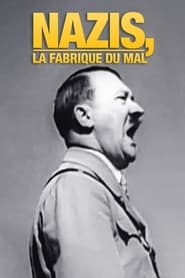
True Evil: The Making of A Nazi
Download English Subtitle
Release info
Tags
Download English Subtitle Files for Mobile (6)
English subtitle preview
The first 200 lines.
They seem like ordinary men.
Articulate, educated, civilised.
But they will turn into depraved, twisted monsters.
They will commit acts of unimaginable cruelty
for which they will feel no shame or remorse.
Here is true evil.
Berlin, 1945.
At the heart of the ruined city,
the charred remains of Dr Joseph Goebbels and his wife.
Close by, the dead bodies of their six children.
The Goebbels' kill their own children, poison them,
because their love for Hitler and their love for Nazism
is just so great
that they'd rather commit infanticide
than to see the world without their beloved Fuhrer
and their beloved Nazism.
Joseph Goebbels -
the Nazi master of propaganda and marketing.
Joseph Goebbels was brilliant at his job.
He starts using simple imagery, simple wording,
and he knew exactly what he was doing.
He knew his audience.
Joseph Goebbels, the man who sold Hitler.
Goebbels elevates Hitler into a godlike figure,
into a divine presence,
and imbues him with a spirituality
that he hopes will inspire people on a level
that transcends anything that ordinary politicians could offer.
Joseph Goebbels, the club-footed socialist,
university academic, and novelist.
This extraordinarily intelligent man
was one of the most evil men in history.
Born in 1897 near Dusseldorf,
Paul Joseph Goebbels is the sickly child of a bookkeeping clerk.
Life wasn't particularly easy for Joseph Goebbels.
He contracted polio very young,
which left him club-footed and physically frail.
As a student he excels,
at school and then here at Heidelberg University,
and he decides to become a novelist.
He is a highly intelligent person.
He earns a doctorate in Romance language and literature
at Heidelberg University.
Goebbels, like many academics, is left wing.
He believes in a large state, and state control.
He blames free-market capitalism for ruining Germany.
Goebbels in the early years is more on the socialist side of National Socialism.
He is interested in bringing down capitalism.
Goebbels has read Karl Marx.
Marx vilifies the Jews as usurers and money-worshippers.
Marx calls Polish Jews "the smeariest of all races".
Marx even calls his political opponents "Jewish niggers".
Goebbels had a pathological hatred for capitalism.
He associated capitalism with a Jewish conspiracy,
and his attacks on the Jews were inextricably linked
to this hatred of a new, modern, capitalistic society
which he thought had corrupted the values
of a traditional and pure Germany.
But Goebbels sees Soviet-style socialism as the wrong kind.
The Communists favour industrialisation.
Some of their leaders are Jewish.
They proclaim themselves internationalists.
Trotsky and his followers argued for a worldwide revolution.
Goebbels' romantic socialism looks to the pre-capitalist past.
He idealises not the industrial working class
but the rural German folk, or Volk.
In the 1920s, Goebbels is looking for political direction.
He finds it when he comes across a Bavarian activist - Adolf Hitler.
This is a lightning bolt moment for Goebbels.
He says, "What Hitler has to say
"chimes exactly with what I'm thinking
"but haven't been able to express."
It's transformational.
When he had seen Hitler speak, he had been mesmerised by him,
and in his diaries, he talks about
how he almost feels a love for Hitler.
He refers to Hitler as "half-commoner, half-god".
Sieg Heil!
Goebbels is enthralled by Hitler
and, as it happens, Hitler needs Goebbels.
When Goebbels joins the Nazi Party,
it is little more than a local Bavarian sect.
In Berlin, few people have heard of Hitler's National Socialists.
It will be Goebbels' job to go there and put the Nazis on the map.
This is really significant, because up until then,
the Nazis had only really been successful
in their home area around Bavaria,
and Berlin was still largely under the thrall of the Communists
and other parties.
So, to crack Berlin was a key aim and objective for the Nazis
and Hitler entrusted it personally to Goebbels.
In Berlin, Goebbels' first challenge is to get the Nazis noticed.
In the early years, the Nazis didn't have control of media outlets or newspapers.
They needed to orchestrate publicity-grabbing stunts,
and to use an old marketing adage,
no publicity is bad publicity.
Goebbels makes rabble-rousing speeches
and organises Nazi rallies, which spill over into violence.
Goebbels believes that Berliners need action and sensation
to keep them engaged,
so when he arrives in Berlin he incites violence.
He incites people to be angry
and there are lots of riots and attacks and thuggery,
and he sees this as a way of swelling the Nazi cause.
Goebbels has the Nazi supporters dress in home-made uniforms.
These Brownshirts intimidate
and carry out attacks on homosexuals, Communists,
but especially Jews and Jewish businesses.
The Brownshirts are brazen.
Their attacks are widely reported in the papers.
The Nazis of course were a primary perpetrator
of street violence in Berlin.
The Nazi Brownshirts would be deliberately sent to a neighbourhood
just to invite trouble.
Goebbels is above all, at this stage, a rabble rouser.
He really wants to have actual fights
that are going to create publicity, create a sense of conflict,
and are therefore just going to get the Nazis into the news.
But Goebbels wants his own propaganda vehicle,
so in August 1927, he sets up a National Socialist newspaper.
It's called Der Angriff - The Attack -
and that's exactly its purpose.
It was full of vicious attacks
on Communists, Jews, Freemasons, you name it.
Any supposed enemy of Nazism.
Goebbels used Der Angriff to focus on
what he thought were the most important issues of the day,
and perhaps more than any other leading Nazi,
Goebbels thought the most important issue of the day were the Jews.
Goebbels calls for a boycott of Jewish shops
and sends out his Brownshirts
to intimidate ordinary Germans from using them.
It is they, the capitalistic, commercial Jews,
who are behind all Germany's problems.
Goebbels demonises the Jews in just about every way possible.
The essential message which he puts in every outlet
is the Jews are to blame.
The Jews are to blame for everything.
If there's a food shortage, it's the Jews.
If there's violence, it's the Jews.
The New York Stock Exchange is in a panic.
Everyone wants to sell.
With the Wall Street crash of 1929,
Goebbels' vilification of the Jews reaches new levels.
Firms fold. Unemployment rises.
Recession spreads around the world.
Berlin is the political capital
but it is also a manufacturing centre,
and it is clobbered by the unemployment crisis.
And if all that is not bad enough,
the federal government doesn't seem to be able to do anything about it.
The crash marks the end of an easy credit boom,
caused by money printing.
This is the fault of the American Federal Reserve
and other central banks.
But Goebbels, as ever, blames the Jews.
In the run-up to the 1930 election,
Goebbels' poisonous anti-Semitic campaign is a spectacular success.
The Nazis become the second-largest party in the Reichstag.
But Goebbels knows that hate is not enough.
To secure power for the Nazis,
he decides to use the latest marketing techniques,
and for these he turns to America.
Although Joseph Goebbels hates capitalism,
he is intrigued by the emerging advertising industry in America.
American capitalism is producing vast numbers of consumer goods.
Keeping the coffee in the icebox?
Yes, Mr Jones. It's a new kind of coffee.
To market these goods,
new forms of communication and sales techniques are being developed.
Goebbels will copy the techniques used by the ad men on Madison Avenue,
not to sell breakfast cereal and washing-up powder
but to sell the Nazis.
Goebbels is in the sales business.
He knows he has to sell Hitler and he has to sell the Nazi Party,
so he turns to the world of advertising
and he becomes fascinated and enthralled
by American advertising companies of the period.
He even hires one and brings them over.
He could have been selling washing machines or fridges
with the techniques that he's using
but actually he's selling the darkness of Nazism.
Goebbels starts using very recognisable imagery.
It's simple imagery, simple lettering, simple wording.
And Goebbels uses his messages repeatedly.
He's very clever.
They work on a simple level
but if he puts them into a brain often enough,
they really sink in, they work, they mean something to people,
and he knew exactly what he was doing.
He knew his audience. It was clever stuff.
This drumbeat of repetition
makes people feel the ideas have to be right,
and they become an innate part of the way people see the world,
and that is a propaganda and political tactic
that is still very widely used today.
Heil, mein Fuhrer!
Dr Joseph Goebbels applies his newly acquired marketing techniques
to transform the image of Adolf Hitler.
Hitler is seen by many Germans
Comments
No comments yet. Be the first to leave one.