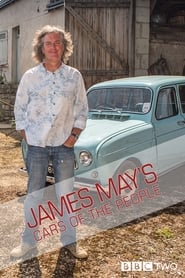
James May's Cars of the People
Download English Subtitle
Release info
Tags
English subtitle preview
The first 200 lines.
In the early days of the car, it was believed that the spread of this new
motoring fad would be limited by our ability to train chauffeurs
and supply leather for the upholstery.
Only the rich would have cars.
The rest of us just walked on.
But we, the shuffling masses, had seen the cars.
And we saw that they were good.
This is the story of how motoring came to the masses...
how dictatorships
and democracies alike pursued the dream of cars for all...
..of red herrings, seen here in green, and automotive cul-de-sacs,
of shattered dreams
and the fall of the mighty.
This is how we fell in love with our wheels.
Also, this happens.
'This week, totalitarian transport -
'the people's cars of the state
'and how some were more equal than others.'
Ow!
'But first, it's time to slay a sacred cow.'
The term "people's car" is a very emotive one amongst car historians,
and most of them would tell you that it all started
with this, the Ford Model T.
But then again,
wasn't it Henry Ford who said, "History is more or less bunk"?
And I agree with him.
Adolf Hitler was not an engineer.
He was more of a wildlife enthusiast.
"You only have to look at nature,"
he is alleged to have said, "to see what streamlining is."
Herr Hitler sagte, mein Auto sollte wie ein Kafer aussehen.
Mr Hitler said, my car should look like a beetle.
For me, the Beetle is where the true story of the people's car begins,
and because it was a social initiative, not a business one.
Today, the Beetle is the world's most recognisable car.
Over 21 million were made,
and it's the only car to have its own Hollywood movie franchise.
But the Love Bug has a dark side.
The Beetle's beginnings were mired in scandal, deceit, theft
and, let's not beat about the bush here, crimes against humanity.
And like no other car in history,
the Beetle played a unique political role in increasing
a dictator's control over the lives of his people.
To begin with, the Beetle wasn't even called a Volkswagen.
It was called the Kraft durch Freude Wagen -
the strength through joy car.
Kraft durch Freude
was Hitler's ministry of family leisure activities.
It was created to promote the joys of living under a Nazi regime.
The KdF operated on a massive scale.
It built Titanic-sized cruise liners...
..vast holiday complexes,
and laid on free trips for the honest German family.
There were even nationwide keep-fit clubs.
A little bit of morning exercise
with just a subtle hint of bunting.
Hitler thought there should be a car as well.
That would bring the state right into the heart of everyday
family life.
The man entrusted with its design,
legendary engineer Dr Ferdinand Porsche.
He's the one with the tache.
The KdF car would be built in a vast new factory -
the Volkswagenwerk in Saxony,
and should, above all,
be affordable for the average German worker.
And this is what he came up with -
the original Kraft durch Freude Wagen.
And when I say original, I mean very original.
This is the oldest running Beetle in the world.
It's prototype number six,
and it was built by Dr Porsche in his Stuttgart workshop
so strictly speaking,
since the Volkswagen factory hadn't been finished yet,
this is a Porsche.
When you look at an original prototype like this,
you can see exactly what Hitler was on about.
It should look like a beetle and it does,
it does look like a beetle.
Operate the semaphore indicators.
Now, obviously, it isn't fast, it is actually quite noisy,
the steering is a bit wayward,
if somebody comes past in an Audi at 150, I definitely feel it.
But, at the time, the KdF-Wagen was quite something,
especially if you'd never been in a car.
The hard-up German public
were utterly seduced by the promise of owning their very own car.
After all, the Beetle was good enough for the party bosses,
who, predictably, got the first ones.
This actual KdF-Wagen I'm driving
went on to be the personal car of Dr Robert Ley
who was head of the Kraft durch Freude movement.
And, in essence, he was the minister for fun.
Robert Ley was one of Hitler's earliest supporters
and his KdF was instrumental in keeping the German worker
sweet with the Nazi regime.
But, when he was not running his vast empire of cruise liners
and holiday camps, he was involved in camps of a very different kind.
His slave labour activities resulted in the deaths of thousands.
He was going to be tried for war crimes
along with the rest of them, but he managed to hang himself in his cell
before Albert Pierrepoint could do the job for him.
This is genuinely disturbing.
I've driven a lot of strange cars
but I've never been in one that's a genuine instrument of evil.
Apart from the G-Wiz.
I'd just like to make it clear I'm very interested in his car,
but I don't share any political views with Dr Robert Ley.
And the reason I can't help but like the car
is because it's beautifully well thought out.
The engine, as we know from that joke about the nun
who thought hers had been stolen - is in the back.
That means that all the noise and all the fumes it produces
are left behind.
And, because there was no engine in the front,
the nose could be rounded off.
The whole car approached the ideal streamlined
half of a teardrop shape,
and streamlining was all the rage in the 1930s.
But the KdF-Wagen wasn't designed to be occupied by a solitary
German officer.
THEY SING
Much better.
This is what Hitler built his Beetle for -
the long-haul Nazi family holiday.
THEY ALL SING
It wasn't just the car itself,
but the entire lifestyle around it that Hitler and the KdF envisaged.
The Aryan family would have as many children as possible
so the car would be suited to a family of five.
They would drive in comfort at 100kmh along the Autobahn
for four hours between stops
until they reached one of the pre-determined KdF resorts.
What could be better?
The holiday atmosphere began as soon as you climbed aboard.
This is Prora,
a 20,000-bed holiday camp on the Baltic island of Rugen.
The Nazis got the idea from Butlins...
..including the communal showers.
By putting away a few pfennigs a week,
you could stay in your well-appointed KdF seaside apartment
equipped with your very own KdF radio.
HITLER SPEECH PLAYS ON RADIO
And by putting away a little more,
you too could arrive there in Darth Vader's helmet.
Stylish, affordable, totalitarian.
The car cost 990 Reichsmarks.
The typical working German family earned around 32 marks a week.
So, the rule was -
Funf Mark die woche musst du sparen, willst Du im eigenen Wagen fahren.
"Five marks a week must you put aside,
"if in your own car you wish to ride."
So, savers bought these five marks stamps
and stuck them in this Sparkarte, a savings card.
When the card was full, you could have your car.
But if you defaulted on just one of these weekly payments,
the whole thing was forfeit.
But, really, five marks a week was easy.
Even children could contribute to the family car
with one of these KdF-Wagen savings tins.
Look at this thing.
It is rather beautiful, isn't it?
The savings plan and the lavish marketing driving it
proved irresistible.
By 1938, when the giant Volkswagen factory finally came on line,
millions of Germans were dutifully filling the KdF coffers
and the Nazis had a hit on their hands.
The whole scheme was rather brilliant.
A car, a radio, a holiday.
What innocent German citizen,
remembering all the hyper-inflation of the 1920s,
wouldn't have bought into it?
I'd have bought into it.
There was only one tiny problem.
The whole Beetle savings scheme was a giant con trick.
Hitler was secretly saving up for something else entirely.
The war changed everything.
The Prora holiday camp never opened.
If there'd been a KdF customer complaints line,
it would have had a longer queue than Virgin Broadband's.
No-one received a Beetle -
none of the families who'd funded that massive Volkswagenwerk factory
with all their scrimping and saving.
If the Germans had actually eaten kippers,
you could say they'd been stitched up like one.
The great factory became an engine room of the war effort.
The Beetle's versatile, innovative chassis
was adapted to create two German war vehicles -
the rugged all-terrain Kubelwagen
and the amphibious Schwimmwagen.
But it didn't stop at vehicles.
Russian and Jewish slave labour
were also forced to make Hitler's secret weapon - the V-1 flying bomb.
So, unwittingly,
those honest hard-working German Volk of the mid 1930s,
with their brightly coloured cash tins and their saving stamps,
helped to demolish a row of houses
about a mile from where I now live in London.
But, let's be positive, at least it wasn't the chip shop.
The Allies soon identified the factory
James May's Cars of the People subtitles in other languages
More English subtitles for James May's Cars of the People
- JamesMaysCarsofthePeopleSeason2complete · 21 downloads · 2021-07-30
- James Mays Cars of the People Season 1 complete · 37 downloads · 2021-07-30
- James May's Cars of the People - Episode 3 · 33 downloads · 2014-08-26
- James May's Cars of the People - Episode 2 · 32 downloads · 2014-08-24
Comments
No comments yet. Be the first to leave one.