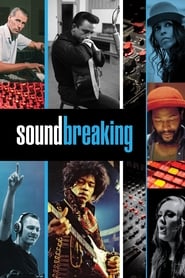
Soundbreaking
Download English Subtitle
English subtitle preview
The first 169 lines.
-My interest in music, yeah, it starts when --
when things become electric.
started a music revolution.
Blues went electric.
They put it on a train and took it up North
and plugged them in.
Hot-wired the blues.
-I plug it in. I get it home and I turn it up it's like "Khhhhh."
"Ehrrrrr!"
"Euhhhhhrrrrr!"
-Suddenly, you didn't need a horn section anymore.
I spent most of the mid-'60s
not hearing anything I ever sang.
-Electricity didn't just turn up the volume,
it opened up a world of new sounds.
-These albums are kind of sonic fantasies
that could never actually exist in real life.
-I fell in love with the synthesizer.
-Is this how you make up all these songs?
With all these --
-We let the machines make up the songs.
-You cannot put me anywhere near a synth.
I don't care if it was old-school synth,
you know it's still a manipulated sound.
-It was like they were working on Frankenstein.
All day, all night.
-This is the story of how one epic innovation
triggered a musical chain reaction
that's still throwing off sparks today.
-It's amazing technology already happening,
which expands what can be created,
'cause someone will use one of those things,
and by accident, stumble into a brand new sound
that no one's ever heard before.
-Just think of what would happen to the music business
if we pulled the plug on all the electricity.
Okay, then. Okay.
It'll be an F for you.
Here we go.
Just one more time.
-Right after I say, "Are you sure?"
Da da da -- yeah.
Oh.
-Hal, here's how I want to do it. Takes like this.
-All right, it's fun time. Fun time.
Here we go.
-Oh, really? -17, take one.
-This will be the keeper. -
[ The Who's "My Generation" plays ]
[ The Who's "My Generation" plays ]
-Well, amplification in The Who, uh, is a very long journey.
-I mean, I remember when The Who first were using Beatle 100s.
-Those are the first big amps we ever saw;
they're called Super Beatles.
-And we covered the speaker fronts with Union Jacks.
And it was such a fantastic celebration
of, uh, loud music, loud, loud, loud.
-Incredibly loud. Incredibly loud.
-You didn't feel like you were gonna be sick;
you felt like you were gonna float up to heaven.
In the area of London we lived,
there was a shop called Jim Marshall's,
and he started making amplifiers, and he says,
"Well, I've done this, and I've done that.
Try this one out."
And they gradually got bigger and bigger.
-It got bigger and bigger and bigger,
and it was like, kind of like the, uh, arms race
against other bands we played with.
If Jerry had two Fenders, Jorma wanted two.
Jorma went up to four. Jerry went up four, uh, Fenders.
-Everything got louder, and the drummer had to get louder, too.
-And we're playing 'em harder and harder and harder.
Too hard.
Bob and Jerry, they were ripping their cords out,
trying to sing over the din.
-And I think I spent most of the '60s
not hearing anything I ever sang.
It made me develop a pair of lungs that I've still got today.
-In 1976, The Who were recognized
as the loudest band in the world.
125 decibels.
-Over the course of the 20th century,
electricity and amplification didn't just make music louder,
it transformed it, and there's no better example of that
than the electric guitar.
-The electric guitar is its own instrument.
-It magnifies every little nuance
that the string gives off,
that you probably wouldn't hear on a regular acoustic guitar.
The richness of tone and the treble,
it brings that out.
It can sustain.
-You can make it sound almost voice-like.
You can make really gentle chords
and almost ethereal sounds,
and then with a flick of the switch,
you can knock down buildings, you know.
-The electric guitar became so popular
and it gave the power to guitarists,
and it took all of us a long time to go
and wrench it back out of their nasty, little hands.
-Well, first thing that happened with the electric guitar
that was so important was Charlie Christian.
People don't understand how important he really was.
And he was discovered by John Hammond.
-John Hammond helped define the landscape
of American popular music and jazz for a very long period.
He put Charlie Christian together with Benny Goodman,
which put the electric guitar on the...map.
He not only went to Oklahoma and brought him,
he forced him on Benny Goodman.
A black guy on the most famous white bandleader in the country.
And Goodman hated guitar players!
-Early on in the '30s, jazz guitar players
were the guys in the big band with acoustic guitars,
and they would play chords, just chords,
and it wasn't loud enough to play the melodies.
-So somewhere around 1939, Gibson comes out
with a amplifier with the guitar.
It's like 150 bucks, and Charlie Christian bought one.
Hammond was so confident
that Goodman would completely freak out
when he heard that a guitar player
could play like a saxophonist, that he would change his mind,
so he said, "Benny, just do this one audition.
Just, you know, he's a kid from Oklahoma, just do it."
And as soon as Charlie started playing,
and that sound came out of the amplifier,
the Benny Goodman sextet was born.
-For the first time, the guitar was not a background instrument.
Used to be dominated by saxophones and trumpets.
Now, when you needed any more power,
just turn that amplifier up.
-Well, I'm a big Charlie Christian fan.
He's definitely the first rock guitarist.
You can see from there to Hendrix,
he's just blowing everybody away.
-The fact that there was a black man
playing an electric guitar, it opened up the doors,
'cause when you hear his sound,
it's -- there's a direct connection between the tone
of Charlie Christian's instrument and the blues.
-It's difficult to think about music
without thinking about the blues.
When you love music, no matter what --
You like punk rock, or pop music, or rock 'n' roll,
or jazz, or rockabilly, country, they all lead right back
to the blues; that's the root of all of it.
-I didn't get an electric guitar till 1946.
It would cost about $100 for the amplifier and the guitar.
But the people just making a living on the farm
ain't getting no guitar too much, you know what I mean?
-When I was young, I'd never seen an electric guitar,
and where we lived it wouldn't have did me
any good anyway because we had no electricity.
-This area in Mississippi gave birth
to this incredible laundry list of people
who are the pioneers of the blues.
Honeyboy Edwards, Robert Johnson, Muddy Waters,
and some of them, of course, left there.
-From the early 1920s, you have this massive migration
of African Americans from South to North.
Chicago absorbs a lot of Southern black migrants.
People call it the Up South.
-But really why I left the South for was to make records.
I couldn't find no way to get to make records down there.
I couldn't get no connections, you know.
Said, "Well, I'm going to Chicago.
More English subtitles for Soundbreaking
- Soundbreaking E08 I Am My Music · 30 downloads · 2016-11-24
- Soundbreaking E06 The World is Yours · 27 downloads · 2016-11-24
- Soundbreaking E07 Sound and Vision · 25 downloads · 2016-11-24
- Soundbreaking E05 Four on the Floor · 26 downloads · 2016-11-24
- Soundbreaking E03 The Human Instrument · 34 downloads · 2016-11-24
- Soundbreaking E02 Painting with Sound · 21 downloads · 2016-11-24
- Soundbreaking E01 The Art of Recording · 25 downloads · 2016-11-24
Comments
No comments yet. Be the first to leave one.