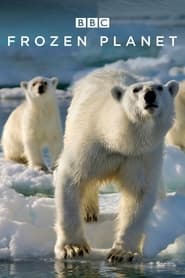
Frozen Planet
Download English Subtitle
Release info
Tags
English subtitle preview
The first 177 lines.
The polar winter.
This is the planet at its most hostile.
Those that stay here at this time
must face the harshest conditions on Earth.
The High Arctic in late autumn.
Empty and abandoned to ice and snow.
Most animals migrated south weeks ago.
The few that stay will face violent winds,
plunging temperatures and months of darkness.
A female polar bear searches for shelter.
Other bears are out on the frozen ocean looking for food,
but she won't feed again until next spring.
Using as little energy as possible,
she starts to dig a shallow nest.
The snow here is easy to work.
It's soft and light.
A sure sign that soon, plenty more will accumulate on this slope
as winter advances.
And that is what she needs.
If she has chosen well,
the Arctic wind will do much of her work for her.
Once the snow here is deep enough,
she will dig down to make a den.
She'll then lie, waiting for her cubs to be born as winter sets in.
The sea ice already covers twice the area it did in summer.
Those animals that, a few weeks ago,
came down here to feed in the sea, are now locked out.
But there are windows in this white desert.
Gateways to the rich ocean below.
Most birds have migrated south.
But in the frozen Bering Sea,
ducks of one particular species
are gathering together in a single, immense flock.
Spectacled eiders.
Hundreds of thousands of them.
With the seas that fed them throughout the summer
all but frozen, this is the eider's last refuge.
Such patches of open water,
kept free of ice by strong currents,
are given a Russian name, polynyas.
If this polynya stays open all winter,
the ducks will have avoided an exhausting migration.
It's a gamble and a tremendous risk,
especially for the spectacled eider,
for this polynya holds the world's entire population.
Surrounded by ice, these spectacled eiders' survival
depends on this single, vulnerable oasis.
And conditions here can change very fast.
A smaller pool.
Here, common eider ducks are learning a bitter lesson.
An early winter storm has caught them out
and the ice is closing in.
The pool is shrinking, and the ducks are freezing to death.
These gamblers have lost.
As the sun's influence continues to dwindle here in the north,
the cold pushes south into Arctic lands.
Winter brings a devastatingly-destructive force.
Frost.
Ice crystals form as moisture in the air freezes.
Inside plants, the same thing is happening
to the water in their cells and their sap.
With these first frosts, most plants die.
Their insides ripped apart by ice crystals.
Coniferous trees, however, like fir and pine,
can withstand very low temperatures.
It's these trees that create the greatest forest on our planet.
This is the Taiga.
It encircles the globe and contains one third of all the trees on earth.
As winter deepens, frigid air from the Arctic
meets warm, moist air from the south,
producing particularly heavy snows.
For the big animals of the forest,
there's no way of hiding from the winter.
But size, for the Bison of Northern Canada,
is, in fact, their salvation.
Big bodies lose less heat
and can carry more insulation.
That may be why these bison
are the largest land animals in North America.
And only a large predator can tackle them.
Wolves hunt better in packs,
but there are only two of them here and the prey they pursue are giants.
A vast Arctic wilderness stretches all around.
In it somewhere, there are bison.
These deep tracks in the snow are easy to follow,
but which way were the bison going?
They have detected a scent. The hunt is on.
Running in the bison's tracks is easy.
The snow here is compressed and firm.
At this rate, the wolves will soon catch up.
They attempt a shortcut.
The giant bison can plough on through virgin snow,
but for the wolves, deep snow is a hindrance,
and now they're losing ground.
The hunters rejoin the bison's tracks and the contest is on again.
The bison are the only prey here in winter.
The wolves have no option, they must tackle them.
But bison are ten times their size.
In winter, the line between life and death is so narrow
that for a wolf, even a small injury could be fatal.
It's crucial they select the right target.
This one is very big.
Good decision.
This is smaller, a yearling.
Even though it's young, it's none the less heavier
than both wolves combined and it is extremely powerful.
The male wolf backs off.
Perhaps he's frightened of injury.
But the female is more determined, or more desperate.
Having given so much already, she must make the kill.
This is a battle of life and death for them both.
The bison has no strength left.
The battle is over.
Winter deepens. The snow continues to accumulate,
smothering the forest.
Some trees are loaded with three tonnes of snow.
It shuts out what little light there is at these latitudes,
and that shortens the growing season still further
and limits how far north trees are able to grow.
So, snow influences both the shapes of the trees
and the extent of this forest.
And it affects the animals, too.
SQUAWK!
It helps to have friends
if you want to find food at this time of the year.
Wolverines and ravens, a match made in the Taiga.
It's the hardest time of the year to find food.
But the wolverine knows that a raven's call
is as good as a dinner bell.
And the raven has just recruited the best can opener in the forest.
The moose carcass is frozen solid,
but the wolverine has immensely powerful jaws,
well able to deal with frozen food.
The raven's bill is more suited to leftovers.
The raven has to be patient.
A wolverine's appetite is legendary.
According to folklore, it can eat more at one sitting
than any other creature in the forest,
hence its other name, the glutton.
What the wolverine can't eat now,
it stores in the deep freeze.
It will bury these food parcels across the forest,
planning ahead for leaner times.
For a few, the snow is an ally.
Voles stay active throughout the winter beneath the snow,
despite the freezing temperatures above.
Travelling along tiny corridors,
they move from pocket to pocket of perfectly refrigerated food.
Snow is a great insulator,
so down here, the temperature never falls
more than a degree or so below zero.
And that's warm enough for a vole to thrive,
even if it lacks the stature of a bison.
In some years, vole numbers boom,
and then they are forced to break cover to search for more food.
The great grey owl is a silent and very skilful hunter,
but deep snow can be beyond its reach.
But such snow is no barrier to one predator.
The least weasel.
A tiny hunter, and the vole's nemesis.
Its body is exactly the same width as a vole's,
so there's nowhere a vole can go that the weasel can't follow.
INSTRUMENTAL
The weasel's long, slender shape
is perfect for hunting in tunnels,
but the worst possible shape for staying warm.
So they need a special way of doing that.
She plucks the fur from its body tuft by tuft.
And now she puts it all together to make a cosy blanket
under which to sleep in her den below the snow.
Midwinter in the northern forests.
The sun is so low that it's twilight at midday.
Further north in the high Arctic,
the sun has been below the horizon for months
and it'll be several more before it appears again.
The male polar bear spends winter out on the frozen ocean.
Few creatures can endure these conditions.
Frozen Planet subtitles in other languages
More English subtitles for Frozen Planet
- BBC: Frozen Planet - Complete Series (2011) · 136 downloads · 2018-07-16
- 07 On Thin Ice 720p HDTV MP4 · 83 downloads · 2014-03-17
- Frozen Planet -Complete Series-720p HDTV x264 YIFY-350mb-Eng · 133 downloads · 2013-07-23
- Frozen Planet 2011 720p BluRay x264-RO4EVA · 167 downloads · 2012-05-09
- BBCFrozen Planet EP01 To The Ends Of The Earth 2011 720p BluRay AC3 x264-HDxT En · 248 downloads · 2012-03-07
- BBC Frozen Planet 2011 1080p BluRay DTS x264 D-Z0N3 · 173 downloads · 2012-01-21
- BBC Frozen Planet E08 The Epic Journey · 81 downloads · 2011-12-30
- frozen planet ep7 Resync for vsenc release · 89 downloads · 2011-12-16
Comments
No comments yet. Be the first to leave one.