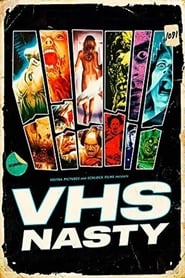
VHS Nasty
Download English Subtitle
Release info
Tags
English subtitle preview
The first 200 lines.
On behalf of the motion picture industry,
welcome to the world of home video entertainment.
A video nasty is a colloquial term
used in the United Kingdom and Europe
to describe a number of films which are distributed
on VHS video in the early 1980s, which were heavily
criticized by the press, Parliament
and various religious organizations
for their content which contained
strong use of violence and graphic nudity.
No legislation was in place to regulate home video content.
This meant that any films on the market
and available for video rental stores had no certification.
Although the act did not govern home video at the time,
at this time the British Board of Film Censorship
was established in 1912 only governed theatrical
cinematic releases and was not
enforced to censor home video.
This is due to a loophole within
the film classification laws at the time.
Because of this, in the early 1980s,
the market was flooded with low budget horror films
featuring gore, violence and graphic nudity.
Due to the video nasty debate in both Parliament
and in the courts, this resulted in a number of films
being prosecuted in the early 80s
by the director of public prosecutions.
Following this, the government passed
the Video Recordings Act 1984,
which meant in Britain all video releases
had to appear before the BBFC.
The so-called video nasties caused
an outright media frenzy during the early 1980s.
To avoid fainting, keep repeating, it's...
Only a movie, only a movie, only a movie.
In 1982, Vidco placed an advertisement
for the Driller Killer in a VHS magazine.
This advertisement served to bring the awareness
of these types of films to the attention of the masses.
What happens next was...
Censorship, censorship.
Cannibalism.
Censorship.
I think it's important for us to define
what we're talking about here at the start.
This isn't the small type of censorship,
say an adult trying to restrict the access of a small child
to pornography, something you could argue
is in the best interest of someone who is not capable
of deciding for themselves what's best for them
or what is possibly bad for them.
This is something different.
This is something larger.
This is something insidious.
This is a small group of people,
a governing body of some type
restricting the access of the body,
of the masses to something that they want.
These are people who can decide for themselves
what's good for them or possibly bad for them,
but you have this overreaching governing agency
or government enforcing their own
ideals, morals on the masses.
This is where things get wrong.
And this is what we're talking about
when we talk about censorship within this context,
the video nasties, the PRMC, the Satanic Panic,
this whole era of restriction of music and film and art
in general from the masses.
So if you were lucky enough to own a video player
in the early 80s, you had unrestricted access
to a number of violent horror gore films
full of blood full of gore full of splinters going in eyes,
full of drills going in heads, full of nudity,
full of Nazis, full of everything.
The video nasties are bloody amazing.
They're very important for film, for film history.
I don't think there isn't a film maker
a horror film maker alive today
who doesn't owe a debt to a video nasty.
They were such a big part of our British culture
and worldwide, they're a worldwide phenomenon.
Even the word nasty, what does it mean?
At the time when that phrase was coined,
it was considered an incredibly nasty, vicious film
with a lot of violence, usually sexualized violence.
Women were the main target and victims in these films.
And certainly American films I even find distasteful
the early Wes Craven, Last House on the Left,
I Spit On Your Grave, for example another film from that genre
which seemed to revel in sexual violence
and it's something that I've never felt comfortable with.
But whether those films should be banned
or whether they should just have a warning on them
is a controversial subject.
Because if you talk about banning things
then you get into that area where
if you know Fahrenheit 451 essentially
is the temperature of which paper erupts into flame
and that was kind of exemplified as an example
in that great film of the same name.
Pretty much everything on this list is known for its brutality,
movies like House on the Edge of the Park.
It's got a lot of rape scenes,
but they're also very violent in nature.
The same thing with Last House on the Left.
I think that's sort of what in a lot of ways
what makes these videos video nasty,
it's just the nastiness of it all.
I know the actual New York repo
and they actually escorted that film out of the country
because they didn't want anyone even making bootleg copies
or any distributor getting hold of that film.
So the New York repo was actually escorted out the country,
which is really crazy.
But here's the problem censorship inevitably runs into
is that any time an art form, music, film whatever
is censored that inevitably creates an underground movement,
a collective of creative people that are inspired by
the restrictions that have been placed upon them
and seek to circumvent that
and find new ways, new forms of expression,
more extreme forms of expression
as a direct response to the unfairness of the censorship.
That whether it's hip hop, whether it's punk rock,
whether it's horror films,
that underground movement eventually
because of that extremity
because of the interest in the rebelliousness
of what they're trying to do
that outside group inevitably takes over the mainstream
down the road and becomes the mainstream.
The real hilarious thing about censorship
is if you think about things that have been
censored from The Wolf Man in 1931 to Friday the 13th
to Where the Wild Things Are it doesn't work.
I mean in the end over the long term,
censorship does not work, because eventually
these things you're trying suppress always
get out there, always.
That's the irony of censorship.
Censorship.
There should be no censorship in films whatsoever
except for children, protect the children, that's it.
It was a disaster to ban the movies in the 80s,
like Mother's Day, Toxic Avenger
because what you got a 40-minute version
of the Toxic Avenger.
It wasted people's money, it wasted their time
and wasted very good art.
There's no reason for any kind of censorship.
This is idiotic.
So it means that what we're in danger of
is throwing all of these films into a great conflagration
and destroying them forever
and then a very valid part of our movie history is lost.
So I think that's what the British government at the time
had in mind when the list of video nasties emerged,
where they decided that any film that had any kind
of graphic violence was considered beyond the taste
of the British taste makers and because of that
they decided that the public should not have access to them.
They became an illegal list whereby if you wanted them
and they still were available, you literally
had to get them in a brown paper bag under the counter
and take them home and bring them back in the same manner.
The story I heard is that they had a Go Video
once try to drum up some publicity for his film
so he sent a copy to Mary Whitehouse
pretending to be an angry member of the public
who had come across it in a video store
and he was hoping that she'd complain about it
and that would get people going out and buying it.
But instead it had a bit of a catastrophic effect
on the video industry as a whole at the time
because then it kickstarted
the whole Department of Public Prosecutions
raids and making a list and police raids.
So I think that was the kind of catalyst for the whole thing
but most of the time you would have video magazines
that would have full page ads
for stuff like The Dreaded Cutter, Essex Experiment Camp
and things like that and the video industry
didn't help themselves at the time.
But as you can see from the list of video nasties
a lot of the films are great Italian classics.
You're looking at Suspiria, one of the great art movies
of the late 20th century.
Looking at Tenebrae another really beautiful,
but extremely violent film, which also had humor
and some of the most dramatic camera movements
ever recorded in cinema history.
You had the films from Lucio Fulci,
which again are extremely violent zombie films,
but they're zombie films.
They're not to be taken that seriously.
Zombies are fantasy.
As we can see now in the 21st century,
one of the biggest shows on the planet
is The Walking Dead.
More English subtitles for VHS Nasty
- VHS-Nasty-2019-1080p-WEBRip-x265-RARBG · 17 downloads · 2021-06-28
- VHS Nasty 2019 720p AMZN WEB-DL DD+2 0 H 264-iKA · 39 downloads · 2019-12-12
- VHS Nasty 2019 WEBRip x264-ION10 · 20 downloads · 2019-11-08
Comments
No comments yet. Be the first to leave one.