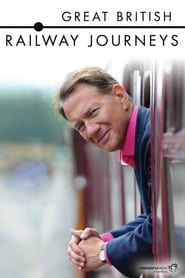
Great British Railway Journeys
Download English Subtitle
Download English Subtitle Files for Mobile (25)
English subtitle preview
The first 200 lines.
In 1840, one man transformed travel in the British Isles.
His name was George Bradshaw
and his railway guides inspired the Victorians to take to the tracks.
Stop by stop, he told them where to travel,
what to see and where to stay.
Now, 170 years later, I'm making a series of journeys
across the length and breadth of these isles
to see what of Bradshaw's Britain remains.
I've embarked on a new journey following in the tracks of Victorian entrepreneurs and travellers
along railways that were the arteries to industrial England's Black Country heartland.
And from there on to the verdant beauties of Wales.
On today's stretch, I'll meet the remarkable craftsmen
behind the Victorian furniture trade...
My dear bodger, I believe that I have made a bodge!
..discover how George Bradshaw helped to save Britain's canal heritage.
He inspired railway travellers in the 19th century
and canal travellers in the 20th.
And see Shakespeare through the eyes of a 19th century railway tourist.
"Our revels now are ended
"These our actors..."
Bravo!
Starting in the rolling Chiltern Hills, my guidebook will lead me
through Oxfordshire and Warwickshire
towards the industrial centres of the Midlands.
Turning west, I'll experience the stunning Severn Valley railway
en route to mid Wales,
and the Victorian seaside resort of Aberystwyth.
Starting in High Wycombe, this leg takes me north-west
to one of the Victorians' favourite spa towns,
before heading for the heart of Shakespeare country.
My first stop will be High Wycombe, seated deep in the Chiltern Hills.
Bradshaw says, "Wycombe is a borough in Buckinghamshire on the Wyck,
"in vicinity many corn and paper mills."
But the arrival of the trains here in 1854 helped to furnish the town with a new industry.
Trains puffed into High Wycombe courtesy of the Wycombe Railway,
which linked the town to Brunel's famous Great Western.
Today, it's a popular commuter town.
Indeed, even in the 19th century,
the area attracted those who wanted to live at a distance from the "big smoke."
I've always wanted to come to High Wycombe Station. Seriously!
Near here was the country home of one of my great heroes,
the Conservative Prime Minister Benjamin Disraeli,
who had a very good relationship with Queen Victoria, mainly because he was a great flatterer.
By own admission, he laid it on with a trowel.
Queen Victoria did him the extraordinary honour of visiting her Prime Minister at his home.
Imagine how gratified he would have been
when he received Queen Victoria at this very railway station.
When she arrived here in 1877,
the Queen was collected by carriage and driven past an eye-catching display -
a giant arch, constructed from wooden chairs.
It was built in honour of an industry which thrived here in the 19th century
thanks to a very special kind of craftsman.
I'm going down to the woods today to get a big surprise.
The exceptional tale of the Chiltern chair bodgers.
Hello.
Hello. Bit of a stranger in these woods!
Ha! I'm sorry to interrupt your work. I see you are Stuart King of the Bodgers.
Indeed. Yes. What is a bodger?
A bodger historically was a wood turner
who turned chair legs for the High Wycombe chair industry,
mostly working in the woods amongst his raw material,
usually the beech trees.
Why would you come to the woods to do this work?
It's much easier to take my simple equipment like this, the raw material,
than to take very heavy beech logs perhaps many miles to a workshop.
Bodgers have worked here since at least the 18th century,
but their heyday came in the railway age.
Train transport transformed the High Wycombe chair industry.
It opened up new markets, and sped up getting to those markets.
Before the railway, everything was taken to London, the Midlands,
or the south coast by horse and cart.
With the coming of the railways, they were there within hours instead of days.
In the late 19th century, there were 340 men at work in this area.
But by the 1960s, the advent of electric-powered lathes
had seen off the last of the bodgers.
Thankfully, craft historian Stuart King is keeping the skill alive,
which means mastering the bodger's key machine tool.
This is chair bodger's pole lathe.
There's the pole.
So, I'm going to put a hollow here.
That's magnificent!
Do you think you could put one there? No!
THEY LAUGH
You put the tool on the rest first. Yeah.
Have you any idea, when the industry was at its height,
how many chair legs were being turned out?
Oh, enormous numbers.
If we take a pair of chair bodgers, they would produce maybe
three gross a week, a gross being 144 chair legs.
Fantastic output.
My dear bodger, I believe I have made a bodge!
In fact, you've done pretty well.
I have to give you eight out of ten.
The bodger's finished legs and stretchers
were destined to be incorporated into High Wycombe's famous Windsor chairs.
Apparently, the name dates back to before the arrival of the railway,
when the chairs were taken overland to Windsor then by river to London.
But by Bradshaw's day,
over 4,700 chairs a day were being carried out of High Wycombe by rail.
Stuart Linford is amongst the last of the town's chair makers.
Stuart! Hello, sir!
Welcome to Kitchener Works.
Thank you very much. Lovely to be here. Is this a Victorian factory in origin?
Absolutely right. This was built in the 1890s and it is the last working chair making workshop left
in High Wycombe, sadly, out of over 100.
High Wycombe's thriving factories helped meet the demand
from Britain's rapidly expanding middle classes.
They flaunted their newfound status by buying elegant furniture,
and the Windsor chair was a firm favourite.
And this is the famous Windsor chair? Absolutely.
What are its chief characteristics?
Right, it's got a solid wooden seat
into which the back and legs are socketed.
So the axis of construction is the seat.
These days, the legs and stretchers are turned by machine, not by bodgers.
But the method for assembling the Windsor chair remains unchanged since Victorian times.
This, Michael, is the Windsor framing shop,
where we actually make the chairs.
Stuart's going to demonstrate just how quickly a framer could make a chair in Bradshaw's day.
This process is called legging up,
That's a legged-up base.
Now we've got to put the sticks in.
Amazing! This construction kit goes together in moments!
If I just grab... That's it! Hand me that lovely steam-bent component.
That fits in there like that.
There's a finished Windsor chair.
Please have a seat.
Bravo! That's fantastic!
Sadly, there's no time for me to sit around.
I'm now continuing my journey along the Chiltern Mainline, heading north-west.
I've crossed the border from Buckinghamshire into Oxfordshire,
where I'm seeking out the roots of Britain's Victorian prosperity.
Next stop for me is Banbury.
Bradshaw's tells me that the navigable canal from Coventry to Oxford
passes by and is conveyed through a hill by a tunnel
three-quarters of a mile in length.
George Bradshaw began his career by mapping canals,
and he may have been upset that his beloved railways eventually put them out of business.
In the late 18th century,
Britain's canals helped to launch the Industrial Revolution,
transporting coal and other materials faster than ever before.
Banbury soon found itself on an important route
from the Midlands to London.
I've come to Tooley's Historic Boatyard to hear the story
from director Matthew Armitage.
Matthew.
Oh, Michael. Hello. Good to see you. And you.
A boatyard more than 220 years old, that must be some kind of record?
It's something pretty special, isn't it?
The boatyard was built in 1788, around the same time as the Oxford Canal,
one of the major arteries of the fledgling canal system.
It provided the final link in an ambitious "grand cross" of waterways
connecting up the rivers Mersey, Trent, Severn and Thames.
The canal became very busy and was actually the M40 of its time,
transporting goods to London,
pretty much connecting Coventry down to the River Thames at Oxford.
When this canal was thriving, what would the scene here in Banbury have been?
Boats coming from all directions, horses, you'd have had a blacksmith in the forge.
There would have been hammer ringing where they were making horse shoes and parts for boats.
Soon, the Oxford Canal encountered competition, when the Grand Junction canal opened a more direct route
from the Midlands to central London, bypassing the Thames.
But, before long, an even bigger rival emerged.
The canals must have faced intense competition from the railways?
Exactly, that's right.
They actually used the canals to transport all the goods and equipment needed to build the railways.
Once the railways were built, they filled them in afterwards, stopping any competition,
but that wasn't the case for the Oxford Canal. It kept going, which is pretty amazing.
There's something special about the Oxford Canal.
The boats plying the Oxford route
could stop off here in Banbury for repairs,
and this boatyard continued to thrive
through the 19th century and right up to today.
So we're at the bottom of the dry dock now. You can see it's pretty dry.
We've got a boat. We're blacking it.
We're busy. So I think we could do with a hand, really.
These days, it's pleasure boats that come here to be serviced.
After a period of decline in the early 20th century,
Britain's canals had a revival as a place of leisure.
And that story began with a man called Tom Rolt,
who, in 1939, bought himself a dilapidated narrow boat.
He brought his boat to the dry dock.
To this very dry dock? To this very dry dock, and it was repaired by the Tooleys.
He set up his boat and went on a journey around the waterways,
and during this time, he wrote a book "Narrow Boat", which became very, very famous.
It was pretty much a catalyst for setting up the Inland Waterways Association
which campaigned for the canals, bringing them up to what they are today.
So, Rolt's book set people travelling on the canals
in the same way as my Bradshaw's has set me travelling on the railways?
Yes, very much so. In fact, I've got a copy here, and there's something
here which I think you might find rather interesting.
Have a look at just that point there.
"A large-scale map of the canal system hung on the wall of my bedroom,
"and I would lie abed, planning imaginary journeys.
"I had also acquired a second-hand copy of a book
"which is indispensable to the canal traveller.
"Bradshaw's Guide to the Canals and Navigable Rivers of England and Wales."
Good old George Bradshaw! He inspired railway travellers in the 19th century
and canal travellers in the 20th.
It's heartening to think that Bradshaw helped preserve the canals
for us all to enjoy.
More English subtitles for Great British Railway Journeys
- Series 7 · 72 downloads · 2016-04-19
- Series 6 · 37 downloads · 2016-04-19
- Series 5 · 30 downloads · 2016-04-19
- Series 3 · 50 downloads · 2016-04-19
- Series 2 · 54 downloads · 2016-04-19
- Series 1 · 43 downloads · 2016-04-19
- Great British Railway Journeys S05 DVDRip X264-FUtV · 13 downloads · 2015-05-20
- Great British Railway Journeys S05 DVDRip X264-FUtV · 19 downloads · 2015-05-20
Comments
No comments yet. Be the first to leave one.