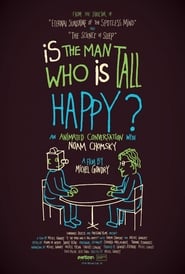
Is the Man Who Is Tall Happy?
Download English Subtitle
Release info
Tags
English subtitle preview
The first 200 lines.
I discovered Noam Chomsky
by picking up a couple of DVDs at a video store
in New York a few years ago:
Manufacturing Consent and a Rebel Without a Pause.
I remember this sequence
where a few kids from a school radio station
are interviewing Professor Chomsky at their little station.
Noam was giving them his full attention,
as he does to everyone who requests it.
Film and video are both, by their nature, manipulative.
The editor or director proposes an assembly
of carefully selected segments that he/she has in mind.
In other words, the context becomes more important than the content.
And as a result, the voice that appears to come from the subject
is actually coming from the filmmaker.
That is why I find the process manipulative.
The human brain forgets the cut, a faculty specifically human
that, I will learn, Noam calls psychic continuity.
The brain absorbs a constructed continuity as a reality
and consequently gets convinced
to witness a fair representation of the subject.
On the other hand, animation that I decided to use for this film
is clearly the interpretation of its author.
If messages or even propaganda can be delivered,
the audience is constantly reminded
that they are not watching reality,
so it's up to them to decide if they are convinced or not.
Also I have been looking for a project
that would add up a long process to a hopefully coherent result,
a way to focus my often shattered creativity
and maybe contribute to expose values I share.
Of course, the egotistic side of me also felt empowered
about the prospect of spending some time
with "the most important thinker alive,"
as he is described in a paragraph
which coincidentally ends by asking
why Chomsky is "an American hater,"
a misconception only possible if you consider
that the same people who run a country also constitute it.
But what the hell?
Professor Chomsky is not getting any younger, and I better hurry up.
After all, I just did a film about my aunty for similar reasons...
not animated, though.
Then again, she is less controversial.
Or is she?
We're going to have a conversation,
and sometimes this going to run and sometimes not so.
Hopefully, it's not going to be too distracting.
Oh, it doesn't bother me.
Okay, 'cause it's a bit noisy.
It's like that.
It's an old-fashioned sound,
so I wanted you to be prepared.
Hearken back to your youth.
Doesn't it wreck the audio?
Well, a little bit. We will hear the camera.
But as long as we understand the word, I don't mind.
Yeah.
So I prepared my question a little bit,
but I... ah, I'm sorry.
I'm a little bit nervous. I... I...
You are nervous?
He is.
After all your experience in the public eye?
No, not... it depends on the person I'm meeting
more than me.
So I wanted to start with asking you
if you could record the very first memory of your life.
- The first memory of my life? - Yeah.
Yeah, I suppose.
There are memories that I can date
because I know where they were, you know.
So I can date memories from about a year and a half,
when I was sitting on a...
I know where it was,
so it had to be a year and a half,
where I was sitting on a counter,
and my aunt, who...
My parents had jobs, which was unusual.
This was the 1930s.
So there was a stream of aunts and cousins
and others who came through,
and there were several aunts who spent time with us.
One of them was trying to get me to eat oatmeal,
which I didn't want to eat.
So I just put it in my cheek and refused to swallow it,
and she was... tried to figure out
how to get me to swallow that oatmeal.
But I must have sat there for a long time.
I was a stubborn kid.
I was not going to eat that oatmeal.
I remember that very well,
and that had to be at about 16 months or 17 months,
and I remember other things from that time.
I was in a nursery school, I remember,
and sort of standing there looking around,
wondering what all these kids were up to and why and so on.
And do you think it's connected
with the development of language,
the formation of memories?
Does it correspond to where the brain start to grasp...
A lot is being learned about language acquisition.
The more intensively the topic is studied,
the more sophisticated the research techniques,
the more we learn
that children know quite a lot of language,
much more than you would expect,
before they can exhibit any of that knowledge.
The direct evidence about this...
and there's also indirect evidence.
So just to mention some of the indirect evidence,
there is a technique of teaching language
to the deaf-blind.
Actually, my wife did a lot of the work on this.
It's called the Tadoma method.
Yes, with the hand.
Well, what they do is teach the person
to put their hand on someone's face
and, using the motions of the face and the vocal cords,
to interpret what you're saying.
Extremely little, very little information comes through.
But people get a very satisfactory knowledge
of language from that,
I mean, so much so
that you have to do pretty complex tests
to see what they don't know.
However, they have never succeeded in using this method
for people who lost sight and hearing
before about 18 months old.
What seems to be the case
is that during the earlier exposure,
where the child is not manifesting very much knowledge,
maybe producing a word or two-word sentences,
they're acquiring the basic character
of language, quite a lot of knowledge,
which they can then build on when they...
it's unconscious, of course, but they can build on it
when they get this later instruction,
which has very little evidence.
And they can, in fact, live in a society
where people are talking,
and they can understand what they're saying
if they can put their hand on your face.
In fact, I should say that, you know,
one of the most striking things about language
which has really not been studied...
just consider an infant, you know, a one-day-old infant.
Now, the infant...
There's all kinds of things going on in the world.
How does the infant figure out
what part of what's going on in the world
has to do with language?
It's an incredible feat.
No other organism can do it.
Well, you know, when I grew up,
we used to believe in reincarnation.
Reincarnation?
It's a fairy tale, but I think
it make me look to a new being as a fully completed person.
That's Plato.
That's Plato's theory of remembrance.
He was puzzled by the question of how you would know so much.
And he said, "Well,
you must remember it from an earlier life."
You're as smart as Plato.
So I wanted to ask you quickly
the type of education you received from your parents
and quickly about at school.
It was a Deweyite progressive school,
which was very successful.
For me, at least, it was perfect.
It was not unstructured, but it did emphasize
initiative, creativity, working with others.
There was no grading, you know,
but you were encouraged to pursue your own interests
and... within a structure that was established,
so you did, you know, learn the things you had to learn.
But, I mean, you were all pursuing your own interests
and often working with others.
In fact, I didn't... I wasn't even aware
that I was a good student until I went to high school.
I went from this relatively free, creative,
exciting environment
to a pretty regimented and academic high school
where everyone was ranked
and you'd do exactly what you were supposed to do
and everyone's trying to get into college and so on.
And then I discovered I was a good student.
I mean, I knew I had skipped a grade,
and everyone else knew I'd skipped a grade,
but nobody else...
The only thing anyone noticed was,
I was the smallest kid in the class,
but it didn't mean anything aside from that.
And I can remember the school years very well.
I barely remember high school.
It's kind of like a black hole.
And do you think competition is counterstimulating?
It shouldn't be.
What's the point of being better than someone else?
Is the Man Who Is Tall Happy? subtitles in other languages
More English subtitles for Is the Man Who Is Tall Happy?
- Is The Man Who Is Tall Happy 2013 DVDRip x264-DeBTViD · 37 downloads · 2014-06-22
Comments
No comments yet. Be the first to leave one.