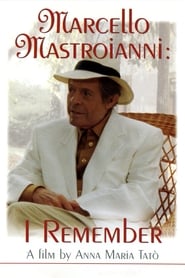
Marcello Mastroianni: I Remember
Marcello Mastroianni - Mi ricordo, sì, io mi ricordo
Download English Subtitle
Release info
Tags
English subtitle preview
The first 200 lines.
I remember, yes. I remember...
We'd see a movie most afternoons.
We'd take a snack along and we'd see two films
plus the coming attractions and Mickey Mouse.
We'd stay from 3:00 until suppertime.
I devoured cinema, as did my whole generation.
The magic, dark, mysterious auditorium.
The projector's beam with the cigarette smoke.
That was a fascinating thing that doesn't exist now.
It was a place for escape.
But more than escape, the cinema let you dream.
Gary Cooper, Errol Flynn, Clark Gable...
Tyrone Power.
We loved those actors.
When we left the theater, we'd imitate them.
After seeing John Wayne in Stagecoach with his gun,
we'd try to copy his walk.
And the actresses...
Try to find their like these days.
Greta Garbo, Marlene Dietrich...
To be honest, I never went for those two.
I appreciated their talent, but at that age, 15 or 16,
I preferred the girl next door.
They were unattainable goddesses.
There were our actors too. Amedeo Nazzari.
Alida Valli. We liked Amedeo Nazzari. He was a fine character.
They called him "Italy's Errol Flynn."
I worked with him. He was very generous.
Anna Magnani, Aldo Fabrizi.
Extraordinary.
And Totò, the magnificent, great Totò.
The French actors, too.
We loved Jean Gabin and Louis Jouvet.
It's odd since, at that age, our obvious heroes
were Gary Cooper, Clark Gable, etc.
French films were more challenging.
But we loved them, too. And a few Germans.
The Axis powers produced films together. I forget the names.
Mr. Mastroianni, we leave in ten minutes.
Thank you, Pedro.
Let's not forget Ginger Rogers and Fred Astaire.
That's the realm of myth.
You could just cry watching Fred Astaire.
He was such a great dancer.
I've always been fond of musicals
and of dancing.
I've always thought that an actor
cannot express himself better than by dancing,
using his body, instead of words,
supported by the music.
I think it's such a thrill for actors to do that.
He tap dances, too?
I myself did a musical once: Ciao Rudy.
I tried to tap dance
and did it again occasionally - In Fellini's Ginger and Fred,
in Ferreri's Bye Bye Monkey in New York.
Originally, it wasn't a dance.
What was it then?
The slave's Morse code.
- A wireless phone. - Here we go...
The slaves couldn't talk in the cotton fields.
If they did talk, the guard...
would have them flayed alive.
So, what did they do?
They talked to their companions in this way.
"Look out, the guard."
"I've got the knife."
"Kill him."
Or...
"I love you."
"So do I."
Lovely, a language of love and death!
Who told you that?
I've always known. I could do a book.
Fifteen years, and in all that time, he never told me.
Pippo, it's so important. It's a lovely story.
I've got goose bumps.
You married couples...
We're not married.
Thanks, it was very interesting.
Kicks...
Spin me around.
- And now? - Again.
- Slow turn. - God, cramp...
That's good.
Tap dance.
How can I describe the beauty of the cinema of that period?
Maybe we were just more naive
and it took very little to enchant and excite us.
If I think of what the cinema,
the big screen, meant to my generation...
I wonder if the cinema today
has a comparable effect on today's young generations.
Or whether they prefer that mini-cinema that I hate:
Television.
Fellini once said, "You know,
we used to watch Marilyn Monroe like this, gigantic.
Now we watch her on the floor, all tiny."
It's different.
Another thing I remember is following elephants
into Cinecittà for the first time.
The procession!
Throw the petals!
Throw the petals! More!
Higher!
Keep the distance!
Keep the same distance!
Slow down!
Forward, like that. Go!
Who's he?
Get down! Down!
Throw them higher!
Turn off the fans!
Cinecittà...
a mythical name, an impregnable fortress.
So many dreams.
Fellini described it perfectly in Intervista.
The blue tram from the station
arrived at Cinecittà.
I did one of Dino Risi's first films called I'll viale della speranza,
all about the Cinecittà tram and us young people full of hope.
I made my first film appearance at the age of 11.
There, too, luck played its hand.
The family of friends of mine, the Di Mauro family...
ran a restaurant inside Cinecittà.
There were three restaurants then:
First, second and third,
for the performers, employees and crews.
For years, Signora Di Mauro got me passes to work as an extra.
You needed a pass to get in.
Pappalardo, the gatekeeper, was a grouchy bear
who wouldn't let anyone in without a pass.
So, I first entered Cinecittà
in a Beniamino Gigli film, Marionette.
The scene was a village grape harvest and I took my mother along.
We stayed up all night,
ate so many grapes I think we were ill the next day,
and at dawn, they gave us 10 lire each.
Basically, it wasn't only a game or a dream of doing this job.
I have to say that it was also the need to earn a little money,
given the conditions.
I don't want to set you weeping.
This was the life of 80 percent of Italians back then,
always chasing after crumbs.
One particular memory moves me...
for its very artlessness
and the way I tormented De Sica.
As a young woman, my mother worked at the Bank of Italy.
Her friend, who also worked there,
was Signora Maria, Vittorio De Sica's sister.
Just imagine. I wanted to be an actor
and occasionally, I'd say, "Let's visit Signora Maria
so she can write a note to her brother."
We'd call on her, drink coffee and all that.
And this woman would patiently write me a note.
"The son of a dear friend..."
I would regularly go to De Sica's set during the break.
"Sir, your sister..."
Each time, De Sica would say, "My boy" - I was 15 at the time -.
"Study, study! You'll see one day. Just study now."
"Thank you, sir."
Three months later, I was back.
This went on for years.
I adored him then and even more once I worked with him.
At the start of my film career, two directors counted a lot.
First Luciano Emmer, with a big hit called Domenica d'agosto,
in which I was a city-dweller alone on a Sunday in summer,
having problems with his pregnant girlfriend...
It was a hit abroad, too.
And Mario Monicelli,
with whom I made Vita da cani.
Monicelli worked with Steno then - Steno and Monicelli...
And a lovely sketch,
perhaps the best sketch in the film Padri e figli
where I was the only "non-father."
I grew fond of a little nephew
who then had to go back to his parents.
Enjoy.
Thanks.
Did the tooth hurt when they pulled it out?
Not at all.
I told you so.
What is it?
What are you doing?
I kept a little to eat with you.
Pull up a seat then.
Want some?
I often worked with Monicelli. Then came the masterpiece:
I compagni.
A film on one of the first ever strikes in Piedmont.
The poor, ignorant workers
urged on and led by a madman, Professor Sinigaglia,
a socialist and idealist.
He was dangerous, because his daydreams
could cause real trouble and even death.
Listen to me, my friends.
Just a second...
We've been forced to strike to defend ourselves.
We make sacrifices and starve.
We're starving too! It's been a month...
Marcello Mastroianni: I Remember subtitles in other languages
Comments
No comments yet. Be the first to leave one.