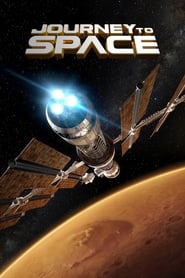
Journey to Space
Download English Subtitle
Release info
Tags
English subtitle preview
The first 200 lines.
We are the species that explores,
that fashions vessels to carry us into the unknown.
We sailed the planet of our birth,
saw its wonders and made it home.
And it wasn't enough.
We built flying machines
to explore higher, faster, farther.
Heroes flew them beyond what once seemed possible.
And it wasn't enough.
In time, we created special craft
that would ferry us to the edge of space and back.
And as always, there were the few...
Brave and brilliant souls...
Ready to guide this vessel through dangers
in the name of discovery.
Using the space shuttle,
we built an unprecedented outpost in the heavens.
We learned in the weightless world
of the International Space Station,
peered into the dark night of an infinite universe.
And it wasn't enough.
Now we are fashioning vessels to set off
on our greatest adventure of exploration ever:
to Mars and beyond.
Who knew that 30 years would go by so quickly?
That these unique spacecraft
would leave in their wake
a public captivated
by their achievements...
a planet poised at the brink
of deep-space exploration.
As an astronaut, I definitely felt
I was saying good-bye to a long-time friend
when the last shuttle landed.
My name is Chris Ferguson.
I was lucky enough to fly on three shuttle missions,
one of them on Endeavour.
So it's no surprise that I wanted to be there
when she was headed for her new home
at the California Science Center in Los Angeles.
From the look of it, you might think it took
as much engineering to get Endeavour
through the streets of L.A. as launching her into orbit.
Watching the orbiter squeeze through the city neighborhoods,
you could feel just how much the shuttle had come to stand for,
almost as if it had taken all of us into space.
I sure don't want the world to forget
this remarkable spacecraft and those who built it,
and the legacy they left,
lighting the way toward our next frontier in space.
They're coming.
The shuttle was the first
reusable piloted spacecraft.
And its engineering and software was so bulletproof,
it could be flown by computers
less powerful than today's smartphones.
Two hundred.
One hundred.
At 235 miles per hour,
the shuttle had the fastest touchdown speed
of any flying vehicle ever built.
When you glide 220,000 pounds of spacecraft
to a no-power landing, the gear hits with a major whomp.
Touchdown.
Conceived in the 1970s
as a kind of winged delivery truck
to build a United States low-Earth-orbit space station...
Give you a payload l.D. of one.
The shuttle actually flew
more than a decade beyond original expectations.
It was the shuttle program that allowed us to do
real ongoing work in space,
to put delicate equipment into orbit and to retrieve
and fix that equipment when things went wrong.
'
Orbiters deployed, retrieved and repaired
over a hundred scientific and communications satellites.
And no missions were more important to our understanding
of deep space than the five flights, beginning in 1993,
made to repair and upgrade the Hubble Space Telescope.
Hubble affirmative.
You have a go for release.
I think history will view the Hubble Space Telescope
as one of the crowning achievements in astronomy.
The Hubble gave us an unprecedented view
of both our closest neighbors
and of galaxies unimaginably far from our own.
Further space telescope investigations have revealed
that the number of Earth-like planets
capable of harboring liquid water
is vastly greater than scientists once calculated.
In 1995, the shuttles began
a new era of international space exploration
when Atlantis docked, for the first time,
with the Russian MIR station.
Eight inches.
One-oh-point-oh-seven.
One-oh-six.
Four inches.
Now. We have capture.
Altogether,
the orbiters made 11 trips to visit Mir.
These missions established a level
of international cooperation and expertise
that continues to this day.
Though MIR no longer orbits Earth,
the shuttle proved itself as a brilliant reusable tool
that allowed us to live, build and do science
in the weightless environment of space.
But the shuttles' truest legacy
crosses the sky above us every 90 minutes.
The International Space Station could never have been built
without the shuttles' payload and space-walk capabilities.
Space shuttles and Russian Soyuz and Proton rockets
made more than 40 flights
to construct the International Space Station...
A true engineering miracle.
All three of my Orbiter missions were to the ISS.
Modules built by NASA partners in Asia,
Europe and North America, came together above Earth,
over a period of 13 years,
to create a floating world
longer than a football field
and with more living space than a six-bedroom house.
A typical ISS mission requires an astronaut
to live six months on board.
But some crew members will spend a year
learning even more about the very real physical
and psychological stresses
of long-term separation from Earth.
These missions and the 15 nations
that designed, built and crew the ISS,
forever changed space exploration
into a cooperative international program
and made a true home and science lab like no other.
ISS system designs and scientific experiments
have spawned a multitude of Earth-useful discoveries,
including breakthroughs
in water purification and robotic microsurgery.
But most important,
the ISS is our springboard to the future,
giving us the knowledge and confidence
to sustain human life as we explore deep space.
Life on ISS is all about getting the job done
and having a little fun.
And nationality is mostly
about tasting each other's food.
Through three decades of camaraderie and dedication,
355 people rode the shuttle into history.
They circled the Earth 21,000 times,
and it all came to seem routine...
until it wasn't.
One minute, 15 seconds.
Velocity 2,900 feet per second.
Altitude nine nautical miles.
Downrange distance seven nautical miles.
This shuttle mission will launch...
My God!
There's been an explosion.
Flight controllers here
looking very carefully at the situation.
Obviously a major malfunction.
In two accidents that stunned the world,
we lost 14 astronauts.
It was a sobering reminder that every space flight
is charged with potential danger.
They had a hunger to explore the universe
and discover its truths.
They wished to serve, and they did.
They were pioneers.
The future doesn't belong to the fainthearted.
It belongs to the brave.
The world mourned, but pushed on,
because the accomplishments of the space shuttle
and the International Space Station
were full of life-changing promise.
In memory of our lost heroes, the global space community
pulled together to reignite the future of both programs.
Who could ask for a better ending to my career
as an astronaut than getting to fly
the last shuttle mission on Atlantis,
and a final visit to the ISS.
Atlantis launch director, air to ground one.
Atlantis go.
And so, for the final time, Fergie, Doug,
Sandy and Rex, good luck, Godspeed,
and have a little fun up there.
We're not ending the journey today, Mike,
we're completing a chapter of a journey that will never end.
You and the thousands of men and women
who gave their hearts, souls and their lives
for the cause of exploration, have rewritten history.
Let's light this fire one more time, Mike.
Though the shuttles no longer fly,
I never miss a chance to see Atlantis
at the Kennedy Space Center.
But I came to KSC to get a look at the next big step
in deep-space exploration, and it's called Orion.
Here, in the giant operations and checkout clean room,
the new Orion multi-purposed crew vehicle
Journey to Space subtitles in other languages
More English subtitles for Journey to Space
- Journey to Space (2015) 4K (Documentary) Patrick Stewart en · 19 downloads · 2025-09-08
- Journey to Space 2015 DOCU 1080p BluRay x264 TrueHD 7 1 Atmos-SWTYBLZ · 36 downloads · 2018-03-06
- Journey to Space 2015 720p BluRay x264-ROVERS · 29 downloads · 2016-06-11
- Journey to Space 2015 720p BluRay x264-ROVERS · 32 downloads · 2016-06-11
Comments
No comments yet. Be the first to leave one.