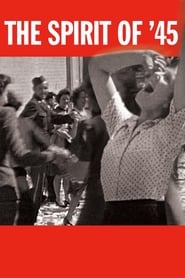
The Spirit of '45
Download English Subtitle
Release info
Tags
English subtitle preview
The first 200 lines.
This is a tremendous moment.
The war is over.
I cry a little.
I think of my dearest friends,
of those men fighting in the services I've known.
Piccadilly was already a seething mass of people.
The hoarding around Eros was crowded with young people,
mainly from the Forces.
People were everywhere.
On shop fronts, up lamp standards, singing and shouting.
I can remember my father taking me to school one day.
There was a house absolutely flat on the floor
and a woman standing outside and saying, "I only washed my windows yesterday."
The nurses' home was hit in 1940.
Then again in 1941, the whole hospital was hit
and it was completely destroyed.
The main surgeon, Mr Grey, he was killed
and quite a few of the doctors and nurses.
And two wards of maternity
with about 50 babies and mothers
and other casualties as well.
I always... Every 3rd of May, I could go over it again.
# When we go strolling in the park at night #
# All the darkness is a boon #
# Who cam if we're without a light #
# They can't black out the moon #
# I see you smiling in the cigarette glow #
# Though the picture fades too soon #
# But I see all... #
# Kiss me once Then kiss me twice #
# Then kiss me once again #
# It's been along, long time #
# Haven't felt like this, my dear #
# Since can't remember when #
# It's been along... #
Underlying our joy and thankfulness,
there is one uneasy question.
What about the future? What will happen now'?
Will we, the people who have won the war,
drive home our victory against fascism
By defeating our pre-war enemies of poverty and unemployment?
I think the expectation was,
'We are not going back to the Britain of the 1930s."
'We're..." It was "never again".
It wasn't only "never again" about war.
It was "never again“ about that kind of peace
where everything was run by rich people
for rich people.
The mood among the people that I was with
was that basically it was them and us.
The officers were on one side of the barrier
and we were on the other side of the barrier.
People were all very much afraid
that what happened after the First World War
would happen after the second, which was enormous poverty and adversity.
I mean, I worked with people in the last war who, basically between the wars,
had gone long periods without any jobs at all.
I don't think people were greedy for a lot of things those days.
They just wanted to live peaceful, have a job,
have children and have a home life.
I think just everybody wanted a good home life with their families, you know.
I was born 87 years ago in the slums of Liverpool
off Great Homer Street,
a street called Mellor Street.
I was one of eight children.
And we slept five in a bed.
In my bed there was three lads and two girls.
We got into bed of a night
with a bed full of vermin.
When I say full of vermin, I mean the bugs.
The fleas were in hundreds in the beds.
And we got in the beds.
There was nothing we could do about it because they were in the building,
behind the wallpaper, in the skirting boards.
And we just got in that bed and lived with them.
And next morning when we went to school,
we would have the cane for having dirty knees.
Every Monday morning,
we were meant to take the bundles up to the pawn shops,
which were in the city area.
And I'd get on the trams
and the tram conductor would say, "Dalgleish is the next stop.“
"Browns. I'll be at Browns giving a good price today, ladies."
And when it got to the terminus, he'd say, "All away, Poverty Park
And it really was a poverty park.
The '30s for me, I can remember quite vividly, was no shoes on my feet.
Having spoonfuls of malt, this horrible malt,
when we went into school to try and stop the rickets.
And coming home from school
and you could smell some food
coming from somewhere.
Then all we used to have was a bowl of com flakes or something like that.
Coming home in the evening, you'd probably have a big, big plate
full of swedes and potatoes with no meat.
They didn't have a carpet on the floor.
And when we used to visit, they'd scrubbed the floorboards.
And if they'd just scrubbed the floorboards,
they actually literally had paper down on the floor.
My grandfather's suit had to go
into the pawn shop on the Monday,
in order that they had some money not only to live,
but also for the youngest son, vino had a kidney complaint,
to pay for his doctor's fees.
Then they'd get it out again when he got his money on a Friday,
so that he could wear his suit to go to the pub.
Bread and jam was the usual thing they had.
They talk about bread and dripping.
You had to have beef to make dripping,
so the chances of having dripping were remote.
It was more often than not bread and jam.
In our house there was three children died
between the ages of...
...two and four.
Two died at the same time.
And I can recall
putting two coffins across our knees in a one-horse coach...
...and the one-horse coach taking us to the cemetery.
And as I recall,
them two coffins went on top of other coffins at the cemetery.
The other thing I can remember about the '30s
was the long periods
when, because of the militancy, they closed the pit down altogether
and we had to go picking coal off the tips.
My grandfather and my father,
when they heard the steam engine,
the steam train passing, they would come out to the back of the house
to count the number of trucks that were going up to the colliery
because with that knowledge they would know then
whether they had work for a day or two or for the week.
They used to call it the umbrella pit
because it was constantly opening and closing.
My father took me down to see the dole queue in Liverpool
and then he walked me the full length of it.
Then he walked me back so I could see all their faces.
And he said, “Now, remember that."
"Remember that and don't let it happen in your day.“
And I was ten.
We went to all the meetings in those days.
They were mostly out in parks or street corners.
And I got quite used to it,
so I was really pretty well educated as regards politics.
What really matters
is who controls industry
and the result of industry.
Hear, hear.
This rubbish about the banking system is the greatest.
Hear, hear.
You don't make money, you don't make wealth
by passing bits of paper to one another.
Close up the ranks. Fall in.
Join the great army of the children of the night
marching to the conquest of the future.
Marching to build Jerusalem
in England's green and pleasant land.
I was 25 years of age...
...when I read my first book, The Ragged-Trousered Philanthropists.
It just completely changed my life.
I couldn't sleep after reading The Ragged-Trousered Philanthropists.
I just thought, what fools everyone are.
How we've all been taken in and we're still being taken in.
We're just sucked into a false life of what it's all about.
When we were living in the slums off Great Homer Street,
we were the greatest empire in the world.
We had India, Africa, Canada, Australia.
The greatest empire in the world.
We were living in the worst slums in Europe.
My dad used to take an orange box round to the docks
and urge the dockers
to join a union, to band together with all the other...
"You'll never get anywhere if you don't."
"You've got to be solid." You know.
I was quite proud to go with him.
I could hear the men saying, "It's Johnny and the kid."
So I was quite proud to be the kid with Johnny.
Well, I've been thinking about the gaps between the houses.
What comes down has to go up again, you know.
Not like it used to be, I hope. Not with all those slums and tenements.
That's just the point.
We've got to see that the job's done decently this time.
Ya, but how? Do you think we can do anything about it?
Well, why not? If we can work together now
to look after the lives of the people here,
I don't see why we couldn't work together afterwards to clear up the mess
and help build a better world in which these things can't possibly happen.
I'll second that.
It's people like us that have been doing the work of the war,
and it's people like us that are going to do the work of the peace.
My mind goes back to a meeting we had in a troop ship.
Then one lad got up.
He said, "In the '30s, we had mass unemployment."
He said, "We don't have unemployment in wartime."
He said, "if you can have full employment killing Germans,
why can't you have full employment
building homes, building houses,
building schools, recruiting teachers,
recruiting nurses, recruiting doctors?"
And that argument registered.
We're starting something called ABCA.
We're going to have an hour's discussion every week on current affairs.
And it's going to come out of working time.
The Spirit of '45 subtitles in other languages
More English subtitles for The Spirit of '45
- The Spirit of 45 2013 DVDRip XviD-GxP · 53 downloads · 2013-07-07
Comments
No comments yet. Be the first to leave one.