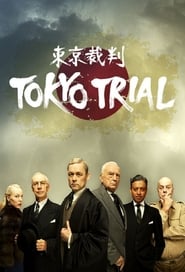
Tokyo Trial
Download English Subtitle
Release info
Tags
English subtitle preview
The first 200 lines.
Between the 1930s and 1940s,
Japan sends troops to the Chinese mainland,
across Southeast Asia, and into the Pacific Islands...
to engage in warfare that ultimately leaves tens of millions of people dead.
On September 2nd, 1945,
Japan signs the Instrument of Surrender to end the war.
The Allied powers appoint General Douglas MacArthur
as supreme commander
and quickly occupy all of Japan.
Former Japanese cabinet ministers and military leaders are arrested.
In November of the same year, leaders from Nazi Germany,
Japan's ally in the war, go on trial in Nuremberg.
In January, 1946, using Nuremberg as a reference,
Supreme Commander MacArthur enacts a charter for the Tokyo Trial
that outlines three categories of war crimes.
These are crimes against peace,
conventional war crimes,
and crimes against humanity.
Twenty-eight former Japanese leaders are then charged as class A war criminals.
The Tokyo Trial begins.
"My dearest Lies...
It was a long journey from the Netherlands to Tokyo,
but I am safe and settled into the magnificent Imperial Hotel.
It's a miracle the hotel is even standing.
From here to Yokohama,
there's nothing much left but ashes and ruins.
The hardships faced by the people here are almost unimaginable.
Soon, we will begin the difficult task
of searching out justice amid the devastation and chaos.
The tribunal is being led by Justice William Webb,
an Australian appointed by General MacArthur,
the supreme commander.
Most of the other judges have arrived and are staying at the hotel.
We are all men of different birth places, backgrounds
and, I suppose, different ideas.
Justice McDougall is a trusted friend of the Canadian prime minister.
Even though Chiang Kai-shek is now fighting the communist army,
his administration appointed Justice Mei to represent China.
Justice Northcroft was a Supreme Court judge in New Zealand.
Justice Higgins from the Superior Court in Massachusetts
is the American appointment to our tribunal.
The French have appointed Justice Bernard,
who fought and served as a justice in their African colonies.
General Zaryanov, who represents the Soviet Union,
is a loyal subordinate to Stalin.
Lord Patrick, a Scottish Justice,
was chosen to represent the United Kingdom.
He is due to arrive any moment,
and I am eager to meet him.
My love to you and all of the children."
William Patrick.
Lord Patrick?
I'm Justice Röling from the Netherlands. Very nice to meet you.
Justice Röling. A pleasure.
So it was quite a long trip, isn't it?
Quite.
What's the commotion?
Oh, that's Sir William Webb from Australia.
He's our tribunal president.
No more bloodshed to cover,
these reporters try to stir up trouble in other ways.
Why did General MacArthur choose you as the president of the tribunal?
Give us the goods.
Well, you'd better ask the General that one, boys...
if you can get him to talk to you.
I would have thought he'd pick up an American or even a British judge.
All my colleagues are fine jurists.
But Australia is a Pacific country.
We fought the Japanese right to our own shores.
That has to count for something.
How long do you expect the trial to last?
Six months.
That long?
We are making history, gentlemen. And that takes time.
Good day to you.
"Making history."
Um... I am Justice Bernard, uh, from France.
Gentlemen... and lady.
For those of you who have not met him,
may I introduce Mr. Justice Northcroft from New Zealand.
He will also be serving as my acting president.
This grand building will be our working space
for the duration of the tribunal.
Follow me, please.
I'm Higgins from Massachusetts.
Has the General been to Massachusetts?
The General does not like to visit the places
with the names he cannot spell.
Uh, this building once housed the Japanese Military Academy
and the War Ministry.
Some of the accused would've planned their attacks
right here in this room.
Now, we will use it to decide their fate.
Uh, the General says you all share a great responsibility.
As individual judges in our own countries,
we decide the fate of others.
From divorce to fraud to murder.
But the issues we face on this stage are extremely complex...
and will require our collective skills and experience.
You've all been briefed in advance,
and you have all read the charter that governs our duties.
However, please indulge me
as I take us through a summary of the challenge ahead.
It falls upon us, uh, to deal with three categories of crime.
The most striking of which is crimes against peace,
more frequently referred to as crimes of aggression.
We are being asked whether or not these leaders
conspired to plan and wage aggressive war.
We are also being asked to consider crimes against humanity.
They include murder, extermination, enslavement, deportation,
and other inequities, including...
uh, crimes committed by a power on its own citizens.
Finally, we have to consider conventional...
war crimes.
That is...
ill treatment of prisoners of war
and atrocities committed on the battlefield.
In other words, crimes that violate the traditional rules of war.
In China, millions of people were killed, most of them civilians.
I sympathize with your countrymen, Justice Mei,
as I do with the soldiers and civilians of all our nations.
However, we must be careful as we tread a fine line between justice and revenge.
I wasn't thinking of revenge.
I was referring to the fact that the atrocities in China
are grave crimes under international law.
With respect to Justice Mei, aside from courtroom blueprints,
Nuremberg clearly provides us with strong legal precedents to uphold.
Oh, there are many differences between events in Europe
and those here in the Pacific.
It seems to me the crimes are the same.
The whole world will be following this trial,
and every argument and decision we make.
All the more reason to uphold the precedents of Nuremberg.
Yes.
As I was saying, we face an immense challenge.
I am confident we will find a way through it.
How very tragic that China should've reengaged in civil war.
Yes, uh, heartbreaking waste of lives.
Some of my family are missing.
I'm so sorry.
I believe you play the violin, Justice Röling.
- Somebody complained already? - Not at all.
I heard music in the hall.
Perhaps you'll play for the rest of us some evening.
Oh, only after you've all had plenty to drink.
Our courtroom.
Designed to replicate the one being used to try the Nazis in Nuremberg.
This evening there will be a screening of the film about the Nuremberg Trial
in the hotel cinema,
for those of you who want to attend.
Nationalistic pride
turned a blind eye towards the horrors of these concentration camps.
As the corpses continue to be counted,
this grim footage was entered into evidence in Nuremberg,
where 24 political and military leaders of the Third Reich
are tried for war crimes and for crimes against humanity.
Some of my colleagues on the Utrecht Court were taken away.
All of them Jewish.
I saw a lot of horrors in World War I.
Nothing quite like tonight.
That is why I consider this tribunal to be so important.
Japan occupied Asia-Pacific, all the way from China...
- to here... - Mmm-hmm.
To Dutch East Indies.
Overtaken early in the war for strategic purposes.
Are those natural resources?
Yeah, oil and rubber.
- Oh, precisely. - Mmm.
Because of Japan's occupation in China and Indochina,
as well as its relationship with the fascists in Germany and Italy,
the United States and others
had placed an embargo on them before the war.
Japan has no natural oil resources.
Therefore, Indonesia became an important target.
Hmm.
Some of my wife's family were there at the time.
They were forced into Japanese prison camps.
Gentlemen, please join us.
Twenty-eight men have been accused of war crimes.
Now, these men are made up of military leaders,
politicians and others who may have influenced them.
The jurisdiction of the trial,
the period we're interested in,
starts with the Pact of Paris in 1928
and ends with Japan's surrender in 1945.
I open the floor for discussion.
I have, um, one question.
How was the list of the accused constructed?
A team of prosecutors combed through the Japanese documents,
intercepts and the accounts of expert witnesses.
Considering that Japan has had 17 prime ministers in the last 15 years
and that, as soon as the war ended,
the Japanese burned many of their documents,
the list must have been hard work.
Do you have a particular point you wish to make, Justice Röling?
It all looks rather arbitrary.
And then, suddenly, two new names have been added at the bottom.
On what grounds?
Uh, Justice Zaryanov can answer that.
Uh, Shigemitsu participated in Japan's conspiracy
Tokyo Trial subtitles in other languages
More English subtitles for Tokyo Trial
- tokyo trial s01e04 720p WEBRip x264-RARBG · 51 downloads · 2017-02-22
- tokyo trial s01e02 720p WEBRip x264-RARBG · 88 downloads · 2017-02-21
- tokyo trial s01e03 720p WEBRip x264-RARBG · 50 downloads · 2017-02-21
Comments
No comments yet. Be the first to leave one.