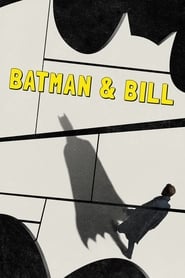
Batman & Bill
Download English Subtitle
Release info
Tags
English subtitle preview
The first 200 lines.
Good morning, guys.
Good morning.
Have you heard of Batman?
Yes.
Just checking and just kidding.
Of course you've heard of Batman.
So I have had the honor
of getting invited to speak all over the world
to tell the story that you're about to hear.
And everywhere I go, whether it's Tanzania in Africa
or Chile in South America
or Hong Kong or Thailand
or the United Arab Emirates,
everywhere I go, I show that symbol,
and I have not been to a school
anywhere in the world where someone doesn't know it.
Now don't worry if you're not interested in superheroes
because I've done this many times,
and I can guarantee everyone here, including staff,
that you will walk out of this room in an hour
with a different perspective
than you have right now, I guarantee it.
On every Batman story since the first in 1939,
there was only one name in the credit line.
"Batman created by Bob Kane."
Here he is.
And here's the thing about that credit line:
It is not true.
The reason I do explain why
that I like superheroes is a little bit pat,
and it maybe is a little bit disingenuous
because I wasn't thinking like this as a kid.
But I do like stories of selflessness
and I like stories of sacrifice,
and superheroes sacrifice something on a daily basis.
Superheroes are not doing this to get paid or praised,
and it is not about them.
They are doing something for the greater good,
then they disappear into the night.
The notion of that is so rare in real life.
I mean, we know so few people
that can afford to be selfless.
As a six-year-old, I wasn't thinking like that,
even as a 12- or 15-year-old.
I just liked a good story, a good adventure, and I still do,
so it was a combination of those things,
this purity of purpose
and then just a great cliff-hanging, rollicking adventure.
_
Here is the Batman section.
One, two, three, four full... almost full shelves.
And compare that to... Superman.
Not knocking Superman, but just looking at the reality.
Here's Superman up to about there.
Batman is not only the most identifiable
and recognizable and famous and beloved superhero,
but he is one of the most recognizable
fictional characters of all time.
Can take almost any Batman book off the shelf
and open to the title page.
"Batman created by Bob Kane."
Bob, for the few people who come from another planet,
who may not know what you do,
what is it that you're known for?
- You've got to be kidding. - I am, of course.
Bob Kane is the original cartoonist of Batman
and the man who has been credited on Batman
for most of Batman's history.
When I was 18, I tripped across a character called Batman.
Bat... how do you pronounce that?
- Batman? - B-A-T-man.
It was called "Batman by Robert Kane."
In 1938, two gangly kids from Cleveland, Ohio
sold an idea for a character named Superman.
Superman was a huge influence on Bob Kane,
not the creative side, the financial side.
So I thought of, yeah,
"How much money is Siegel and Shuster making?"
They were the creators of Superman.
And in those days, in '39,
they were making $800 apiece a week.
When Bob Kane found out how much money
the Superman creators were making on a weekly basis
which was $800 at the time,
he went to an editor at National.
He said, "Listen, Bob, can you do another superhero?"
I said, "For that kind of money, you'll have it on Monday."
For that kind of money, you'd be the superhero.
Boy, you better believe it. I'll steal it somewhere.
And I went home, and lo and behold
I thought about all my childhood heroes
when I was a kid and my world of fantasy.
And on Monday, I came up with
a very crude drawing of Batman.
And the rest is history that Batman...
Batman is my claim to infamy.
Well, like most adults that like superheroes,
my interest started when I was a kid.
I just never outgrew it.
And that began a passion that I had most of my life.
I had a little gap in adolescence
when I had to distance myself from things
that could get in the way of girls and life,
but for the most part, I've stuck
with superheroes my whole life.
I am an author of books for young people,
and some of them are books for all ages.
And I've written about 75 books.
This is my first-ever book.
The Felix Activity Book.
Tour de force, I'm sure you remember it well from 1996.
And then here's the epic sequel,
Felix Explores our World.
I think the recurring theme of my nonfiction is untold stories.
Boys of Steel.
Biography of Jerry Siegel and Joe Shuster,
creators of Superman.
There are sometimes tragic stories
behind these iconic characters.
Marc loves to bring out the story behind a story,
so he goes deep, and he's also very persistent also
as a human being.
You got two toothpastes because you didn't know
if I wanted fluoride or not?
- Yeah. - Because they just announced
that fluoride is a toxin now.
I know that.
I told you all along.
It's in the water, it's in the toothpaste.
No, I know it's there, but that doesn't mean
- it's a toxin. - Oh, you're filming us?
I definitely feel sometimes
that I'm not only married to a writer,
but also even more so a detective.
When I decided to write a book
on the story behind Batman, it hadn't been done yet.
Whenever you start a research project,
you can't possibly know how much
or how little you're going to find.
In this case, I was going into the Batman book
knowing that there were secrets
that hadn't been widely discussed,
but I had no way to know it was a lot more than that.
So this story, for me,
was uncovering a big superhero secret
that should have been blown wide decades ago.
In New York in 1965, was the first official Comic Con,
and the reason that this is considered the first official Comic Con
is because it was the first time that professionals showed up,
not just fans in a hotel basement with some back issues.
This was historic, this was a big deal.
They didn't know it at the time, but it was a big deal.
There were 200 of us at that Comic Con.
And this place was so sketchy.
And we got there, and my mother freaked
when she saw where we were.
There was literally a guy drunk, unconscious
on the floor in the lobby,
and roaches on the walls, and she just said,
"We're out of here, we're leaving."
The hotel itself, a few months later, actually, much of it collapsed.
Luckily, it didn't do so while we were in there,
but none of us was particularly surprised
to hear that the Broadway Central had collapsed.
My mom finally said, "Okay, we'll stay,
and you can go up to this comic book convention,
but don't touch anything."
And as we went through the bar,
we saw Otto Binder sitting there at the bar
with another guy drinking.
And we go in and we sit down on the stools.
And he goes, "What are you boys drinking?"
We ordered our Cokes.
And Otto turns to me and Bob,
he said, "Boys, how would you like to meet
the creator of Batman?"
And, like, our jaws dropped, our eyes had to be wide open,
and we figured we were going to meet Bob Kane,
which was the only name we ever saw
on a comic book, it was always in a box with a big "O" for Bob.
And Otto said, "Fellas, meet Bill Finger."
So in 1965 at this Comic Con, in this dingy hotel in New York,
Bill Finger made what is probably his first
and maybe his only public appearance,
and he appeared on a panel with three other comics' creators.
At this panel, Bill was introduced
by the moderator whose name was Jerry Bails.
And perhaps we'll hear some...
Jerry was the fan, who in 1964 or so,
figured out that it could not be
just this one guy, Bob Kane, writing and drawing
every Batman story every month.
So Jerry did some detective work of his own.
He wrote letters to DC Comics saying, "Who's really doing all this?"
And in those days, companies would write you back
with a personal letter.
And the name that he saw more than any other
was Bill Finger.
So in 1965, Jerry wrote a two-page article which was called
"If the Truth Be Known, or A Finger in Every Plot!"
Batman & Bill subtitles in other languages
More English subtitles for Batman & Bill
- Batman and Bill 2017 2160p HULU WEBRip x265 10bit SDR DTS-HD MA 5 1-TEPES · 34 downloads · 2021-05-18
- Batman and Bill 2017 720p BluRay x264-GETiT · 60 downloads · 2020-03-31
- Batman and Bill 2017 720p WEBRip x264-GH7JKB6 · 62 downloads · 2017-12-22
Comments
No comments yet. Be the first to leave one.