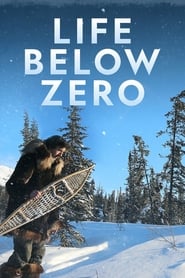
Life Below Zero
Download English Subtitle
English subtitle preview
The first 200 lines.
So I'm going through my woodpiles here.
I'm trying to find some nice lumber.
I've decided I'm gonna build myself an iceboat,
so I can go sailing out on the frozen lake.
We haven't gotten much snow.
What you see right here,
that's the extent of all of our snow so far this fall.
It's been a crazy year.
I'm having a really hard time trying to get some exercise,
get some miles on my dogs.
It's not easy maintaining a kennel of dogs,
but it's also your lifeline,
and it's the thing that provides me with transportation and food
and access to hundreds of miles of country
that I can collect wood in, I can go trapping in.
And so I'm gonna build an iceboat.
I always wanted to have a little iceboat
so I could go sailing out on this lake.
I'm pretty landlocked in.
The Yukon River's flowing ice goes all the way around me.
So I've basically got four miles of trail I can run.
Unfortunately, the four miles of trail, there's no snow on it.
Getting out with dogs, mushing nearly impossible.
Very dangerous to do.
Nothing to cushion your fall
if you take a bad spill on the sled.
Something happens to me out here, I'm on my own.
Nobody's gonna come looking for me for a month or two.
Never built an iceboat before.
I've built a kayak, I've built a wooden boat.
Lots of houses and things like that,
but I've never built an iceboat.
I'm just gonna get a whole bunch of lumber
that looks fairly good, get it into my shop,
and then I'm gonna just start trying
to do some assembly here.
The most important board
is gonna be this crosspiece right here.
It's eight foot long from there to there.
With all my weight right back in here in the center,
so I have to make sure I have a really high quality board
for that one board.
If that fails, then the whole project just goes to crap.
So I'm gonna go ahead and cut that one first.
Hey, there's my eight-footer.
I'm making the runners right now for the three skis.
They're made out of stainless steel angle iron.
Ford Lake is about a mile long, about a half-mile wide.
It's a fairly good-sized lake.
It blows really hard there all the time.
That's what kind of got me the idea of building this iceboat.
What research I've learned about these iceboats
is they can go five to seven times the speed of the wind,
so if I get a 10-mile-an-hour wind,
I could potentially go 60, 70 miles an hour.
I'm making pretty good progress.
I need to get this runner in place.
I mean, if this thing's going 40 or 50 miles an hour,
there's a lot of stress on these skis.
So that's feeling pretty tight that way.
Snug this up nice and tight.
You got skis on.
Okay.
I think that'll be a good start for tonight.
These kinds of temperatures are nothing to fool with.
It bites, it hurts, it snaps like a frickin' wolf.
Ay, ay, ay! The weather's coming at me.
Alright.
I've still got some daylight, although it's getting less,
so it is time to get out into the shop, get the Bobcat,
if it will start in these temperatures,
crank it over, grab the drag,
and see what's the longest stretch
with the least amount of issues for a plane to land in the dark,
with the flare pots in an urgent and non-urgent situation.
Kavik is now a designated airport.
What does that mean?
Nighttime landings year round.
If search and rescue says we're coming in,
I have to be ready for it.
I am just on the cusp of being 24-hour darkness.
That means planes are gonna take off and land in the darkness.
For people to land here safely in the dark,
I need to be able to light a section of the runway up.
I have things called flare pots.
It's sort of like a teapot with a lid.
Once I light it,
you've got 8 to 10 hours of this orange flame.
You can see a yellow flickering light from 50 miles away.
As a designated runway,
I have to get this system up and running
so that when you have an emergency
and your plane's dropping out on you,
a pilot can pick this out and go, boom, safety.
Alright.
Got this little dude here.
This is my flat drag.
This is an old tongue of the trailer,
modified it a little bit.
Took a little bit of the nubs off, and it's a flat drag.
You've got to come up
with tundra engineering out here, man.
This is a Sue fix.
Here we go.
Alright, now for me, what I'm gonna do is just simply pull out
and go up and down the runway,
knocking anything that might be in the way down.
The whole purpose of Kavik is safety and protection.
I've got to have it flat, and I've got to be able
to put my little pots, my little flames, on the sides.
I do see myself as a warden of the area.
I take other people's safety into consideration
with far greater care than my own.
It makes me recognize I'm on the right path for who I want to be,
to make sure that I help people.
To make sure that the job I do
is the best that I could do every day.
And sometimes your best is just being able to put on pants
and brush your hair.
You're not always a rock star every day,
sometimes you get to be the groupie.
The runway is looking pretty good.
But the vegetation is growing taller than it ever has.
That means I'm getting drifts where they never have been.
A plane lands and runs into this,
it's gonna do that and kill everybody on board.
I need to get my axes, quack, quack,
get the ones out that I need out,
go back in, start gathering my flare pots.
If I want to keep people safe,
I just got to get my booty out there to do it.
Dog team is not like a snow machine.
Snow machine, you never take it further
than you can walk back out,
because it's probably gonna break down on you.
Another beautiful morning here in paradise.
I'm packing up my sled.
I'm getting ready to head out for three days
to a lake in the Alaska Range.
Temperatures are dropping. It's getting cold.
This is a good time to get out there.
I'm gonna try to do some ptarmigan hunting
and some camping with my five best dogs here.
Jessie Holmes and his sled dogs
have carved out their existence along the Nenana River
with the area's resources.
To survive dark winter,
Jessie and the dogs must constantly scout new territory
and hone their skills in the wild.
It's gonna be cold, so I got to, like, have everything
that I'm gonna need in my sled to survive for a few days.
I won't have the security of a cabin,
so all the things that I take in my sled
are super critical to me being able to care for myself
and my dogs out there.
I don't plan on bringing a lot of food.
I plan on getting my food off the land while I'm there,
and that'll give me something or a good reason
to be out there testing my survival skills
in the cold temperatures.
I feel that surviving in the cold is like a knife.
It gets dull sometimes,
you got to take it out and you got to keep it sharp.
You got to keep your skills polished here.
So when I go out there for three nights,
and I just got me and my dogs and what I got in this sled,
I have to survive out of that.
Checking everything over in my mind right now,
making sure that I got everything
I'm gonna need out there.
I want my gun easily accessible in case I see something.
I'm always a little nervous going into situations like this
because I know what can happen.
You don't think about the best, you think about the worst,
and you prepare for it.
Who's ready to go? Huh? Who's ready to go camping?
Alright.
I'm leaving the comfort of my warm, cozy cabin behind,
heading out into the remote wilderness
to test my survival skills.
This isn't your average camping trip.
Most people don't go out camping when it's 30, 40 below.
When I'm in dog races, I could be out there for up to 10 days,
in extreme temperatures of 50 below zero.
So it's essential that I am able to survive
in those kind of conditions and keep that skill set up.
This just adds to my confidence
that I can always go and push through the storm.
I need to make sure I got a good place to camp,
because it's getting dark.
It's cold out.
I want to be nice and settled in
and know where I'm gonna be sleeping tonight.
Straight, straight.
Straight ahead.
Alright, Flash, straight ahead, straight ahead.
Straight on up in there. Straight on up in there. Good!
Alright, whoa, stay.
Right here under this big spruce tree
looks like a good spot to camp.
Life Below Zero subtitles in other languages
More English subtitles for Life Below Zero
- Life Below Zero First Season · 86 downloads · 2019-10-08
- Life Below Zero S10 1080p WEB H264-EDHD · 23 downloads · 2018-09-03
- Life Below Zero S10E08 1080p WEB H264-EDHD · 21 downloads · 2018-09-03
- Life Below Zero S10E07 1080p WEB H264-EDHD · 15 downloads · 2018-09-03
- Life Below Zero S10E06 1080p WEB H264-EDHD · 13 downloads · 2018-09-03
- Life Below Zero S10E05 1080p WEB H264-EDHD · 15 downloads · 2018-09-03
- Life Below Zero S10E04 1080p WEB H264-EDHD · 14 downloads · 2018-09-03
- Life Below Zero S10E03 1080p WEB H264-EDHD · 13 downloads · 2018-09-03
Comments
No comments yet. Be the first to leave one.