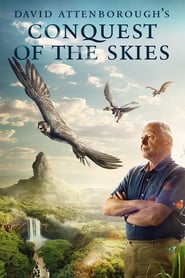
David Attenborough's Conquest of the Skies
Download English Subtitle
Release info
Tags
English subtitle preview
The first 200 lines.
We human beings are very latecomers to the skies,
and although we might think that we now pretty good at this,
the Natural World, with the help of several million years of evolution,
has produce a dazzling range of aeronauts whose talents are far beyond our.
The story of how animals manage to colonise the air is truly astonishing.
First into the skies were Insects,
they initially had two pairs of wings
which in due course were modified in many different ways.
But after having had the skies for themselves for about 100 million years,
a new group of animals took to the air,
Vertebrates. creatures with backbones.
They faced a different challenge, for their bodies were much bigger and heavier.
But eventually they evolve several ways of solving that problem.
We will travel the globe to trace the details
of the extraordinary skills of the backbone flyers.
~ Conquest Of The Skies ~
RIVALS
This is Borneo.
And here there are still great tracks of pristine rainforest.
Forest that is wonderfully rich in animals of all kinds.
I'm being winch up into one of the tallest trees here,
in search of a creature that can give us a hint
of how backbone animals first took to the air.
Hidden among these leafs of this fern, high up here in the canopy,
is a very remarkable little frog.
It's a Harlequin Tree Frog, and it a very-very good climber.
It spend most of its life up here, clumping around in the branches.
Here it's away from the numerous predators there are,
that might attack it down on the forest floor.
But if in fact, a predator were able to get up here, to hunt it,
a snake perhaps, well, the Tree Frog has a remarkable trick for defense.
It glides.
It has membranes between greater elongated toes,
so that each foot becomes a parachute which slow the frog descent,
and so enable it to make a relatively safe landing.
The Vertebrates made their first forage into the air around 260 million years ago,
and it very likely that some of these pioneers use skinny membranes
to control their falls in much the same way as this little frog does.
It has to be said that is not a very good aerial navigator,
it seems that it just jumps and hopes for the best.
But there are animals up here, that glide around from tree to tree,
which are very good navigators indeed,
so good in fact, that they can go from one tree to another
and never go down to the ground in their entire life.
One of them is a little lizard called Draco.
Each male has his own little territory in the branches,
and tries to attract females and warn off rivals by flashing his dewlap.
He also spread colored flaps of skin from his flanks,
that when fully extended do more or less the same thing.
But there are predators among the branches.
Snakes also live up here, and they hunt Lizards.
But Draco side flaps now serve another purpose.
He uses them to glide by hinging forward a specially elongated ribs.
And he so skilled in the air that he can steer land
on the trunk of his choice.
So, if you live up in the branches it's less laborious,
and indeed, safer to travel by air, than to come down to the ground.
But if you want to be a true flyer, you have to be able to fly
not only downwards but upwards, you have to have powered flight.
This is another reptile,
and one with even greater flying abilities than that little gliding lizard.
Today, sadly, it's extinct.
This is Dimorphodon, we can deduce from its fossils
that he had the muscles needed to beat its wings.
And computer imagery can show us what he must was look like.
Dimorphodon was one of the first large animals ever to travel by air,
200 million years ago.
It belong to a group called the Pterosaurs, The Winged Reptiles.
It was probably a forest dweller and it descendant of a tree living glider.
This gliding ancestor might have had wings like those of Draco,
that was made of skin, and perhaps extended from its fingers down to its ankles.
But Pterosaurs have evolved larger wings with a hugely elongated fourth finger.
The wing membrane was strengthen internally by thin rods of a stiffer tissue.
They were muscles fibers too, that enable it to modified its contours as it flew.
Looking at the wings insection revealed a secret of their efficiency.
They have a rounded front edge and a sharp back edge,
a shape known as an aerofoil.
It's works by forcing the air flowing above the wing, to speed up.
This faster air has a lower pressure, and the wing is suck upwards.
The larger the surface area of the wing, the greater lift it can produce.
So, it seem certain that Pterosaurs were very competent flyers.
And judging from their teeth, it's seem likely that many fed on the great variety of Insects
that had preceded them into the air.
Insects have had the skies to themselves for around 100 million years.
Now, bigger creatures had arrived. Reptiles.
The Pterosaurs design for flight proved hugely successful,
they use that new powers to spread beyond the forests
and colonize whole new environments.
A great number of them lived and fed near water.
We know this because fossils of many species
occur in rocks that was once mud at the bottom of lakes and shallow seas.
This one shows the skeleton of little animal that 150 million years ago
fell to the bottom of a shallow lagoon.
This is its head, here is its backbone,
tail, hind legs,
and here stretching from these long extended finger bones are its wings.
And this fossil is particularly remarkable,
because it show an impression of the membrane in extraordinary detail.
You can see every little tiny fold.
You can judge how an animal lived by its skull.
And this one, have these long jaws,
with forward pointing teeth, and we think that this indicates
that it lived by skimming across the surface of the lagoon,
and snatching up fish with impaled on those teeth.
This, very different one, it's just the head.
As you can see has very long jaws
and on the tip of the lower one is this little tuft of very fine filaments.
We know from other specimens that these filaments
originally stretch right along the entire jaw.
This bristely fringe enable the creature to filter feed, taking in a beak full of water,
expelling it through the bristles with the beak half closed
and then swallowing what the bristles retained.
And here's is a skull of a very much bigger species from Brazil.
And it had neither teeth nor bristles in this jaws.
But microscopic examination of the surface of the bone here
reveals very tiny little blood vessels
and that suggests that this jaw was once covered with horny beak.
So maybe this animal used it's beak like the forceps
to pick up small little reptiles or maybe catch dragonflies in the air.
This particular skull reveals something else about the lifestyle of this specimen.
Because of the back of the scull it has this great flange.
And Pterosaur from other species
have been found some with such flanges but others without.
So it's tought that maybe this was the difference between sexes.
Maybe was the male that had this big flanges backwards to display them.
Maybe was covered with the skin. We can only guess.
Many different pterosaurus species evolved these headcrusts
and seems very likely that they were colored.
This spectacular example is known as Tapejara.
And it made it's home beside inland lakes.
But Pterosaurs diversify another ways too. Some evolved much larger bodies.
This species had a wingspan of over 20 feet, 7 meters.
But not all Pterosaurs lived in the forests or near water.
An open arid landscape like this one, was the likely home
of one of the most extraordinary.
Around 70 million years ago a pterosaur appeared
that was of truly colossal proportions.
That was one of the largest creatures that had ever flown,
it was in the size of a small aeroplane, and it was called Quetzalcoatlus.
Its immense wingspan allowed it to ride on the currents of warm air
that rise up from sun heated land.
It could then glide great distances, searching for food.
Small creatures like lizards, or the dead bodies of much larger ones, Dinosaurs.
But the Pterosaurs, with their wings of toughen skin
weren't the only group of reptiles to make it into those ancient skies.
About 150 million years ago, another reptilian group appeared
on the Planet that also flew.
Like most reptiles, including Pterosaurs,
these creatures began their lives inside an egg.
But they had evolved a revolutionary new design for flight.
One that would usher in a remarkable fresh chapter in our story.
And unlike the Pterosaurs, they still with us today.
There are of course the Birds.
Some today can provide clues about how their ancestors
manage to get into the air.
This is the chick of a bird found in farmyards everywhere.
A Bantam Hen.
And at this very early stage in its life, it can show us something very interesting
about the origin of that crucial piece of flying equipment. A feather.
Its feathers are downy, that to say they made up of simple filaments,
and their function is not for flight, but insulation,
to keep this little creature warm.
And back in the Jurassic period, long before the arrival of True Birds,
very similar looking feathers appeared on very different animals.
Reptiles. Dinosaurs if to be precise.
To find evidence for that astonishing statement,
which not so long ago was highly controversial, we heading for China.
Northeast of China's Great Wall, near the borders of Mongolia,
lies the chilly province of Liaoning.
Here, there are great areas of rocks that was lay down as mud
in the bottom of immense fresh water lakes.
The bodies of animals that was swept down into these lakes
was slowly entombed by the fine grains sediment
that preserved them entire and in exquisite detail.
And from these rocks have come specimens
that solve one of the most hotly debated of evolutionary arguments.
The origin of the Birds.
The key specimens are now in Beijing,
where they been delicately prepared under the microscope.
They have been studied here by one of the world greatest Dinosaurs experts,
professor Xing Xu.
First, he showed me one of his oldest specimens, part of a Dinosaur arm.
But thanks to the finest of the mud of those ancient lakes,
there is more here than just bones.
You see here, this species it called a Beipiaosaurus,
So, because this is a very not like us, two or three meters long,
so quite a big animal. And here is an arm, hand, you see here...
dark filamentous structures... - Yes.
along that arms and hand, they are actually primitive feathers.
And those feathers very simple, very simple,
so we believed they represent the very primitive stage for feather evolution.
These simple strands were made of the same material as the feathers of today Birds.
They were relatively thick and must have been quite stiff,
so they would of stuck out beyond the dinosaur arm.
Behind them, were shorter strands that covered its all body.
Like the down on the chick, these might have kept the dinosaur warm.
But those long strands most likely had a different function.
Clues to what that might have been can be found on an even more extraordinary fossil.
These claws and finger bones belong to a creature called Caudipteryx.
The long dark shapes around them are the remains of feathers.
David Attenborough's Conquest of the Skies subtitles in other languages
More English subtitles for David Attenborough's Conquest of the Skies
- David Attenborough's Conquest of the Skies, SEASON 1 1080p x265 [23 976 FPS] · 25 downloads · 2026-06-04
- David Attenboroughs Conquest Of The Skies S01 INTERNAL 720p BluRay x264-SHORTBREHD · 35 downloads · 2022-10-10
- David Attenborough's Conquest of the Skies Making Of 720p 10bit BluRay x265-budgetbits · 76 downloads · 2022-07-23
- David Attenborough's Conquest of the Skies (2015) - S01E03 - Triumph (1080p BluRay x265 afm72) · 47 downloads · 2022-05-25
- David Attenborough's Conquest of the Skies (2015) - S01E02 - Rivals (1080p BluRay x265 afm72) · 58 downloads · 2022-05-25
- David Attenborough's Conquest of the Skies (2015) - S01E01 - The First to Fly (1080p BluRay x265 afm72) · 53 downloads · 2022-05-25
- Conquest Of The Skies E03 Triumph 1080p bluray x264-eng · 54 downloads · 2019-10-14
- Conquest Of The Skies E01 First To Fly 1080 bluray x264-eng · 57 downloads · 2019-10-14
Comments
No comments yet. Be the first to leave one.