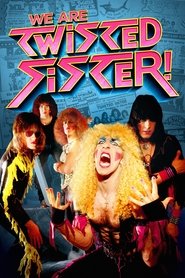
We are Twisted Fucking Sister!
Download English Subtitle
Release info
Tags
English subtitle preview
The first 200 lines.
Good evening, ladies and gentlemen.
Before we begin we would just like to remind you
that the act you are about to see
is not for the faint of heart.
Twisted Sister has been accused of using foul,
indecent and profane language during the course of their show.
If you do not-- repeat-- if you do not wish to subject yourself
and/or your loved ones to such abuse,
then please vacate the premises now!
Thank you very much.
Now?! Right.
They look like women, they play like men,
and they're the biggest bunch of hell raisers to come out of the States!
It's Twisted Sister!
In the summer of '72
I pretty much determined that the drug scene
that I had been part of as a hippie New York City kid
was pretty much over.
And during that summer I had gotten a subscription to "Fusion Magazine"
and with that subscription came a Lou Reed album,
a David Bowie album, and a Mott the Hoople album.
And the cover of "Fusion" had David Bowie on it.
And I went whoa! Whoa! What's this?!
This is not the Grateful Dead.
This is something completely different.
And I changed gears 180 degrees.
And so when The Dolls started playing at Mercer Arts Center,
that was a new world for me.
Bowie was there, and Lou Reed was there.
And there was this glam glitter kinda thing.
You know I strangely was connected to it,
except I was a musician
and these bands were not that musical to me.
They were pretty bad actually.
I mean they were awful.
They looked great. Man, The Dolls looked amazing.
I would go home and go,
"That band, if they could play, they're gonna make a fortune.
But they do suck."
And I thought, "Wow, if you could get a band like that, but be good!"
I started to put the feelers out,
you know, that I wanted to be in a glitter band.
And I get this phone call from a guy
who kinda sounded like Rocky Balboa.
And he was like, "Hey, how you doing?
My name is Mel, you's inta Glittah?"
"You's inta Glittah?"-- I'd never heard that phrase,
"Youse inta Glittah." Like You's?
Yeah, I'm into glitter.
"Bowie, Lou Reed, Mott the Hoople, yeah, yeah."
"We gotta band together,
and we're gonna be like dressing like women."
I said, "Really?"
I said, "Are there a lot of groupies?"
He said, "Oh yeah, you gonna get laid a lot."
And when he comes to my house,
you know, the doorbell rings and I look out.
And there's this African-American guy there.
And I go, "Excuse me, who are you?"
And he goes, "It's Mel." And I went, "Oh, okay. Whatever."
We get in the car and drive to the first rehearsal in New Jersey.
And they told me that night, if you want the gig, you want in,
basically it's yours.
The band had a kind of template.
There was Michael the singer,
and Billy the guitar player
who fashioned themselves as Mick and Keith.
Mel was more of a jazz-influenced drummer,
I think, but a good drummer.
Kenny on bass was this great musician
who seemed a little out of place in the whole thing socially,
but a sensational musician.
So I thought here's a good playing band.
And we're gonna be like looking really great--
like, we'll look like The Dolls,
but we'll sound much better, and we'll get a record deal.
Hello, Stu? You're gonna freak out.
You should see this act.
The New York Dolls have nothing on these guys.
One of the first questions they asked me was would you be,
um, against like putting on any makeup or anything like that.
And I figured yeah, okay I could do that.
I never had. Now this was stuff different
than what I was used to playing.
They were playing like David Bowie--
like David who?!
This is, like, a little weird. I didn't say anything,
'cause I wanted to be like a team player.
So I wasn't really sure if I liked it,
but when we would play some of the songs,
like the energy was there.
And one thing for sure was,
I didn't wanna have to go get a real job again.
In the '70s, in New York,
the capital of the world which had sort of been abandoned
by the grownups at that point
and left to anybody who had the balls to still live there.
In the city proper you had rap,
which was you know being born and developing
and punk was growing out of downtown.
And as soon as you went over a bridge
or through a tunnel and left the city...
you were in America, essentially,
and it was a different world.
The beauty of that era was that there was absolutely...
nothing to do as far as nightlife,
except for go to the movies or go see a live band.
And there was usually more happening with the live bands.
And it was great
because everybody just came out in droves.
The scene at that time, mid-'70s or so, in the Tri-State area
started originally like in Westchester County
and some parts of Long Island,
and it just grew and grew and grew.
What I've understood,
it's the only place in the country
that had this kind of intense club area.
And much like there are still to this day Top 40 bands,
uh, club owners were looking for
bands that played the hits of the day.
We were playing Led Zeppelin,
we were playing The Who, we were playing Jethro Tull,
we were pretty infamous for that.
And it was all done properly.
It was all done up to snuff
Everybody wanted to see, oh, could they do AC/DC?
Could they do Led Zeppelin?
How good could they do this?
Nobody wanted to hear original music.
And nobody played original music at that time.
And lo and behold, once you got into the circuit,
and you swam in that stream,
You know, all of a sudden it all opened up, and there we were.
The first show at the Satellite
was definitely something different.
It was like a huge place,
and it actually was right near Fort Dix Army base
and then right across the street from McGuire Air Force base.
So you had like the Air Force and the Army
and all these guys coming here.
The makeup we were doing was very feminine.
And I remember being like really nervous.
'Cause I'm thinking well they're gonna take one look at us
and they're gonna start throwing stuff.
But there was no one in this room.
It was a giant bowling alley that holds 3,000 people.
There was maybe 20 people a night.
Tuesday night, nobody.
Wednesday night, nobody. Thursday night, nobody.
We kinda get comfortable into the groove,
that maybe nobody's gonna show up and we'll learn the songs
'cause we barely knew enough songs to get through three sets.
We had to play five. Come the weekend, bang!
There was 3,000 G.I.s-- oh, my God!
I was sick, physically sick to my stomach.
Looked outside, saw these 3,000 people,
saw myself in a dress with a dog collar on,
thinking, "Oh, I am gonna just get killed.
"This is where I'm gonna die.
It's come to this, dressed in drag, I'm gonna be murdered."
But for whatever reason,
the soldiers there were just drunk and wanted entertainment!
Around 16 years old I was coming to a crossroads
where as an unpopular kid
who didn't have many friends or didn't fit in
with any cliques or anything like that,
I, um, came to a point where I really realized
that I was sort of fading.
I was fading into the background,
and I was becoming a nonentity.
And I remember literally sort of shaking myself and saying,
that, you know, I will not go quietly into the night!
And I was this sort of outcast but I didn't really care.
I just became my own person.
I always sang in bands. And that I started to excel at.
So my bands started becoming the popular bands in the school.
Harlequin was my post-high school band--
my first band to start to play out in clubs a little bit.
But somewhere along the way,
I was offered the opportunity to join a working bar band,
who weren't nearly the band Harlequin was.
They were called Peacock.
But it was gonna give me the opportunity
to actually make a living.
And I figured I would really hone my craft.
So I left a much better band to join a weaker band.
People just couldn't get over the way we looked.
There really wasn't anybody else out there in the scene
that was doing anything like what we were doing.
We would kiss during the Bowie medley.
And that would be outrageous, but cool.
And the chicks would dig it, and we'd get laid a lot.
We got these dog collars--
pretty severe, you know, like this high, and studs.
And we got a chain and we would chain each other together.
One thing we had to be careful though was to make sure
the amplifiers were grounded properly.
Otherwise you get a heck of a shock.
We got a truck really cheap.
And we were able to make $150 a night,
Comments
No comments yet. Be the first to leave one.