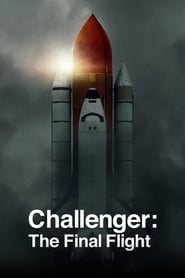
Challenger: The Final Flight
Download English Subtitle
Release info
Tags
English subtitle preview
The first 200 lines.
Yeah, I just found it the other day.
It's like... Yeah, I didn't even remember it.
It was a birthday present from Christa.
She always kept a journal and hoped that I would do the same.
This journal entry is July 4th, 1985,
and this was right before Christa, I believe, was selected.
"So there's been quite a bit of excitement recently.
This coming January, a space shuttle will be launched
carrying one of America's teachers.
Each state elected two representatives,
and I am proud to have my sister as a representative from New Hampshire.
Christa runs, plays sports, does not drink much, and never smoked,
and I think she has a great chance.
The final decision is up to NASA.
It will be nice to see her today at my parents'.
My husband, Bob, his sister, Sally, and mother, Gert
are all going to join in celebrating Independence Day,
and the possibility of having an astronaut in the family."
Space shuttle is back. Is it back?
Is it… Does anybody know? Where is it?
I think it came in Monday, the space shuttle.
It's back. Look at this, three people know.
This is incredible, space missions!
The most exciting thing that there ever was to happen.
Right now, people don't even follow the spa... I mean, it's…
They should make it exciting. I don't know how they could make us all watch again.
Maybe they should send up some guy that doesn't want to go.
Wouldn't you watch? I mean, I think everybody would watch that, you know…
Dragging some guy down the hall, you know…
put him in a spacesuit. He's holding on to door jams.
See his face in the glass on liftoff.
I think the public anticipated something more than what they got.
When it becomes routine, people lose interest in it,
and because of that, it was no longer front page.
It was second page, third page, eighth page.
That was my metric that I used
to determine how excited the public was for this program.
They got bored with flying to the moon, you know, the American public.
So why wouldn't they get bored with flying around the Earth?
We worried about it a lot because
it's the public's support for NASA that keeps it going.
NASA began to think this was time for us to bring in
a non-professional astronaut to experience and share space flight.
The day is coming when you don't have to be an astrophysicist
or an astronaut or a medical doctor to go into outer space.
NASA, in fact, is looking for the first non-astronaut
to fly a shuttle mission.
The opportunity for the public, in some form,
to fly on this spectacular vehicle was there.
I remember hearing a lot of names like Tom Wolfe or Walter Cronkite.
Almost every news anchor in the country wanted to be the one to go up.
Writers, journalists,
or having a great poet go, or an artist.
What's your one big fantasy?
- What is... - I wanna go up on the space shuttle.
That's… You could do that.
It's wonderful.
I remember hearing some talk about
Big Bird being a possible spaceflight participant,
but you couldn't get a Big Bird costume into the crew compartment.
All kinds of people have applied to fly on the shuttle:
doctors, entertainers, writers, TV news anchors,
and yesterday, President Reagan announced his decision.
Today, I'm directing NASA to begin a search
in all of our elementary and secondary schools,
and to choose as the first citizen passenger
in the history of our space program, one of America's finest, a teacher.
My husband and I were watching the evening news,
and he says that I said, "I'm going for it."
I don't remember saying that, but I definitely remember thinking about
what a fantastic opportunity this is.
But when that shuttle lifts off,
all of America will be reminded of the crucial role
that teachers and education play in the life of our nation.
And so, I went to school the very next day
and mentioned it to my colleagues.
Three of us went to see our superintendent.
He thought it was crazy that we wanted to go into space.
These are some of the applications from teachers
hoping to be chosen for that flight.
There's something like 11,000 teachers completed those applications.
Everybody has a fantasy. My fantasy was to be an astronaut.
The competition is gonna be stiff,
but… it would be great to be that person selected.
The competition with these 11,000 teachers
was narrowed down to ten.
Ten finalists.
We went to the NASA Johnson Space Center,
where we would undergo evaluations
that needed to happen before, uh, being selected to fly.
Even though they just arrived this week,
the teachers have already had their share of prodding, poking, testing, and running.
It's all part of the screening process
that will eventually lead to one of the group making history.
That's when I first got to meet Christa.
My sister Christa was always a very special person.
Growing up in a very small house…
The house had three bedrooms, and there were seven of us.
Christa, my younger sister Betsy, and I shared a room.
I remember when she would go out on dates with her boyfriend, Steve.
When I would wake up in the morning,
she would always have a little something next to Betsy's and my dresser,
like a book or maybe a piece of candy,
and I thought that was an unusual thing
for a teenager to go out on a date and think about her siblings.
And that's just who she was.
She and Steve both graduated college, and they got married.
She was, I believe, 21.
She had the belief that she could do extraordinary things,
but she also believed that everybody could do extraordinary things.
When Christa saw the Apollo go up,
she said, "Well, I wish I could go into space."
She was just thrilled about the whole idea
that they were thinking of sending a teacher to space.
NASA had three questions that they would ask us.
They gave us two of the questions,
and we were told that the third question would be a surprise.
Describe your philosophy of living.
"My philosophy of living."
Well, I think my philosophy of living is to get as much out of life as possible
and to certainly involve other people in that enjoyment,
but also, because of the country that we live in, to be a participant.
NASA officials
will pick a finalist and a runner-up before the end of the month.
The winner will go to space in January.
When NASA was starting to open up the space shuttle flights
to people who were not professional astronauts,
that was not well-received within the Astronaut Office.
We really, truly, didn't believe that we were as safe, if you would,
as that would tend to lend you to believe.
We were still learning how to operate the system
and to develop the capabilities to do it regularly and successfully.
We accepted those risks, but we thought they were always going to be managed.
My first major assignment at NASA
was about three weeks after I'd come on board.
My supervisor said, "Go over to the Office of Space Flight,
talk to the engineers, and document the problems they were having
with the solid rocket boosters."
I had been hired to work on the space shuttle program
as a budget analyst, and one of the big cost factors
was the cost of the solid rocket boosters.
When I got over there,
the engineers told me that after each shuttle flight,
on every agenda, NASA listed problems in the solid rocket boosters.
I didn't know the extent of the issues, so I started looking at the problem.
NASA is a nationwide organization.
The solid rocket boosters
were managed by the Marshall Space Flight Center
in Huntsville, Alabama,
which had responsibility for the solid rocket boosters
and for the solid rocket booster contractor, Morton Thiokol, in Utah.
I'd been to several test firings of the solid rocket boosters
in Utah on several occasions.
Whenever an astronaut would go to our contractor locations,
our general message was,
"The work you do is paramount to my safe flight,
and we want you to remember that,
that there are people that are dependent upon how well your product performs."
I was the director of the Solid Rocket Motor Project
for the Thiokol Corporation.
This was the first time that we were involved in a vehicle using solid rockets
that actually launched people into space.
Twin solid rocket boosters
produce a combined thrust of over five million pounds for liftoff.
Two minutes later, the solid boosters will burn out,
separate from the external tank.
We see… Set flight.
Roger…
Then parachute to a water landing and recovery
in the Atlantic Ocean.
The boosters will be refurbished and returned to service
on a continuing basis.
We recovered the boosters that fell back down into the sea,
and we were able to inspect them and evaluate the performance.
When I started out at Thiokol, I was in the reliability engineering section.
That's when we started to see some erosion inside of the boosters.
When we brought the boosters back, pulled them apart,
and pulled the O-rings out, inspect them,
we could see it got burned, right where we saw a hole,
where gas had come through at that exact location,
and there's a little bit of the O-ring missing that had actually burned off.
It's not something that we'd want.
What you'd want is to have the O-ring come back whole and un-singed.
The O-rings are rubber,
and you've probably seen little O-rings in the hardware store.
These O-rings are a little over a quarter-inch in diameter,
but they're 40 feet long
to fit around the whole circumference of the case segments.
And they fit into grooves, and so they stay in place.
And then when the joint is assembled, they seal against the opposite surface,
and there are two of those in each field joint.
The reason there's two there is because we had to have redundancy
so that if one O-ring failed, the other one would hopefully keep the seal.
If the seal erodes, then the hot flame that's causing that erosion
will burn across the O-rings and come outside,
and we'd have a rocket motor leak. And then the rocket would blow up.
It was a significant concern.
This O-ring problem continued to happen,
and the solid rocket booster engineers
felt it was not being effectively dealt with.
Challenger: The Final Flight subtitles in other languages
More English subtitles for Challenger: The Final Flight
- Challenger The Final Flight S01 WEBRip x264-ION10 · 45 downloads · 2020-09-17
- Challenger The Final Flight S01E04 Nothing Ends Here 1080p NF WEB-DL DDP5 1 H 264-BTN · 30 downloads · 2020-09-17
- Challenger The Final Flight S01E04 Nothing Ends Here 1080p NF WEB-DL DDP5 1 H 264-BTN · 27 downloads · 2020-09-17
- Challenger The Final Flight S01E03 A Major Malfunction 1080p NF WEB-DL DDP5 1 H 264-BTN · 28 downloads · 2020-09-17
- Challenger The Final Flight S01E03 A Major Malfunction 1080p NF WEB-DL DDP5 1 H 264-BTN · 17 downloads · 2020-09-17
- Challenger The Final Flight S01E02 HELP 1080p NF WEB-DL DDP5 1 H 264-BTN · 24 downloads · 2020-09-17
- Challenger S01 720p NF WEB-DL DDP5 1 H 264-NTb · 59 downloads · 2020-09-17
- Challenger The Final Flight S01 WEB H 264-RBB · 30 downloads · 2020-09-16
Comments
No comments yet. Be the first to leave one.