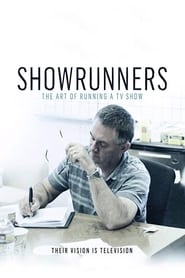
Showrunners: The Art of Running a TV Show
Download English Subtitle
Release info
Tags
English subtitle preview
The first 200 lines.
The showrunner of a series is responsible
for the creative direction of the show,
keeping scripts and episodes coming in on time,
dealing with notes,
trying to keep the whole damn thing afloat.
Being a showrunner is utterly consuming.
You're editing and writing
and doing a hundred different things at once.
It's draining, it's awful – I miss it terribly.
Showrunner is a fairly new term of art.
In the former days, it was the head writer,
the executive producer.
But as the shows have become much more cinematic
in their scope and intention,
the job has become much more complicated.
And yet, we're expected to deliver a show every seven days.
Showrunning is incredibly brutally hard,
and you can't really lean on anyone,
because part of the job
is being the broad shoulders of the show.
This is a crazy, crazy, fucking job.
It's a really cool one, but it doesn't make any sense.
It's like a controlled plane crash every week.
It's a billion decisions a day.
You're the guy that has to decide what we're going to do.
They only bring you questions.
When you're a showrunner,
you're getting squished by the network and the studio.
You're feeling pressure from the crew on up.
People look at you and you think, "Oh, you're the boss,
you have nothing to worry about."
You're worrying about all of it.
Part of the job of the showrunner
is to set the tone for what you're doing.
Many a time, I've been standing on a set
where we're at some crisis, and it's like,
"Okay, we gotta do this and this and this."
And people are like this, and I'll say, "But...
"we're not curing cancer here, guys.
This is a TV show."
It is, at the same time, the best and the worst job.
You can't imagine quitting, and at the same time,
it's a job that's exhausting to the core of your being.
And I always say it gives you the thing
of walking around and saying, "I have such a bad back
from unloading all this gold bullion."
Most show aren't smash hits.
84% of new shows in America fail.
So, you know, hopefully, you beat the odds
because if you stay in the race long enough, you're gonna win.
And it's just a question of how you can stay in the race.
The showrunner is the life blood of a television show.
It's a collaborative art form.
But you still need that one central voice through which
all the marvelous creative contributions are processed.
The age of writers and showrunners
being anonymous is... is over.
My day has the same shape.
There's a certain rhythm to it that can change day to day.
If I have writing to do, I come in extremely early.
Morning.
Because around about 9:00 or 9:30,
I'm going to be talking to people more than I'm writing.
Oh, that weighs a ton.
You always have, say, six episodes
at some station in the process,
so you've got one that you're finishing the final mix on
and going to lock and hopefully put on the air,
and then you've got people pitching story ideas,
so you've got something to tend to on each one of those things.
One of the downsides of being a showrunner is that
if you're doing it correctly, everyone that you've come
into contact with – actors, the other writers,
the other producers, the network, the studio...
You know that things are going well on your show,
if everybody's just a little annoyed with you.
Showrunning, I think, is like painting a painting
while writing a novel, while doing your taxes.
It's very, very, you know, right brain, left brain, boom.
House of Lies came from a book by Martin Kihn
about management consulting and what a scam it is.
It felt very relevant to me.
Well, when you get to the point of making a show,
it's pretty sexy in its own way.
I get to make a half-hour pilot.
If, god willing, the... the show gets picked up,
I don't know exactly how I'll work it.
I wanna write as much as I can of it.
The showrunning part, the administrative part,
it's really, uh, not for me, in a way.
As somebody who's a writer as much as anything,
that's the reasons they let me do any of the stuff
that I do, is that I can write okay.
When I moved to New York, trying to write plays,
Joanne Woodward and Paul Newman saw my first play
called Diary from Avenue B.
Joanne found something in it that she liked.
They were just dead set against any of their protégés
going to Hollywood, moving to L.A., writing for film,
acting in films, um, doing television especially.
They were absolutely against it – of course, all of us have.
Part of what the showrunner has to do
is head in four different places at the same time.
You're in a constant situation of feeling
like you're doing, uh, not a good enough job.
The idea for Men of a Certain Age came from
when Ray Romano and I were both between projects.
And he, uh, he was kind of still in the wake
of Everybody Loves Raymond, trying to figure out
what he was supposed to do next.
And as we started conversing, it was all existential
mid-life crisis stuff that we were both going through.
The more we talked, the more stories we had
and the more it felt like, well, this is what we should
be writing about because a lot of people can relate
to this. And it worked out very well.
We were extremely happy
with all of our episodes in the first season.
We felt like, you know what, we did a good show
so let's just get it out there and see if people like it.
And people liked it.
We feel the same way about this season.
This season, people are still trying to find it.
If you have to remember only one thing, it's four words.
Quality scripts on time.
If you don't have quality scripts,
then what's the point of doing any of this?
But if quality scripts don't come on time,
you're gonna be off the air.
If your script is late, it's not enough
to simply say, well, it's good.
I don't care if it's the fourth day of prep.
You got 180 people that are trying to do their job,
and you've just made their job so much more difficult.
You've made your budget soar and when push comes to shove,
all things being equal, when the network and the studio
look at the hot costs and look at what the show has done,
they'll say, either we wanna be
in business with that person again or we don't.
Nothing will get you out of it quicker than arrogance,
ignorance and being, uh, over budget and behind schedule.
You know, studios tend not to like that.
I think there is a renaissance going on in TV.
I think it's a combination of so much of feature writing
has gone downhill,
and the middle class of feature writing has disappeared.
So, I think a lot of people who really felt frustrated,
come to TV and go, "Oh, my god, who gave us all this freedom?"
It might be less money but, wow, I have stories I wanna tell.
I'm gonna tell them.
As difficult and as time consuming and as stressful
as it can be, I mean, creatively to be able to, you know,
tell these stories and uh, have the control over it that I do,
uh, is, is such a rare thing.
You know, there are a lot of people who are great writers
who really don't necessarily enjoy the process.
And I really do. I love the first draft
as much as I love the rewrites.
The idea of really having those characters
come alive in my head
and hearing the words is just... it's, it's the rush for me.
Your ambition every time you're making an episode
is for it to be the best episode that you've ever made.
But the reality of the situation is,
we're writing a script every ten days.
And, you know, we began to realize like, every episode
is not gonna be a home run.
And we started looking at the seasons as a whole,
as opposed to a sort of episode by episode analysis.
But at the end of the day, the legacy of the show is gonna be,
there's six seasons up on a shelf
and you can watch 'em one after the other.
So the bad episodes are gonna come out in the wash,
and the good episodes are also gonna come out in the wash.
All that's gonna matter is, you know,
what are the peaks and valleys of the storytelling as a whole?
Writing 22 episodes of a television show
is a heavy endeavor, and anybody who can do it
on their own, more power to them.
But we're not really interested in doing it on our own.
We're interested in having a family of writers
who are all contributing to make the show something
that collectively, we're all proud of.
And hopefully, by the time it gets on air,
everybody feels that part of them is in that episode.
Part of them is in it. Yeah, we don't really care–
I mean, there's a lot of showrunners that are
very concerned because their name's on every script
and while it's our responsibility to come up
with the stories, you know, um, on a consistency
and a through line of where we're going,
you know, it's not important for us
to have our names on the scripts so much.
It's kind of more important that people recognize,
"Okay, those guys are the ones behind the shows."
John, why don't you just head for...
Can you get as far as the end of act two?
Yeah, I can.
Can you get as far as the end of act three?
I can get to the middle of act three.
Showrunners: The Art of Running a TV Show subtitles in other languages
More English subtitles for Showrunners: The Art of Running a TV Show
- Showrunners The Art of Running a TV Show 2014 1080p AMZN WEB-DL DD+2 0 H 264-monkee · 25 downloads · 2018-01-14
- Showrunners (2014) x264 1080p WEB DL iTUNES · 33 downloads · 2017-01-23
Comments
No comments yet. Be the first to leave one.