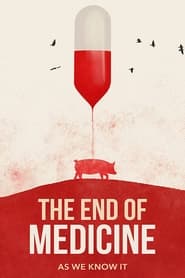
The End of Medicine
Download English Subtitle
Release info
Tags
English subtitle preview
The first 200 lines.
It all felt deeply unethical.
I went in with pure intentions to make a difference.
It really was every day that I'd cry.
And then [ think I was just suddenly like,
"I can't do another day of this."
I just want to share my story
and I want people to know what I've learned about disease.
We have seen multiple episodes over the past several years
where viruses have emerged that have caused cause for concern.
And, thankfully, to date, time and time again,
measures that have been taken by governments,
measures have been taken by W.H.O.
have managed to combat those outbreaks.
I think the whole of the medical community
is mindful and slightly fearful
that eventually there might come a time
where such a virus can't be contained.
There are two sets of laws that we have
that control human behavior.
One is the laws that we make.
And, in those laws, they say from time to time,
"It's okay to do this. It's okay to do that."
Well, it may be okay and it may be lawful
but nature has its own set of laws.
And when you, or we as people, violate those laws,
then nature responds with a consequence all of its own.
And it can be a consequence
that we, as humans, can't tolerate.
We're creating these scenarios
in which viruses can mutate in that way.
It really feels like there's So many alarms going off
and it just isn't being spelled out.
[pensive classical instrumental]
I'm Alice Brough and I used to be a livestock vet
so I worked for about four years
in the British pig industry.
And I left that about a year ago.
As soon as I was old enough to understand
there was a job that was involving helping animals,
that was the career for me
and I didn't ever consider anything else.
It was like, as soon as I could speak, I wanted to be a vet.
Since I sort of turned 15,
I started working on farms every holiday.
And then the veterinary degree is five years long.
So, so considerable amount of time put towards it, really.
So the year before I left,
I was actually a finalist for Young Pig Vet of the Year.
I really put everything into it.
I tried incredibly hard to... To achieve what really
was my aim was to improve the lives of animals.
And I, yeah, it was a...
It was a tough job and I put everything into it.
So, um, why have you since left that job?
Um... that's a tough question.
I think the more I went on,
the more I struggled with the sort of concern
that I was facilitating something
which would be potentially very dangerous
to human health further down the line.
I felt I've had to step back from that role
to feel like I'm not contributing
to some of the biggest threats to humanity
in the form of pandemics and antimicrobial resistance.
There are many different diseases
that have led to pandemics over the history of time.
And there's typically some sort of link
between human health and animal health
within those types of pandemics.
About half of infectious diseases people can get
can be spread from an animal or be zoonotic.
And for emerging infectious diseases, particularly,
scientists estimate that three out of every four
emerging infectious diseases come from an animal source.
Well, the truth is,
when you look at the origins specifically of COVID-19,
we think it's come from some of these wet markets in China.
And for many of us in the West,
we look over there and we say, "Okay, well,
perhaps they should close down."
And to a certain extent that is true.
But we should also look in our own back garden
and just look at how we are treating animals here.
It's not just over there. If we are cooping up
our livestock in unsanitary conditions,
having to give them antibiotics all the time,
we really don't have much of a case to be pointing
the finger at anybody else.
The more I looked into it
and the more research I looked at,
it was sort of like going down the rabbit hole, in a sense.
Animal agriculture is a big business.
It's causing all sorts of major issues,
but nobody's joining the dots.
I worked in the Office
of Counter-terrorism and Emerging Threats
at the Food and Drug Administration.
And, in that office,
we were preparing for things like pandemics,
like COVID-19, that we're facing now.
I worked with the Center for Disease Control.
I worked for the National Institutes of Health.
I worked with the military.
I worked with Homeland Security.
Throughout that entire time, not once
did we ever talk about how these emerging diseases
come about in the first place.
This is the time.
If there is any time, this is the time
to really look into how these infections come about.
So you think about it, we're about
eight billion humans on this planet right now.
But for every human on this planet,
there are about ten land animals
raised and killed for food.
So we think there are too many humans?
Think about how many animals there are.
So we're talking about 80 billion land animals
being raised and killed for food at one time.
You know, with Coronavirus, we are being told to...
To socially distance and rightfully so.
But we're doing the absolute opposite
with these animals in these farms.
We're crowding them into as tight of a space as we can.
And that goes against everything that we know
about how to contain and prevent
the emergence of infectious diseases.
Their immune systems are decreased
because of the stress that they face
and then they're so densely packed.
So, it's so easy for one animal to catch an infection
and then pass it on to another animal
and then the virus can spread like wildfire.
So far, they've been able to verify the deadly strain
of flu virus is passed on from chickens to people.
Four people...
In 1997, with the emergence of H5N1,
it was a highly pathogenic influenza virus
that emerged from chicken farms in China.
Now, that virus had a lethality rate of about 60%.
Think about it. This was a virus that killed
60 out of 100 people who contracted the virus.
You can imagine how deadly that virus is.
I mean, that is a scary, scary virus.
H5N1 came out from animal agriculture
and it is still out there and it is still circulating
and it is still mutating.
We are not done with H5N1.
It's a ticking time bomb,
you know, what's happening in these factory farms
and the influenza strains that are coming out.
It's no coincidence
that when we think of past pandemics,
we think of swine flu and avian flu
and pigs and chickens
are the most intensively farmed animals on the planet.
Intensive farming acts as a crucible
for the development of pathogenic organisms.
It's our insatiable need
for cheap food and for animal protein.
If we didn't have those,
we wouldn't have a lot of the drivers for zoonotic emergence.
So, I'd be driving every day, farm to farm,
and seeing generally similar sort of problems
across the board,
uh, whether that be disease or... or welfare issues.
Um, and these conditions are not...
Not exceptional, not one-offs.
This is really how our meat, dairy and eggs
are produced every day.
We do a lot of unnatural things to animals.
You know, we routinely mutilate young animals.
We cut off teeth, tails, testicles and beaks, horns,
which creates a direct route into the bloodstream
for bacteria, and it's also greatly stressful
and painful, obviously.
We all know dairy cows that are removed
from their mothers almost straightaway.
Chickens don't get any time with their mothers.
Um, and piglets are weaned about three-to four-weeks old.
When you move them into an environment
that's frightening for them, away from their mum
and on a completely different feed,
it's very common to see things like post-weaning salmonella
or E. Coli diarrhea or meningitis.
Generally when there's been an outbreak
of disease that requires my input,
I'll go and take some samples, um.
And I might, you know, swab some tonsils
or nostrils or take some blood from the jugular vein.
And the whole time, I'm kind of leaning down
in front of the nose and mouth of a pig
which might potentially die from something like swine flu
which could potentially pass to me
or, you know, some unnamed disease
which we haven't discovered yet.
The level of ammonia coming from, you know,
tons of waste from these animals,
and the dust that builds up,
everything that those pigs are breathing out,
The End of Medicine subtitles in other languages
More English subtitles for The End of Medicine
- The End of Medicine 2022 1080p BluRay REMUX AVC FLAC 2 0-TRiToN · 15 downloads · 2022-12-08
Comments
No comments yet. Be the first to leave one.