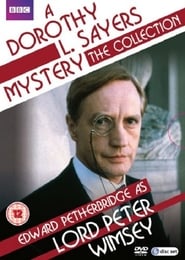
A Dorothy L. Sayers Mystery
Download English Subtitle
Release info
Tags
Download English Subtitle Files for Mobile (3)
English subtitle preview
The first 200 lines.
Woburn Square, cabbie,
quick as you can!
Paper! Paper!
Miss Harriet Vane charged with murder!
Star, Standard, and News. Cheltenham races.
Paper! Paper!
A striking face.
Not just conventionally pretty.
Much more than that.
Damned attractive.
More coffee, milord?
Milord?
Can that really be the face of a poisoner?
Well, milord, I...
Bunter, launch the Lagonda.
Can't wait, Bunter. I'll get a cab back.
Very good, milord.
Very sorry.
Sorry, sir. public gallery's full.
I'm looking for Chief Inspector Parker.
Is he expecting you?
I believe so.
Right you are, sir. Court Number One.
I'm obliged.
Come along! Please!
There's no more room inside.
You're obstructing the entrance.
The case for the Crown is that Harriet Vane
murdered Philip Boyes with arsenic.
The defense do not dispute
that death was due to arsenical poisoning,
and that you must accept.
The only question that remains for you
is whether in fact that arsenic
was deliberately administered by the prisoner
with intent to murder.
The deceased, Philip Boyes, was, as you've heard,
a writer.
He was 36 years old, and had published five novels
and other literary works,
works sometimes described as of an advanced type.
They preached doctrines
which may seem to some of us immoral
or seditious,
such as atheism and anarchy
and... ahem... what is known as free love.
There's Chief Inspector Parker, sir.
What are you doing here, Peter?
I've been following the case in the newspapers.
And now you've come for the kill.
Charles, I think you've made a mistake.
I'm sure I've made many.
I'll catch up with you.
Shall I leave the gentleman with you?
Yes. I'll look after him.
This young woman, Harriet Vane...
she didn't do it.
Will you tell me why?
It's a hunch, as yet.
Ah. A hunch.
Could you squeeze me in?
Yes, come with me. I'll get you in the back way.
Your mother's here, and your friend Mr. Arbuthnot.
Mama and Freddy? Heavens! what are they doing here?
I think all of London's here.
The prisoner is also a novelist by profession,
and it is very important to remember
that she is a writer
of so-called mystery or detective stories,
stories that deal with various ingenious methods
of committing murder and other crimes.
His honor has just started his summing up, so...
Understood. I'll creep in like a mouse.
I don't give much for her chances.
While there's life, there's hope.
If not very much time.
The prisoner herself...
The prisoner herself has told us with great candor
how she became attached to Philip Boyes,
how for a considerable time
she held out against his persuasions
to live with him in an irregular manner.
There was, in fact, no reason at all
why he should not have married her honorably,
but apparently he'd represented himself
as being conscientiously opposed to any formal marriage.
You have the evidence of Sylvia Marriott
and Eiluned Price
that the prisoner was made very unhappy
by the attitude which he chose to take up.
At any rate, in November of 1927,
the prisoner,
worn out, as she tells us,
by his unceasing importunities...
Mesmerized, old bean.
She's got you completely mesmerized.
Now, you may feel, and quite properly,
that this was a very wrong thing to do.
However, various friends have testified
that they apparently continued to live
on terms of the greatest mutual affection
for nearly a year,
until, in October of 1928,
Boyes finally offered her a legal marriage.
Now, you may find this surprising,
but this offer caused the prisoner
to become angry with Boyes,
angry with him because,
after persuading her against her will
to adopt his principles of conduct,
he had then renounced these principles
and, as she says, made a fool of her.
And as a result, there was a quarrel,
and the couple separated,
Miss Vane seeking temporary refuge
with her friend Sylvia Marriott.
After a short while,
Harriet Vane leaves
the sanctuary of Miss Marriott's establishment
and takes a small flat in Doughty Street,
while Philip Boyes accepts the invitation
of his cousin, Mr. Norman Urquhart,
to stay at his house in Woburn Square.
Although living in the same quarter of London,
Boyes and the accused
do not seem to have met very often after the separation,
but there's some evidence of a meeting
towards the end of November,
and another in the second week of December,
and a third in January of this year.
These times are worth noting.
We now come to a date
of the very greatest importance.
On Monday, December the 10th, 1928,
a young woman who has been identified as Harriet Vane
entered a chemist's shop
kept by Mr. Brown in Southampton Row
and purchased two ounces of commercial arsenic...
saying she needed it to destroy rats.
She signed the poison book in the name of Mary Slater.
And on Saturday, January the 5th,
we have another purchase of arsenic.
This time she gave the name of Edith Waters.
The prisoner has given
an explanation of these purchases
which you might consider, for what it's worth.
She says that she was engaged at that time
in writing a novel about poisoning,
and that she bought the drugs in order to prove by experiment
how easy it was for an ordinary person
to get hold of deadly poisons.
Now, these dates...
the 10th of December last, and the 5th of January...
there is a coincidence here which may be of significance,
three sets of coincidences.
Harriet Vane and Philip Boyes met towards the end of November,
and he has an attack of gastritis
on November the 30th.
On December the 10th,
Harriet Vane purchases two ounces of arsenic.
They meet again in the second week of December,
and on December the 15th,
he has another attack.
On January the 5th,
there is the purchase of weed killer.
they meet again soon after that,
and on January the 12th,
he is taken ill for the third time.
On his doctor's advice, he goes to visit his friend
Mr. Ryland Vaughn
and stays with him for a while in Wales.
This ought to blow the cobwebs away.
Yes.
I say, are you all right?
It's just a twinge.
Oh, dash it.
I should never have brought you up here.
No. No, tummy's all right.
More the heart.
You have heard Mr. Vaughn testify
that Philip Boyes was not happy.
In fact, Mr. Vaughn formed the opinion
he was fretting after Harriet Vane,
and on February the 16th,
we find him writing a letter to Miss Vane,
an important letter.
I will refresh your memory.
No, no, no, no. not this one.
"Dear Harriet,
"Life is an utter mess-up.
"I can't stick it out here any longer.
"I've decided to cut adrift and take a trip out west,
"but before I go, I want to see you once again
"and find out if it isn't possible
"to put things straight between us.
"You must do as you like, of course,
"but I still cannot understand the attitude you take up.
"If I can't make you see the thing
"in the right perspective this time,
I'll shut it in for good."
Comments
No comments yet. Be the first to leave one.