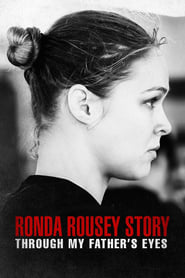
The Ronda Rousey Story: Through My Father's Eyes
Download English Subtitle
Release info
Tags
English subtitle preview
The first 200 lines.
As the years pass by but no memories fade...
every step I take, the mistakes that I've made...
yet his words still echo, scream loud in my ears...
but I just can't remember after all these years.
Every once in a while, you cross paths with someone
who changes the meaning or definition,
of what you think is possible.
In a world full of creeks and ponds,
I was finally introduced to an ocean.
I first met Ronda back in 2010.
She was sitting right here, sweat-stained and beautiful.
But beauty didn't hide a spirit and a fire
of someone I knew was on a mission.
Yeah, she was special.
But nothing ever came easy for Ronda.
When she was born, they thought she was dead.
On a cold winter day in 1987,
a tiny Ronda Jean Rousey brought chaos
into the local Riverside Community delivery room.
I don't have a pulse. What's it look like?
Not clear. It's unclear.
She went unresponsive.
Hypoxia had brought Ronda's little heart
to a sudden and abrupt stop.
I'm not sure she's gonna make it.
Doctors fought for what seemed to be an eternity
to cut her umbilical cord from around her neck
and then administered child CPR.
It's the only time I ever saw my husband cry.
I mean, when she was born, he... we thought she was dead.
Little did we know,
this tiny, little fighting spirit
would change the perception of women in sports,
some 20 years later.
This entire crowd is on their feet
for the arrival of the first ever.
UFC Women's Bantamweight champion,
Rowdy Ronda Rousey.
This is a gigantic cultural moment, Mike.
This is not just a moment for Ronda Rousey.
This is a moment for women's sports, period.
She's changing sports,
she's changing culture.
This is a huge moment
and we can't think of any better person
to carry the weight of this moment.
It was just before Christmas in 2010...
when I received a call from my producing partner,
Pete Antico.
He wanted me to interview his friend of 30 years,
the Godfather of Grappling, "Judo" Gene LeBell.
I arrived in the heart of North Hollywood
at the Hayastan gym, home of MMA great,
Gokor Chivichyan.
Gene, of course, lived up to his larger-than-life reputation.
And if somebody has...
a bad attitude here,
comes in with a chip on his shoulder,
we give him what we call an "attitude adjustment."
But it was someone else who caught my eye.
In the midst of all the blood, sweat and tears
was a beautiful young girl. Her name was Ronda Rousey.
I know you teach men here,
but do you teach women? Do you teach women to fight?
Only pretty ones. But the ugly ones, no.
Well, in here we've got the first woman world champion... judo.
And this is her beautiful daughter, Ronda,
and, uh, she won a medal in the Olympics.
She's had two matches,
and both of them have lasted...
less than a round,
- less than a minute, right? - Yes.
I'm gonna leave you
'cause I've got to get back to the men
'cause they're easier.
When we went down to the gym, we met Ronda,
and I brought, of course, my partner,
Gary Stretch, with me.
And after one meeting,
he asked me if Gary would work with Ronda,
you know, boxing, because I had told him he could fight a little bit.
Presenting the former undefeated.
Light Middleweight Champion of England, Gary Stretch!
Yeah, he can fight a little bit.
Ronda intrigued me.
What is this beautiful, young girl
doing in a male-dominated world of MMA?
My curiosity had got the better of me,
and I wanted to find out more.
So off I went to Santa Monica
to meet her amazing mother, AnnMaria.
Who took me back to the very beginning.
An Apgar Score is what you get when a baby is born.
It's from, like, zero to ten, and essentially zero means
you have a dead baby. You know, that there's no...
They're not breathing, they're blue,
there's no muscular tone, there's no reflex.
Right when they're first born,
and then they do it again after a minute.
And I think her first one was zero.
And then, the next one I think was a three.
So it means they got her breathing then,
and she had a lot of problems early on
that they thought stemmed from that.
They're delayed in learning to talk.
She would have problems with frustration.
Okay, if she got frustrated, you know, she would kick us.
When she was little, she was just really upset
- because she couldn't talk. - So she hasn't changed at all.
She would try to say things
and it wouldn't come out.
She would say, "I want the 'globalol.'"
It was... "What?"
It was just heartbreaking and she...
I remember she said to me, "Mom..."
one time, "Mom, I'm dumb."
I said, "You're not dumb." She says, "No, I'm dumb. Maria, Jennifer."
And she couldn't even say Jennifer's name. "They know the words."
I don't know the words."
Really, I didn't talk until I was six.
I would say things, I would know what I meant,
but what came out of my mouth was, like, gibberish.
So, did your mom understand you?
Um, no. It turns out my sisters were the ones
that understand me. I'd go, "Blah, blah, blah,"
and they're like, "Oh, she wants chocolate milk and cookies."
Like, I don't know. I had my own little language.
And, uh, she actually has a long, funny story about me
trying to get a birthday present one year
and asking for a "ballgrin,"
and it turns out a "ballgrin"
was a Hulk Hogan wrestling buddy.
That's how I said Hulk Hogan was "ballgrin."
It wasn't a conscious thing, but we... Jen and I knew
what she was saying. Even when my mom
couldn't make anything out, her, you know,
her preschool teachers, nobody could make it out,
but Jen and I just knew.
When Ronda was three years old,
due to a gunshot too close to home
and the escalating crime in Riverside,
the family decided to move to Minot, North Dakota
with a population of 40,000 people.
It was actually because of my speech problem,
my speech therapist said that I had to spend
more one-on-one time with a parent
because my sisters were talking for me a lot.
They lived in two separate houses because, you know,
North Dakota's a big state and he worked in Devil's Lake
and she worked in Minot.
So, during the week I'd spend all my time with him.
- Just with him? - Just with him, so, yeah,
- I was total Daddy's Girl. - So you had a very special bond.
- Yeah. - No boys in the family?
I was the closest thing they had.
- Yeah? - Yeah.
Tell me about that.
Well, apparently my dad swore that I was going to be a boy,
and the whole pregnancy, he was like,
"It's gonna be a boy. It's gonna be Ron,
Ronald Junior," or something like that.
- Is your dad's name Ron? - Yeah, his name's Ron.
Ronald John Rousey.
So then it turns out I was a girl.
So then he was like Ron-da.
Yeah, that's the only one I got in school, Ron-da.
I was always worried about her, and he's just, "Don't worry."
He would take her out to his workshop and say,
"We're gonna make a gun," and she would draw.
She's a really good artist.
And she would draw something on a piece of paper
and he would go and get some machine
in the workshop and cut the gun out and make a wood gun,
and they would go out in his four-wheel drive
and drive around and he would have his
real pistol and his gun
and she would have her little wood gun
and do all this crazy stuff.
Ronda's father said,
"You could be a champion of anything you want.
You're gonna be an Olympic swimming champion."
Yes, everyone was, like, really worried about me
all the time, and my dad was the one
that always told me that, "You know, you're a sleeper."
You're gonna show everybody.
"You're going to the Olympics one day"
and he said, "She's fine. She'll come out of it",
and she's gonna surprise everybody."
Ronda's father flew out to New York state
where I was training, and asked me to marry him
about three weeks before the world championship.
And I told him I would think about it,
which didn't please him very much,
but I told him he should be happy
because he was the only one in the running.
He was the kind of guy that if you met him,
he would give you the impression that his whole purpose
in getting up that morning was to meet you, you know?
When people talk about someone being a people person...
When my mom and Ron got married,
The Ronda Rousey Story: Through My Father's Eyes subtitles in other languages
More English subtitles for The Ronda Rousey Story: Through My Father's Eyes
- Through My Fathers Eyes The Ronda Rousey Story 2019 · 17 downloads · 2020-05-05
Comments
No comments yet. Be the first to leave one.