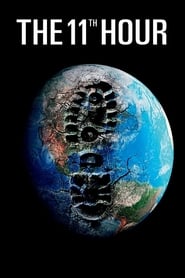
The 11th Hour
Download English Subtitle
Release info
Tags
English subtitle preview
The first 186 lines.
* *
(wild, pulsating electronic music plays)
(plaintive singing continues over wild electronic music)
You know, when you look at the history of humanity,
it's basically this great relationship
between the two most complicated systems on Earth:
human society and...nature,
and whether people have, in fact,
lived in a good balance in that regard,
and when they don't, they're gone.
And, you know, at the end of the day,
when we all talk about saving the environment,
in a way, it's misstated, because the environment
is going to survive--we're the ones who may not survive,
or we may survive in a world
that we don't particularly want to live in.
Our biosphere is sick.
We have a...a planet
that's behaving like an infected organism.
If you look at it from outer space,
you see all these lights, and it's the lights of...
of planet Earth, it's the lights of the people,
but it's also almost like looking at an organism
that has an infection on it,
that is forming a crust of some kind.
Well, I don't only think that the biosphere is in trouble,
I know it is.
I just have to look around in the environment
in which I live.
What I hear in my dreams
is generations in the future screaming back to us in time,
saying, "What are you doing? Don't you see?"
We are at this critical point in time, and we've evolved
to be the leaders of our biological community,
and we are misleading.
We are...we are causing the devastation
to our very foundation of our life system
that has given us birth.
And we are ultimately committing suicide.
So as we destroy nature,
we will be destroyed in the process.
There's no escaping that, uh, that conclusion.
LEONARDO DiCAPRIO: Earth's life-support system's damaged,
the human species at risk.
Could this be true?
In this film, we've reached out to independent experts
on the front lines
of what could be the greatest challenge of our time--
the collapse of our planet's ecosystems,
and our search for solutions to create a sustainable future.
So...if we look for the cause of this planetary destruction,
what would we find?
We would find a global civilization
created by the human mind--
a mind that has evolved to have the ability
to reflect back on ourselves,
to take stock of our own existence,
a mind able to discover quantum physics,
explore outer space, and peer into our own DNA.
But beyond our stunning intellectual
and technological advances, we would also see
our large-scale impact on our home,
planet Earth.
Now, ecological disasters are rarely covered,
but when they are, they're depicted as isolated incidents
by the media.
But if we connect these events,
will we find a larger story that needs to be told--
a human story?
And more so than that, a global understanding
that takes into account who we are
and the state of our relationship to this planet,
our only home.
Life on Earth is possible
only because a number of parameters
lie in certain very narrow ranges.
Some of these
are clearly environmental,
like the Earth has the right temperature and pressure
to have liquid water.
Creation is the universe.
Creation is everything that we can see
and probably a whole lot that we can't;
probably more that we can't see.
But it's what's about us,
and it's the...relationship,
this amazing, uh, web of life that we have here.
Well, Earth, um, is a planet that's...
just far enough from the sun
and has just enough of an atmosphere
of a certain composition that, um,
more heat stays here than radiates out to space,
and the sun warms the planet, and that heat radiates out,
and there's gasses in the atmosphere
that have always trapped some of that heat.
And that's why, uh, we're not an ice ball.
And there have been scientists who compared this whole business
of the different planets going away from the sun
as being, like, the Goldilocks Effect--
there's one that's too cold, one that's too warm
and one that's just right,
and we just happen to be there.
40 million centuries ago,
a cell formed, and that cell had a gene,
and that gene is a password
to every single other form of life there is.
And the amazing thing about the human body
is it has 100 trillion cells, and 90% of them
are not human cells-- they're fungi and bacteria,
microorganisms--and the thing that makes us human
is not human.
So within us is, basically, the backstory of life on Earth,
right to that first original cell 40 million centuries ago.
and if you could, for a moment, stop and feel
what is happening in your body,
there are six septillion things going on at the same time.
That's a six with 24 zeros after it, okay?
Going on right now, right this instant,
as you sit in your chair, and then in the next instant,
within ten seconds, a hundred more things have happened
than in all the stars and planets and asteroids
in the known universe in your body,
and that is called life.
Homo sapiens sapiens
is an incredibly young species.
We don't think of that, but we are.
We're...You know, we... we came very late
in the calendar year of the Earth, you know?
If the Earth, uh, calendar,
you know, where it started in January 1,
and now we're December 31.
We got here 15 minutes before midnight on December 31,
and all of recorded history
has blinked by in the last 60 seconds.
Perhaps the best description of what we are
is, as Jared Diamond puts it, "the third chimpanzee."
There are two kinds of chimpanzees, and there are us.
But in some ways,
we are extraordinarily special, and the most obvious one is
our extraordinary ability to make tools,
our extraordinary ability to communicate, to have...
very detailed discussions with each other.
So we are fundamentally
groups of, uh, animals,
randomly scattered throughout the planet,
slowly...coalescing in, uh, groups
that are more, uh, powerful, larger,
and very much conditioned
by two essential characters.
One is, um, opportunism,
and the other one is greed.
All the animals
and vegetables are opportunistic creatures.
They do what's necessary
for them to do in order to survive.
I think it was the human mind, basically,
that threw us out of balance with the rest of nature.
The tragedy is that it was the human mind
that was the key
to our very survival.
Now, when you think that we evolved in Africa
about 150,000 years ago,
and compared to the other animals that must have been
on the plains at that time, we weren't very impressive.
We weren't very many,
we weren't very big, we weren't gifted with special senses.
Um, the one thing, the key to our survival
and our-our, uh...
taking over the planet was the human brain.
But because the human mind invented
the concept of a future,
we're the only animal on the planet
that actually was able to recognize
we could affect the future by what we do today.
We look ahead,
recognize where the opportunities are,
where the dangers lay and choose, accordingly, to survive.
That was a great survival strategy of our species.
DiCAPRIO: If the human mind threw us out of balance
thousands of years ago, what changed in recent history?
In the last century, we have dramatically increased
our impact on planet Earth.
One element has emerged
that has made us even more destructive,
accelerating our disconnection
and causing extensive damage to our climate
The 11th Hour subtitles in other languages
More English subtitles for The 11th Hour
- The 11th Hour[2007]DvDrip AC3[Eng]-FXG-Italics · 58 downloads · 2008-04-20
- The 11th Hour LIMITED DVDRip XviD-iMBT · 75 downloads · 2008-04-07
- The 11th Hour LIMITED DVDRip XviD-iMBT · 65 downloads · 2008-03-28
Comments
No comments yet. Be the first to leave one.