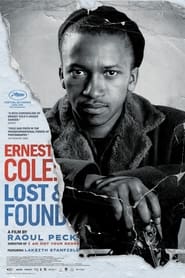
Ernest Cole: Lost and Found
Download English Subtitle
Release info
Tags
English subtitle preview
The first 200 lines.
"November 25th, 1968."
"To the Alien Commissioner, Norwegian Government,
Oslo, Norway."
"Dear sir, I was born on March 21, 1940,
at Pretoria, South Africa."
"I'm presently 28, and unmarried."
"I am a stateless person in political exile in New York."
"I've been advised
that my passport will not be renewed,
but that I could obtain
an emergency travel certificate."
"I've been in the US for the past 26 months,
and while this experience has been insightful for me,
I cannot afford to remain here much longer
since the nature of my work requires me to travel."
"Without wishing to be negative about life in this country,
it is quite evident to me
that it will be difficult for me to work here
at this particular period of my life."
"When I left home, I thought I would focus my talent
on other aspects of life..."
"...which I assumed would be more helpful
and with some joy to do."
"However, what I've seen in this country
over the past three years has proved me wrong."
"Exposing the truth at whatever cost is one thing,
but having to live a lifetime
of being the chronicler of misery and injustice
and callousness is another."
"And such matter is about the only assignments
magazines here want to offer me..."
"...because the subject matter of my first book
happened to be centered on race issues,
the color of my skin, another incidental matter,
and the fact that I endured and escaped
the living hell that is South Africa."
"The total man does not live one experience."
Well, it all started at the end of 1956.
I had just finished my second year in high school.
And instead of going further,
I decided to leave school
because the government had deliberately lowered
the already low standard of education for Africans,
with what they call the introduction
of the Bantu Education Act.
So, I decided this was going a little bit too far and I left,
and decided to finish my schooling by correspondence.
Then of course, it took me a year...
before I could get a break...
as a darkroom assistant.
So, in about May 1958, I got my first break
through a young German photographer,
Jürgen Schadeberg, on Drum magazine.
And...
because Drum was in Johannesburg,
which is two and a half hours away from my hometown,
I, you know, had to read my lessons on the train.
Later in 1959,
I saw my first photographic book,
which is entitled "People of Moscow"
by Cartier-Bresson. So, then I decided,
"Well, this is the form I wanted my work to take."
And slowly, I started documenting,
you know, just to show what life was really like in South Africa.
I was of course aware that after finishing it,
it wouldn't be possible to remain in South Africa,
but then I... you know, I didn't care
because this is a chance you take,
and all of us have taken.
You don't want, you know, to live under the...
those miserable conditions.
I've been banned in absentia, but that doesn't matter.
It'll stand, I mean, you know, in the future, because, uh...
I'm sure South Africa will be free.
Demonstrations against
the South African government's strict Apartheid policies.
At Sharpeville, an industrial township,
thousands gather outside a police station
in protest against new laws requiring every African
to carry a pass at all time.
Reporter 2:
Sharpeville, police fired into a crowd
of unarmed demonstrators,
killing 69, including women and children.
Reporter 4:
Worldwide protests were raised,
including a condemnation of the violence
by the United States State Department.
Operative paragraph three
of Document S/5384
which reads as follows.
Three calls upon all states
to boycott all South African goods
and to refrain from exporting to South Africa
strategic materials of direct military value
is now put to the vote.
Will those in favor
of that paragraph please raise their hands?
Translator:
The result of the vote
is nine in favor, none opposed,
and two abstentions.
The resolution, as amended,
has consequently been adopted by the Security Council.
The achievement in the towns,
new homes for over a million people in 12 years.
Budget, 120 million pounds.
One morning, in 1960,
government bulldozers came clanking down the road,
into the neighborhood where I lived.
This was Eersterust,
a freehold township ten miles past Pretoria.
Some would call it a slum, but I loved Eersterust.
I had lived most of my 21 years in that neighborhood.
My father, a self-taught tailor,
and my mother, a washerwoman,
had raised their six children in that house.
Once the bulldozers began their work,
they were quick about it.
Within minutes, the Black spot had been eradicated.
In South Africa,
a "Black spot" is an African township
marked for obliteration because it occupies an area
into which whites wish to expand.
The government describes relocation
as "slum clearance,"
and likes to brag about its housing developments
as a humanitarian solution to an acute housing shortage.
But the African knows, he is only exchanging his slum
that was home for the sterile prison
of a government ghetto.
The African does not also have the right
to walk the city streets of his country.
His presence in the white urban areas
is tolerated
as long as he's doing the required job.
At all other times, he is a trespasser,
unless he has his "reference book."
Without it, a Black man is nothing.
He cannot get a job, find housing, get married,
or even pick up a parcel at the post office.
A man's pass contains his life history
in brief detail.
It tells his name, where he comes from,
which tribe he belongs to, the place and date of his birth,
and his father's birthplace.
The pass tells whether he has paid his taxes
and indicates his grade of employment,
"domestic servant, laborer, student, clerk, etc."
The government can pull a man's pass
at any time, for any reason, or for no reason at all.
This happens
thousands of times in a day,
and still, it remains a spectacle.
Like in an Afrikaans Rashomon,
these characters are locked in their own narrative.
In this picture,
these three women in the background
show passive curiosity, or anxiety tinged with fear,
or downright panic.
The young boy behind seems to be reasonably reassured
that he is not to be the victim.
The Black policeman does his job by the book,
accurately and conscientiously.
There can be no objections to his routine.
He has a uniform, an income,
a place in society, more than any other fellow.
It is not clear from this photo
whether he was entrusted with a gun or not.
But gun or no gun, he remains his master's man.
And then,
there's this white-looking character
on the right.
Clearly passive, not even curious.
He has nothing at stake here. Both hands in his pocket.
He observes,
like he might observe a lizard devouring a fly.
A day like any other day.
Same incident, different realities.
Even in the court, the African must wait.
But once his turn comes, justice is swift.
The prisoners are led into the courtroom
in small groups...
...and one at a time, they are called forward.
One fine old British custom
survives in South Africa's penal system,
the whip.
In 1963,
according to records meticulously kept,
83,206 lashes were meted out to 17,404 prisoners.
House of Bondage.
I feel like I put my whole life into creating that book.
I risked my life every day.
I had to learn to shoot at eye level.
I had to shoot while walking.
It's a matter of survival.
To steal every moment.
But the monster does not even need to hide.
He is on a mission.
I am collecting evidence,
More English subtitles for Ernest Cole: Lost and Found
- Ernest Cole Lost and Found 2024 1080p AMZN WEB-DL DDP5 1 H 264 (SDH) · 46 downloads · 2025-01-17
Comments
No comments yet. Be the first to leave one.