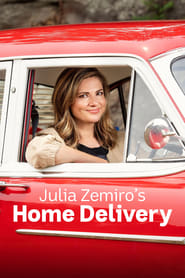
Julia Zemiro's Home Delivery
Download English Subtitle
Release info
Tags
Download English Subtitle Files for Mobile (10)
English subtitle preview
The first 200 lines.
Hi, I'm Julia.
This is Home Delivery where I take some of
my favourite people back to their childhood homes...
Hello, Julia. 50 years, they haven't pulled it down
and built a decent house.
..their schools... He pulled the strap out
and he started beating me around the head.
..their secret hideouts.
I'd break into here and I'd do my own little concerts,
but just for myself. There he is! Hello!
We'll meet their families and friends
and discover the forces that shaped them.
My main activity was sleeping.
Today I'm interviewing one of our greatest ever interviewers.
He has struck fear into the hearts of prime ministers,
leaders the Opposition and bureaucrats.
He's brought out the best in our stars of stage and screen.
He can be relentless, empathetic and he can even be funny.
But, look, whatever tack he chooses,
it's all about precision and getting to the heart of the matter.
It's the fearless Kerry O'Brien.
Oh! Look!
That's one of my best arrivals.
That is such a great sound, Kerry O'Brien.
It's like climbing up out of a lounge chair. Hello, Kerry.
How are you? I'm great!
What's this car? That's a Beetle.
That's a '60s vintage Beetle.
Just a few years older than the first car my father owned.
Well, are you ready for me to take you back?
Uh, look, I am.
I can't vouch for the driving, it's manual. Neither can I.
It's a manual, is it? Oh, God, how beautiful.
Good luck to us all.
As long as your bits aren't gonna start falling off.
I mean off the car - not me.
Welcome to the program.
Kerry O'Brien retired from Four Corners last year,
rounding out a remarkable career from This Day Tonight...
Do you feel that the Western world can and will return...
..to Lateline...
Is it the time to start getting tougher as president?
..to the 7:30 Report.
Good evening, I'm Kerry O'Brien. Welcome to the program.
I'm in his old stomping ground, Brisbane,
to find out what's next for this six-time Walkley Award winner.
I just tried to change gears with your knee then.
Yes, I know, but then I enjoyed it, to be quite honest.
It was delightful.
After the fourth time, you might think it's...
I'll think he's cracking on.
Oh, she's got power. (Laughs)
It's about 25 years since I drove a manual. Is it really?
This cemetery was a great landmark for me as a kid,
so I had - what does this tell you? -
day after day after day as a child,
first I would go past the cemetery where I would see the dead,
then I'd go round the corner past Boggo Road Jail
where I would see the incarcerated
and then I would arrive at school
where the brother was waiting for me with the strap.
Oh, my God.
Here we go. You know what?
I think this is the driveway that my father and I put down.
As we slowly unwind out of the car.
Now, does it look different?
I instantly recognise, that was Mum and Dad's bedroom,
that was my bedroom with my younger brother, Paul,
that was Barbara's bedroom.
And, uh, this place went right under in the '74 flood.
It was about 6ft over the top of the roofline. (Gasps)
Mum and Dad never lived in the house again.
We lost all the family photos,
they lost all their written records of things.
Oh, Kerry, that's terrible.
Mum... It was a great moment of joy for Mum
when she bought a piano when we'd moved in here,
and she used... I'd come home from school
and she'd be playing piano.
The piano was destroyed and they never did get another one.
So, that was a real blow.
They would've been in their early 60s then.
And how old were you when you moved in here?
Uh, I was just 12. So 1957.
Ha! I remember my sister driving up here once
with her boyfriend, and I'd been out at a party,
and I was chundering out my bedroom window.
It was the full gaze of the...
Having a good old vomit out the window, Kerry.
I love finding out these things about you and your drinking experiences.
Kitchen. Where was your dunny?
The dunny was here. Great.
Dunny was probably... right here.
That's a long walk back to the bedroom.
Were your family very political?
Uh, Dad certainly was.
His father was a foundation member
of the Rockhampton branch of the Labor Party.
He was also very strongly Catholic,
and he was one of those whose ties to Catholicism
were stronger than his ties to the Labor Party
and he went DLP in the split.
Shall we go in?
I'll let you go in first 'cause it's your old house.
This would've just been a timber door with a little frosted glass.
Uh...
OK, it's gonna take me a second to get my bearings here. Um...
God, you know I just had a flash
of Mum standing at the sink, washing up.
This was... Yeah, lounge is pretty much exactly as it was.
It was L-shaped lounge-dining.
There was a little tiny serving window there.
Mum's piano was over in that corner. Aww.
Lounge chair's here, facing the television, when we go it.
When you eventually got it. Yeah.
And the kitchen...
That was mostly wall and this was where the kitchen table was.
So, lots of family conversation.
Dad would sit at this end of the table,
and he would have to have his tea ready
to have with the start of his meal.
Everything - tea, food... Yeah.
And he would have two cups of tea with dinner, two teaspoons of sugar.
And he would get cross if the tea wasn't ready when he sat down.
He wasn't a tyrant, I mean,
I'm just giving you tiny little snippets.
But, you know, in my teen years,
I would have a lot of late-night conversations with Mum at this table
when I'd come in from some party or other,
and she'd get up in her chenille dressing down.
And I think that was a very strong, ongoing bond for us,
and I think she was probably a kind of calming influence for me.
You shared a room with your brother Paul,
so you would've been 12 and he's 5.
What's it like sharing a room with a little kid?
Uh, well, I remember...
I've got clearer memories of when he was older. Yeah.
Because I stayed in this house until I was 22. Right.
So, of course, here... Tony your eldest brother didn't live here.
Never lived here. He actually went off and became a Christian Brother.
We were living in Warwick, I was 7, he had just turned 14,
and strong Catholic family,
and like all strong Catholic families,
we were told from the pulpit there could be no greater thing
that a Catholic parent could do than to give a child to God.
We went to the local station, and he climbed on the train
and disappeared into the distance down to Sydney.
And he was big in my life, my older brother.
I haven't thought a lot about what difference it might've made,
but it could've made a lot of difference to... Well, yeah.
I might've been a somewhat... less wild child.
So, you're here...
At this stage though, with your elder sister Barbara...
Barbara was three years - and still is, actually...
She'll always be three years older. I was...
I had just turned 12 when we moved in here.
This was the first house Mum and Dad actually owned.
I can remember Dad going to his first St Patrick's Night dinner
and coming home scandalously late - it was probably about ten o'clock -
and Mum had gone to bed and I opened the door...
He either was fumbling for his key or he'd lost it,
and I had to open the door to him
and stood there beaming like an idiot, you know?
And it was the first time I remember seeing him...
And I very rarely saw him noticeably affected by alcohol.
And he was just nicely... funny and mellow, yeah.
Dad and Mum, quite different people. Mm.
But he was by nature a gentle man, but he had a streak of anger in him.
Mm. And so did I in the end, you know?
And I've thought a few times about that,
and I suppose when I think about my school days,
I can probably understand why.
So, what does it feel like to be back,
having been in the little area and...?
Oh, a little bit unsettling. Um...
'Cause you're the eldest boy here at this stage
'cause Tony's not here, so...
But I never saw myself that way.
And I don't think Mum and Dad did -
it was really, you know, Barbara was the older sibling.
And, you know, Tony, he did brilliantly at school
and then the Christian Brothers allowed him to go to Sydney Uni
at the age of 20,
and he'd left them by the end of his first year
and he was married six months later.
Wow. Um...
And then got a scholarship, or a fellowship, to Harvard,
and he then finished his degree and his Masters and his PhD at Harvard,
and lived in America thereafter.
Catholicism was a big part of your life.
Is it still? Are you still a Catholic? No. No.
But I think I still wear the brand.
What does that mean? 'Cause I'm a non-believer.
What's the brand? You belong to...
I think for a thinking Catholic, the brand is social conscience.
What made you sceptical about it? When did you start questioning?
I can remember, every now and then at school,
we would have a three-day retreat where you weren't supposed to talk
and you would do very holy things - you'd go to mass, you'd pray -
and I remember this particular priest telling us
More English subtitles for Julia Zemiro's Home Delivery
- Julia Zemiros Home Delivery S09 WEBRip iview · 32 downloads · 2022-07-16
- Julia Zemiros Home Delivery S06 WEBRip iview · 45 downloads · 2021-08-04
- Julia Zemiros Home Delivery S05 WEBRip iview · 32 downloads · 2021-08-04
- Julia Zemiros Home Delivery S03 WEBRip iview · 30 downloads · 2021-08-03
- Julia Zemiros Home Delivery S02 WEBRip iview · 29 downloads · 2021-08-03
- Julia Zemiros Home Delivery S01 WEBRip iview · 34 downloads · 2021-08-03
- Julia Zemiros Home Delivery S08 WEBRip iview · 31 downloads · 2020-07-08
- Julia Zemiros Home Delivery S07 WEBRip iview · 17 downloads · 2019-12-11
Comments
No comments yet. Be the first to leave one.