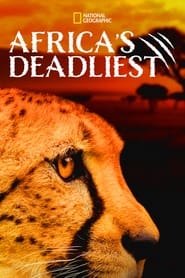
Africa's Deadliest
Download English Subtitle
Release info
Tags
Download English Subtitle Files for Mobile (3)
English subtitle preview
The first 200 lines.
Long after the age of dinosaurs,
giants still roam this planet.
Engineered to withstand the test of time.
They come with supersized bodies.
Thick skin.
Sharp teeth.
And bad attitudes.
This is the world of giant killers.
AFRICA'S DEADLIEST
In Africa, lions are apex predators.
It's an accolade that doesn't come easy.
They have to earn it.
And the lessons start with Mom.
She's a master hunter,
and lethal in taking down prey.
She provides, but not forever.
By the age of three, the young males are forced out of the pride.
Now they must look after themselves.
This young lion lacks the skill and the experience to hunt on his own.
For the next year and a half, he must scavenge to stay alive.
If he's going to survive, he needs at least one partner.
The meeting of these two future kings marks the beginning of a reign of terror.
Between them, they can eat 300 pounds in a sitting.
On their shopping list, almost a fully grown wildebeest
every third or fourth day.
In the next 24 months, this bond will spread fear across the plains.
Together, they weigh almost the same as five fully grown men.
As a new coalition, they can take down bigger prey.
Which is bad news for buffalos.
These bovines carry close to a ton of meat.
But they're no pushover.
They come with a pair of lethal horns.
They are notorious for turning the tables on their attackers.
But these two males simply cannot resist
the challenge of taking down a worthy opponent.
They need to get very close to their prey.
At least within a hundred feet.
Lions are built for short bursts of power.
They don't do long distances.
The mother and her calf should rejoin the herd. Now.
But it's too late.
Razor-sharp claws pierce her flesh.
Each nail is one and a half inches long and hooks into her body.
To kill her, they must topple her.
One lion seeks a grip on her windpipe.
The other jumps on her back.
Raking her hind legs with his sharp claws.
Her death seals the fate of her calf.
He's next.
Hunger satiated, the two males are now driven by an instinct to mate.
To do that, they need to find a pride and dethrone the dominant males.
The invaders split up.
One takes on the old king.
The other tackles the second-in-command and his female supporters.
There's a lot at stake for these two muscled upstarts.
They can be severely injured or even mauled to death in this battle.
But they emerge the victors.
The new masters waste no time in advertising their new status.
They're in top form, and hungry.
A fully grown elephant is a dangerous animal.
They can trample a lion to death.
But a youngster with no experience is an easy target.
This time, there's no need to ambush.
They rely on pure strength.
With powerful muscles in their hind legs and chest,
lions can leap almost 40 feet onto their prey.
The male with the darker mane is the dominant one.
He jumps on top of the elephant and tries to sever the spinal cord.
The second male goes for the throat.
There's bad blood between elephants and lions.
But experts are beginning to notice
a greater aggression in elephant herds towards humans.
And it's scary.
No. No.
No.
Come on, move.
Move.
Easy, easy.
Hey!
Hey! Hey!
When six tons of elephant come at you at 28 miles per hour, you run.
Apart from size, their deadly tusks
can gore the thick skins of hippo and rhinos.
The story of this old bull could explain
why elephants are turning into giant killers.
His name is Isilo, "the big one."
He's one of a dwindling number of elephants on the planet
with gigantic tusks.
They are at least two and a half yards long.
And combined, weigh more than 120 pounds.
For almost 60 years,
Isilo has guided young bulls toward maturity.
The lessons start when adolescent bulls leave their mothers
between the ages of 12 and 20.
Older bulls like Isilo teach these bachelor boys the lay of the land.
They show them how to be dominant, without being bullies.
In their early teens, the sub-adults become sexually active and unruly.
The older bulls nip this friskiness in the bud.
Discipline keeps the raging hormones of young bulls in check.
But in some places in Africa, parental control is absent.
Every day, about 100 elephants are shot for their ivory.
Poachers target big bulls like Isilo.
On the black market, his tusks will fetch more than $20,000.
But if you kill off the big tuskers, the bull hierarchy disintegrates.
14,000 pounds of raging elephant versus a small vehicle.
And the problem is only getting worse.
Where poaching is rife, young bulls become sexually active much earlier
because they don't have to compete with older bulls anymore.
And their bodies are flushed with raging hormones more frequently.
This could account for the increase in aggression.
Elephants could also be suffering from post-traumatic stress disorder.
An elephant whose family members are killed by people
is unlikely to forget it very quickly.
Just like we wouldn't forget if an elephant killed one of us.
In the dry season, hippos and elephants often compete for food.
This old bull wants exclusive rights to this river in Zambia.
But the hippos won't budge.
From an elephant's perspective, this is a blatant act of provocation.
A newborn calf gets separated from his mother in this standoff.
This elephant weighs at least 100 times more than the baby.
One step could squash it.
The mother waits for her calf to resurface.
It doesn't.
When giants clash, the young are often caught up in the middle.
Not many predators would attack a fully grown elephant.
But a baby is fair game.
And this one is on the menu of one of Africa's most feared killers.
Crocodiles.
Possibly the largest crocodile ever seen
lurks somewhere in the Rusizi River in Burundi.
Witnesses say he is 20 feet long and could weigh as much as 2,000 pounds.
He was last seen in 2008.
This huge man-eater is said to have killed 300 people.
Every attempt to catch him has failed.
He could still be out there.
When these giant predators hunt, they don't discriminate.
They will strike man or beast if the opportunity arises.
Their eyes look like periscopes on submarines.
The perfect design for an ambush predator
that wants to hide a bear trap of a jaw and a massive body.
Crocs can pinpoint their prey in 3D
and calculate the exact speed and distance needed to make a kill.
Underwater, they're in their element.
A semitransparent membrane slides over their eyes.
They can detect small objects within striking distance.
And they can hear low frequencies that we can't.
If there's a tiny vibration a few feet away,
they'll find the source.
Crocodiles are both deadly carnivores and caring reptiles.
This croc is a super-mom.
She babysits and plays taxi.
But given half a chance,
she'll turn into a cannibal.
A juvenile in the mouth of a croc isn't playtime.
It's a meal.
A recent study found that crocodiles
have the strongest bite on the planet ever measured.
And a very powerful tail.
In water, they clock 25 miles per hour.
Five times faster than a relatively good swimmer.
But their deadliest weapon is the fact that
they can launch half their body length out of the water as far as five feet.
The elusive man-eating crocodile in Burundi
has the power to attack and kill sub-adult hippos.
But here in the Luangwa River in Zambia,
crocodiles not only target the living.
They also rip into the dead.
The largest crocodile eats first.
And he can consume half his body weight in one sitting.
A thousand pounds.
That's the size of a horse.
Nothing stops a crocodile from getting his quota.
Not even lions.
In lean times, crocodiles can retreat into a den
and slow their heart rate to two or three beats a minute.
With a slower metabolism, they can survive two years without eating.
Like assassins gone into hiding,
they wait for the tide to turn.
And when it does, they emerge with their fat reserves depleted.
To catch up, crocs eat as much as they can in the shortest possible time.
Like all creatures, buffalos approach rivers with caution.
They always grow quiet here.
They're weary of crocodiles and other predators.
One would think these bovines are easy pickings,
but nothing could be further from the truth.
Buffalos are one of the most dangerous animals in Africa.
Hunters call them the widow-makers.
If there's a threat, buffalos don't give a warning.
They'll storm their enemies at 30 miles per hour
and ram them with their lethal horns.
Each year, buffalos gore more than 200 people to death.
It's the horns that kill.
They can be as long as 60 inches.
And they sweep upward in a deadly curl.
Young bulls must bulldoze their way up the ranks.
The fight can last for hours.
It only stops when one is dead or throws in the towel.
A broken horn signals the beginning of the end.
The old bull won't bleed to death,
but this injury reduces his chances in a fight.
More English subtitles for Africa's Deadliest
- Africas Deadliest S03 WEBRip x264-ION10 · 31 downloads · 2023-04-19
- Africas Deadliest S03 WEBRip x264-ION10 · 25 downloads · 2023-04-19
- Africas Deadliest S01 Killer Tactics 1080p NF WEB-DL DD5 1 x264-AJP69 · 50 downloads · 2018-04-13
Comments
No comments yet. Be the first to leave one.