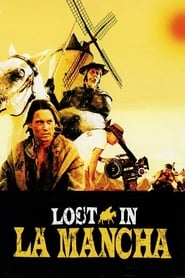
Lost in La Mancha
Download English Subtitle
Release info
Tags
English subtitle preview
The first 200 lines.
As long as I can remember, I think he was talking about
doing Quixote. He believes in Quixote.
It's Terry's sort of film.
It mixes all his humor, his fun, his joy and his darkness.
It's the best sort of Terry Gilliam.
Every film Terry makes, Terry somehow manifests himself as the characters.
And yeah, Quixote, there he is, a man charging against windmills.
This has been bugging me for a long time,
Quixote has been dogging me.
The first time we started this, trying to get Quixote on the page was around 91.
I had been fantasizing this for a very long time.
I made the film in my head.
The pictures were there. It's been played out many, many times.
Quixote has obsesses me for years,
because all my stuff has has been about reality,
fantasy, madness, sanity. Quixote encompasses all of those.
Exterior. Spanish hilltop. Day.
In black and white. An ancient stone windmill.
Okay, cut. You know what I mean?
- Sorry. - Back to the top.
- It's always hard... - Back to the top.
- Terry, Tony? - ...the first scene. This tension.
OK, you guys ready?
- We're going back? - From the top.
I'm gonna go and roll now. Scene 1, take 2.
Exterior. Spanish hilltop. Day.
An ancient stone windmill spins slowly in the breeze.
Don Quixote appears, gaunt, aged, a madly fierce gleam in his eyes.
Stand your ground, foul and fearsome giant!
I am Don Quixote de la Mancha!
Next to him is his fat partner, Sancho Panza.
- It's just a windmill! - Stand aside, Sancho!
Don Quixote lowers his lance and charges the windmill.
The lance impales the sail and Don Quixote is wrenched from Rocinante
and spins high in the air hooked on the revolving sail.
It's starting to look... See it's like out that way.
Terry Gilliam the maverick director behind such films as
Brazil, The Fischer King and 12 Monkeys,
has been trying to mount a film production of Don Quixote for more than a decade.
It's interesting down there.
So the military map has loads of old windmills back there.
That's good. If we can get in there, that'll be interesting to see.
After several false starts and financial mishaps with the project,
Gilliam has finally arrived in Spain to begin production.
Don Quixote seems to be at the back of Terry's work for a long time.
In the broadest sense, he's a hero that would appeal to Terry,
because the notion of someone gleefully
battling in the face of all odds, and logic and reality,
is one that appeals to him.
What happens in Cervantes' Don Quixote
is that you meet a man, an old man,
a man who surrounds himself with romantic novels,
tales of the deeds of great knights.
He then decides that he will go forth
and actually live out these romantic tales himself.
And so he puts together a suit of armor
out of bits and pieces he finds around the house.
The famous helmet is a shaving basin
with the piece cut out for the neck.
He saddles his horse Rocinante, who is an old nag, is falling to pieces.
All he's missing is his faithful squire.
And Sancho Panza is a short, fat guy with a donkey, a peasant.
So they set off and they start to look for daring deeds to do.
Quixote is so deluded that where other people see a windmill,
he sees a giant.
where other people see a windmill's sails, he sees the flailing arms of those giants.
Quixote's delusions are a major part of his appeal for us.
We want to see the world through Quixote's eyes.
Because the way he sees the world, I think,
connects with the way that we saw the world as children.
A world where objects did have a magical significance.
Gilliam has fought many battles to bring his vision of Quixote to the screen.
After several unsuccessful attempts to develop the project in Hollywood
he decided to produce the film in Europe.
Quixote will be among the most expensive films
ever produced solely with European funds.
Ladies and gentlemen, we just,
basically just called this meeting
because we haven't had a sort of open forum.
At least, that is, until now.
We're missing a few people of course,
but this is, you represent
the main bodies of the film
that are under work at the moment.
This is the first time that we have Senor Gilliam in Spain
and he's here to stay. So there's no excuses for any of us now.
If we have any questions, if we have any doubts
or there's something we want to know, this is the place to come to.
I've said this to a few different people, I don't know if I said it to everybody,
but I think it's going to be great.
I think everyone's got a good sense of humor,
Everybody's smart, everybody's good at their job
And you, with any luck, will protect me from making an utter fool of myself.
One thing to say is, you know I'll keep demanding all sorts of things.
And you've got to scream, earlier than later. Say "no, can't, can't do it."
Because we all know that we are working on a budget that is way below
what we normally need to make a film like this.
We gotta do it for what we've got and find ways of doing it.
Basically, let's get on with it.
He's here now, he's a resource, let's use him, let's drain him.
He knows the film. He's been with it for... 2 years?
Let's give it 10. Let's give it the whole decade.
Let's go with 10 years. He knows it for 10 years.
So he should know what he's doing.
Gilliam is not the first filmmaker
to have struggled to bring Quixote to the screen.
In 1957, Orson Welles began production
on his own adaptation of Don Quixote.
The project would become Welles's creative obsession for the next two decades.
In a village in La Mancha, whose name I prefer not to recall...
Welles took on various acting and directing projects to help finance the film.
He would gather bits and pieces of footage whenever he could,
even after the project outlived Francisco Reiguera...
Welles's Quixote.
But by the time of Welles's death in 1985
Quixote remained incomplete.
The struggle to launch Quixote began just a year ago
when Gilliam actually started pre-production on the film
only to have a major financier back out at the last minute.
In order to get the film going this time,
Gilliam and his producer have had to scale back the budget,
from 40 to 32 million dollars.
The budget of this thing is about $32.1 million.
Which by European standards
without American investment
is a big chunk of change.
For what we're trying to do, it's half the money we need.
In Gilliam's adaptation,
he has taken the fantastic story of Don Quixote
and embellished it with another layer of fantasy.
He's created the story of Toby Grosini,
a modern day advertising executive who travels back into the 17th century
where Quixote mistakes him for Sancho Panza.
Johnny Depp stars as Toby,
Vanessa Paradis plays Toby's "love interest" Altisidora,
and the veteran French actor Jean Rochefort plays Don Quixote.
The script is as ambitious as anything Gilliam has ever attempted.
Stand your ground, foul and fearsome giant,
I am Don Quixote de la Mancha!
It's not a giant, it is a windmill!
I am Don Quixote de la Mancha!
It's not a giant, it is a windmill!
More intense. "It's not a giant..."
It's not a giant, it is a windmill!
I must say, there are very few scenes that are simple.
Terry as we all well know,
has the tendency of
overloading everything.
I mean there is nothing ever
simple and plain.
They'll be on things so they can walk down.
Yes, that's what you're saying. I know.
So he ends up like a kid holding on to it.
We rig this thing so the camera can get like that.
Because looking down will be amazing.
Terry came to make a Hollywood movie without Hollywood, it's almost impossible.
The difficulty is making a film
the best possible way
with the money we have.
I think that's the better face.
Now, the sheep can go here very nicely.
They come around that curve, tons of sheep.
This will be very tumultuous. This film will not be easy.
Making a film with Terry, is like riding a bareback pony.
Just grab on to the mane,
dig in the heels
and the knees and hang on. Because you're in for the ride of your life.
Distant thunder.
- What's that? - Don't look.
Toby goes to twist around in his saddle.
- Something's coming. - There's nothing there.
Please don't look.
Giant shadows rise across Toby.
He turns, he looks back.
Three giants loom up over the brow of the hill.
In their hands are great cudgels.
One plays castanets.
The third is fantastic.
Come to me.
You've got to see the giants.
What is terrifying and what is extraordinary about it,
it's suddenly you're seeing what Quixote sees.
And it's like nothing you've seen in film.
Altisidora and Toby charge down a corridor.
She wheels her horse. They set off down a dark tunnel.
Sounds echo behind them - their pursuers.
They emerge into an utterly dark space. Altisidora reigns in her horse.
- What's wrong? - I thought this was the way, but...
- Halt! - They turn and are confronted by...
- ...Don Quixote. - Traitor! Judas!
As Don Quixote moves forward, we see he is a giant puppet.
Toby and Altisidora are suddenly surrounded by a dozen armored guards.
The guards are puppets too.
When this thing splits apart, Toby has got to have his arm getting caught in it.
There is no way to get his arm caught when it comes back together.
- Absolutely. - Have his arm caught?
Yes, this is like whole a key bit.
Could the whole thing become... just chop and pull it, push it, make it thinner
so that when get gets his arm in there.
- So really that his... - No, no...
Lost in La Mancha subtitles in other languages
Comments
No comments yet. Be the first to leave one.