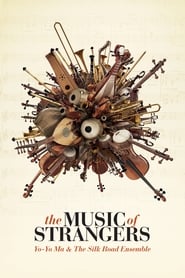
The Music of Strangers: Yo-Yo Ma and the Silk Road Ensemble
Download English Subtitle
Release info
Tags
English subtitle preview
The first 147 lines.
(RUSTLING)
So, this is my cello.
Have you ever seen one before?
(CHEERING, APPLAUSE STOPS) (CHATTERING)
ANNOUNCER (ON PA): ...the many faceted career of cellist Yo-Yo Ma is
a testament to his continual search
for new ways to communicate with audiences...
Mr. Ma maintains a balance
between his engagements and his solo...
He's recorded over 90 albums,
including more than 17 Grammy Award winners.
...studied at the Juilliard School...
I didn't get in there...
...President's Committee on the Arts and the Humanities.
After Mr. Ma's remarks tonight,
we will have an opportunity to ask questions...
So without any further ado, please welcome Yo-Yo Ma.
Hi there.
Hi.
I'll start off with this. There's an old joke.
A six-year-old boy tells his father,
"When I grow up, I want to be a musician."
And the father looks at the son,
shakes his head sadly, and says,
"I'm sorry, son,
you can't do both."
I think when I was a kid,
a lot of things just happened.
There has come to us this year
a young man aged seven,
bearing the name Yo-Yo Ma, (MUSIC CONTINUES)
a Chinese cellist playing old French music
for his new American compatriots.
Being good at something can carry you really far
for a long period of time,
and not require a lot
of introspection, right?
Because... you're good at it
and everyone tells you that.
I would think that somebody who has mastered his art
so early in life, so completely,
would have the problem that most wunderkinder have,
which is, how do you keep your interest up?
That's part of my problem. When you grow up with something,
you kind of don't make a choice.
I never committed to being a musician.
You know? I just did it, I fell into it.
I was interested in a lot of things, but...
I didn't particularly pursue any of those.
Leon Kirchner said to him when he was young,
"You're a phenomenal musician,
but you haven't found your voice."
And this notion was stuck in my dad's mind.
"What does that mean? How do you do that?"
I think he started looking for answers.
I'm always trying to figure out at some level
who I am and how I fit in the world,
which I think is something
that I share with seven billion other people.
I was calling my mom in Damascus
before... before you guys came in.
And she's like, "Oh, Kinan, did you clean the place?"
I'm like, "Yes, Mom, it's okay." (MAN LAUGHS)
She wants to make sure... Moms are always moms.
No, she wants to make sure that the CDs are not here,
because, you know, they're there and, you know, it's like, "Is it all tidy?"
I said, "Yes, I've tried my best. It's going to be fine."
I mean, growing up in Damascus was great.
Just had, you know, lots of friends and family.
I don't think of myself as somebody who just,
you know, packed his stuff and left, actually.
I mean, I still have a little apartment back in Damascus.
And my parents are still there.
I miss it a lot. I do miss it.
Now I'm thinking a lot like, "What is home?
"Is it where your friends are? Is it where your family are?
"Is it the place where you grew up
or is it the place that y... where you want to die?"
I mean, you know, all the... all these questions,
and I think now I'm realizing that
it's basically the place where you feel you want to contribute to
without having to justify it.
And here is your coffee,
whoever wants my little Arabic coffee.
I mean, since I left Syria, lots of things have changed.
There's always a fight in each one of us
between believing in the power of the human spirit
and dreading the power of the human spirit.
March 2011...
when the Syrian revolution started...
I found myself experiencing emotions that are, by far,
more complex than...
than what I can express with my music.
So the music fell short,
and I found myself not able to write any music.
Like, can a piece of music stop a bullet?
Can it feed somebody who's hungry? Of course, it doesn't.
You question the role of art altogether.
When I was a student at Harvard,
Leonard Bernstein came to visit.
In his lectures, he was searching
for a universal musical language.
That idea stuck with me ever since.
What's the relevance of all this musical linguistics?
Can it lead us to an answer
of Charles Ives' unanswered question, "Whither music?"
And even if it eventually can...
does it matter?
The world totters, governments crumble,
and we are poring over music.
Out of the 35 years I've been married,
I've been gone for 22 of those years, away traveling.
I used to throw up before every trip,
you know, just... I would just feel so awful and anxious,
and just like, you know...
it's like I'd get so paralyzed.
What is my role?
I'd better find a good reason to say, "Why am I doing this?"
(CHATTERING)
(LAUGHTER)
Play... play a song.
Which song? Um...
play... "Iron Man."
Let's own it.
My interest is kind of jump out of the box...
...not only limiting myself as a Chinese musician or pipa player.
Yes!
Yeah! Woo-woo-woo-woo!
Thank you, thank you.
Hey, wait. What do you do? This...
I mean, Wu Man was not supposed to be here.
She was just supposed to be a music professor, right,
at the Central Conservatory or somewhere in China.
I remember 1966,
starts the Cultural Revolution.
And then my parents actually asked me to learn music...
to escape from that situation.
Wu Man was in the first class of students
that reentered Conservatory
after the Chinese Cultural Revolution,
and she became a sensation overnight.
We had no information about Western culture.
Right after revolution...
everything was destroyed, culturally,
so we are, I guess, standing on the ruins,
dreaming, "What's the next music?"
Oh! Surprised they open.
The Music of Strangers: Yo-Yo Ma and the Silk Road Ensemble subtitles in other languages
More English subtitles for The Music of Strangers: Yo-Yo Ma and the Silk Road Ensemble
- The Music of Strangers 2015 1080p HBO WEB-DL DD+5 1 H 264 · 29 downloads · 2017-10-15
Comments
No comments yet. Be the first to leave one.