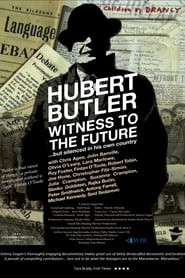
Hubert Butler Witness to the Future
Download English Subtitle
Release info
Tags
English subtitle preview
The first 200 lines.
My father, when asked to describe himself,
he would always describe himself as a market gardener.
Perhaps the most apt description of Islamic State
is to be found in Hubert Butler's The Invader Wore Slippers,
in which Butler defined Ante Pavelić's fascist Croatia as,
quote, "The extraordinary alliance of religion and crime."
Hubert believed in a slap being a necessary thing to administer.
He writes in a way that is utterly distinctive.
You know, the maker's name is on the blade.
This is one of the great essayists,
you know, and not just one of the great Irish essayists.
He really is one of the great figures in the history of this form.
To pick up a book of essays, which was just so fresh,
it could have been written in our own day.
This man was 50 years ahead of his time.
Butler became international, and his time had come.
It's always dangerous to speak for the dead,
but I have a hunch that Hubert Butler might agree when I say
that nationalism and religion,
so often the scourges of humanity in the past,
are in danger of blighting our young century.
If Butler were around today,
the bumper sticker he might have on his car would be,
"Act locally, think globally."
You know, that's very much, I think, the way he tried to frame his own life.
Hubert Butler was born into very much what you might call
County Unionist Anglo-Irish society.
His parents are unquestioning, really, of the political status quo.
It's-- it is about King and Empire,
but they are also very much responsible citizens,
they look after their local community
and feel a strong commitment to Bennettsbridge,
the village where Maiden Hall was located.
And so I think he grows up, in what he remembered later,
as a blissful, kind of pastoral childhood.
And then very rudely is, in his estimation, sent off
to school in England at the age of nine.
And this is a great trauma to him as he recalled it later.
So, he's sent off to prep school at a place called Bigshotte Rayles
and then gets a scholarship to go to public school, to Charterhouse.
But this, of course, meant travelling back and forth,
taking the mail boat home.
And it was during one of these trips that he actually passed through Dublin
in the days right after the Easter Rising.
And for him, this was a sort of epiphany,
because he-he says the buildings were still smoking
as he passed through Dublin.
Of course, the Great War was going on
and he was being trained to get ready to go off to Flanders.
But he said in a way it felt like what had happened in Dublin
was much more his war.
And so, his academic career is really stellar,
and-and that leads him eventually to St. John's College in Oxford.
And at Oxford, he happens to meet some young people from the new states,
from Czechoslovakia, from Yugoslavia.
He says, at Oxford in-in-in 1918,
"There was springtime in the air."
It was about the breakup of empire and the emergence of new states,
inspired often by a kind of Republican ideal.
His mother, particularly, Rita, she supported the union with Britain.
And she was extremely upset by Hubert's wanting to be a nationalist,
that he shouldn't want to live in Ireland and work in Ireland.
And so she had the bright idea of writing
to her cousin who, of course, was Lord Grey of Fallodon,
the British foreign secretary at that time,
who was a cousin of Hubert's mother,
hoping that she could persuade Lord Fallodon
to get Hubert into the diplomatic service.
The same man who, of course, a few years earlier had said--
and we're celebrating a hundred years of that now--
"The lights are going out all over Europe.
I-I think we shall not see them lit again in our lifetime."
Hubert was wise, missed out being a diplomat and became, finally,
what he would want to be remembered as, as an Irishman,
in the mode of Wolfe Tone and Henry Flood.
"There's no barriers north and south, against the border, I am an Irishman."
That's how he wanted to be remembered,
and I think he is and will be…
without barriers.
So there's a famous essay by Butler called The Auction,
in which he describes how his mother is very worried about him
as this adolescent who has somehow caught the infection of nationalism,
which there's this sort of extended metaphor in the essay
about it being akin to catching tuberculosis,
and his mother wants somehow to inoculate him against this.
So, he clearly becomes more and more enamoured
of possibility of being an Irish nationalist
and participating in all the change.
Tony Guthrie, who Butler meets originally as an undergraduate
at St. John's Oxford.
Tony and Hubert really become fast friends here in Oxford,
because they identify as Irishmen in Oxford.
He meets Peggy through Tony,
and there's clearly something going on there.
Tony organises a walking holiday--
Sligo, actually-- for himself and for Peggy
and for Tony's to-be wife Judy.
And the four of them spend the Easter Holiday walking together,
and that's really the beginning of the romance.
Peggy Butler was a trained painter.
She had been to our school in London.
And I was aware that she was interested in painting when I was a child,
but I was not aware at how good she was.
Later, when I saw her work hung at Maiden Hall,
I thought, "Wow, she could have been as famous a painter
as her brother, Tyrone Guthrie, was
an internationally famous theatrical producer."
He is clearly not interested in becoming a gentleman farmer
like his father has been.
And so he actually comes back to Ireland
to go to work for the Carnegie Library Network
under the influence of Horace Plunkett,
and he's very much clear that he wants to participate
in the building up the new-- the new nation.
But at the same time, there's this tremendous sense
that it's going to be hard to make a life as a young Irish Protestant,
given all of the challenges that that community would be facing.
So, I think it's fair to say
that there is both a certain pragmatic reason for Butler going abroad,
but there is also clearly a sense that he wants to explore the world,
and he's deeply invested in the idea that Irish people should be cosmopolitan.
Butler, always alluded to,
was that Ireland was one of the 15 or so secession states
that emerged out of the first world war, out of Versailles.
And that it, he felt,
was in a unique position to lead the kind of understanding
of what it meant to be a secession state,
to be a new state in the interwar period.
And he stayed loyal to that idea.
Yugoslavia was. Ireland was.
Czechoslovakia was. Other states in the east.
So that eastern focus preoccupied him
because he always saw himself as an inheritor
of the consciousness of a secession state.
Russia was the successor of the collapsed Czarist empire,
so it was allied.
So, what does he do?
"The great Russian writers, Tolstoy, Dostoyevsky, Chekhov,
were almost always more conscious of diversity of temperament
than of uniformity of needs.
Then Karl Marx and the revolution created the Economic Man,
and while this wonderfully lifelike dummy is in the shopwindow,
what hope is there for the genius that is kindled by human diversity?
I once tried to talk about these things at Goskurs
during the dangerous half-hour of free conversation,
when my pupils and I, under cover of grammar,
tried to find out what we were like.
One of them helped me out with the cliché, 'ghosts of the past,'
which quenched what I had to say,
and instead I said that Petersburg, like Alexandria and Constantinople,
had the tremendous toughness of cities
that were built around an idea, not a market.
Peter's 'window upon Europe' had been made for autocrats and bureaucrats,
but once opened it could not be shut.
Marx came through,
as well as Dickens and Byron and George Sand and Henry George
and all the strange assortment of foreign influences.
Tolstoy, no less than Dostoevsky the Slavophile, had hated Petersburg
and its Western culture,
as the oyster hates the foreign body it turns into a pearl,
but they could not ignore it.
And what they had accepted and adorned, their successors could still less ignore."
He knew the language. He translated Russian.
He translated The Cherry Orchard for his brother-in-law, Tyrone Guthrie.
He loved Russian writers like Gogol and Lermontov
and those unpredictable, slightly wacky insights
that-that they had.
Sean O'Faolain once told him he could become an Irish Gogol
if he was dotty enough to be-to be an Irish Gogol,
which he-- Hubert wasn't dotty,
and-and he didn't quite become that. He became something else.
He told me about Ukrainian nationalism
years and years and years before I dreamt such a thing existed.
You know, this is way, way back in-- probably in the-in the late '80s.
I hadn't realised how important those nationalisms had continued
to be in the Soviet world.
And, of course, we've all caught up with them since.
But then he comes back to London
and starts learning what was then referred to as Serbo-Croat
at the-the School of Slavonic Studies.
And so, this really prepares him to go out to Yugoslavia
and to really explore that multiple cultures
that comprise Yugoslavia.
"Here we are in Dalmatia, on the island of Korčula,
late April in afternoon light.
Not very many hours later
and in bright sunlight,
we saw Dalmatian women washing their clothes in the Adriatic.
Plum trees and blossom, hills covered with narcissus and wild hyacinths,
mimosa and almond flowers, already faded,
and families sitting under magnolia trees,
sipping wine and complaining of the weather.
In the meantime, I had crossed the great barrier of Karst
that separates central Yugoslavia from the Adriatic, and which accounts
for the extraordinary divergence in the climate.
Yugoslavs say the Venetians cut down the original forests
for the piles on which Venice was built
and later rains and storms washed away the soil."
That observation about the cutting down of the forest of Dalmatia in Herzegovina
by the Venetians
Hubert Butler Witness to the Future subtitles in other languages
Comments
No comments yet. Be the first to leave one.