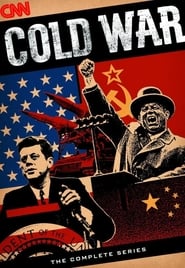
Cold War
Download English Subtitle
Release info
Tags
Download English Subtitle Files for Mobile (24)
English subtitle preview
The first 200 lines.
Cinco, Cuatro, Tres, Dos, Uno,
is on.
A cloud hides the sky,
a nuclear shadow falls across the human future.
Midway through the 20th century,
two superpowers prepared for a conflict
which might have ended life on the planet.
Spring flowers the warm light of day...
the pleasures of life.
But under this American hotel was a hidden gate.
It led into an underworld.
This was the shelter for members of the United States Congress
in the event of nuclear war.
Down here, the politicians would represent the dead and the dying
in the world overhead.
For a handful of human beings,
there was all they needed to wait out the nuclear winter.
But nerves might snap, then order would be kept by force.
The lost world above the shelter would become only a memory - a myth.
The living would come to envy the dead.
Episode 1 Comrades
Berlin 1945.
Soviet troops had stormed the capital of Hitler's Reich.
American, British and French soldiers soon joined them in the ruins.
Churchill, Stalin and Truman were the official victors of the Second World War.
But a special triumph was Stalin's.
Russian power had pushed forward into the centre of Europe.
At Potsdam outside Berlin,
the Big Three met to settle the post-war order.
Winston Churchill represented a Britain exhausted by war.
While Joseph Stalin, supreme ruler of the Soviet Union
faced Harry S Truman, 33rd President of the United States.
It was 3 months after the death of President Franklin Roosevelt
that Harry Truman,
once a Missouri haberdasher, set off for Potsdam.
It was his first overseas conference as Head of State.
GEORGE ELSEY Aide to Truman:
"President Truman was unprepared for the Presidency in the sense
of being fully briefed and up to the minute on all that was going on.
But as a Senator for the past ten years,
as Chairman of one of the most important
Congressional Committees of the war
he was well aware of the major problems
that a President had to face."
VLADIMIR YEROFEYEV - Soviet Foreign Ministry
"Stalin was late for the conference.
He had a sort of heart attack.
Anyhow, he came one day later.
He visited Churchill and Truman,
and immediately apologised for being late."
The Soviet Union was devastated by war.
But Stalin remained a formidable figure.
Averell Harriman U.S. Ambassador to USSR:
"I went up to him and I said, Marshall,
this must be a great satisfaction to you after all
the trials that you've been through
and the tragedy that you've been through - to be here in Berlin.'
He looked at me and said,
'Tsar Alexander got to Paris!'
Did Stalin want to push on to the Atlantic?
Lenin, his predecessor,
once hoped the Russian revolution
would lead on to Communist world revolution.
It was then, after the first World War,
in a clash of ideologies, communist and capitalist,
that the Cold War had its origins.
In 1919,
President Woodrow Wilson took ship to the European Peace Conference
with his gospel for a better world
- safe for small nations, sound for business.
But his peace settlement excluded Bolshevik Russia.
Many nations, including the United States and Britain,
sent troops to fight the Russian Revolution.
Churchill, fresh from victory over Germany, urged:
"Kill the Bolshie! Kiss the Hun! "
The Intervention left Lenin and Stalin convinced
that the West would seize any chance,
embrace any ally,
in order to destroy Communism.
DAVID ORTENBERG - Red Army Volunteer
"I joined the Civil War as a so-called
'son of the regiment'.
We were young boys.
We knew we were fighting for the people
the poor people."
There was widespread support for the Red Army.
The foreign troops soon withdrew.
The Bolshevik Reds defeated the Whites,
their Russian enemies.
IVAN LEGCHILIN - Briansk Resident
"The White Guards who had left Russia were encircling us.
There was starvation.
It was a time when sausages were made from human flesh."
In Russia, famine followed Civil War.
The victorious Bolsheviks turned away from the outside world
to build up the economy at home.
America also turned inwards.
People wanted the good life, and no more foreign entanglements.
Then, in 1929, Wall Street crashed.
The Great Depression began.
Suddenly, across the richest nation on earth,
millions faced destitution.
American politics shifted to the Left.
1933 - Franklin Roosevelt swearing-in ceremony:
"I, Franklin Delano Roosevelt,
do solemnly swear
that I will faithfully execute the office of President of the United States,
and will, to the best of my ability,
preserve, protect and defend
the constitution of the United States. So help me God."
Roosevelt promised a New Deal for Americans.
He would manage capitalism for the public good.
And in a change of policy, he recognised the Soviet Union.
GEORGE KENNAN - US State Department "One has to remember that we had been,
I think, for sixteen years without any representation in Russia
- no ... no relations between the two governments
- and FDR was the one who decided to try to
break that log-jam."
Stalin's industrial drive soon attracted American experts.
Some brought their families.
While Soviet muscles strained to raise dams and blast furnaces,
American corporations supplied skilled engineers on contract.
Communist ideology didn't worry them.
Unlike the Russians, they were free to go
when the job was over.
Stalin was master of the economic plan
- a tyrant who tolerated no failure
and no criticism.
Privately owned fields became collectivised prairies.
The cost of collectivisation was the murder of millions of peasants
and renewed famine.
The truth was kept secret.
DAVID ORTENBERG - Red Army Volunteer
"People didn't really know all about the bad things.
All the achievements were put down to his initiatives.
Those who knew otherwise would shut up.
They knew if they said anything, they would be imprisoned and shot.
It was a regime of terror."
This was socialism in one country.
Heavy industry's output doubled in ten years.
GEORGE KENNAN - US Embassy Moscow "Stalin felt
that in order to get public support for the things he was doing,
which were very harsh policies,
he had to convince a great many of the people,
the common people and the Party members,
that Russia was confronted with a conspiracy
on the part of the major capitalist powers
to undermine the Soviet government by espionage."
Lenin's old comrades confessed to imaginary crimes.
Andrei Vyshinski at Moscow show trials:
"The mask of betrayal has been ripped off their faces.
Let your verdict sound
like the refreshing and purifying thunder of Soviet punishment."
GEORGE KENNAN - US Embassy Moscow
"I could see them there, with their pale faces,
their twitching lips, their evasive eyes.
These were the faces of men who had been,
if not tortured, then terrified
in many ways and often by threats
to take it out on their families
if they didn't confess."
The Moscow trials tore away some foreign illusions.
Stalin's Soviet Union was revealed as a police state,
not a workers' paradise.
But even in America, thousands stayed loyal
to the Communist dream.
In the 1930s, Moscow called for a Popular Front of the Left
against Hitler and Fascism.
Fighting the spread of Fascism
became the great cause for socialist and communist alike.
Doubts about Stalin were repressed.
In Spain, volunteers from all over the world
rallied to oppose the Fascist rebellion launched by Franco.
Franco was armed by Mussolini and Hitler.
In Germany, the Nazis were rearming.
Hitler did not hide his ambitions to dominate Europe,
and then the world.
Under these glorious banners we will move to victory!
Roosevelt wanted to keep out of any European War.
"Despite what happens
in continents overseas,
the United States of America
shall and must remain,
as long ago the father of our country prayed that it would remain,
unentangled and free!"
Britain's Prime Minister, Neville Chamberlain,
trusted that Hitler would listen to reason.
In September 1938, Chamberlain flew to Munich.
War seemed close,
as Germany prepared to invade Czechoslovakia.
But Chamberlain went determined to appease Hitler.
At Munich, Britain, France and Italy licensed Hitler
to seize the Czech Sudetenland,
with its German minority.
Czechoslovakia's allies had abandoned her.
In Moscow, Stalin drew lessons from Munich.
The western democracies, he concluded, would never stand up to Hitler.
Stalin planned a desperate stroke of diplomacy.
The fascist and Communist arch-enemies were about to embrace.
Hitler flew his Foreign Minister Ribbentrop to Moscow.
Cold War subtitles in other languages
More English subtitles for Cold War
- Cold War DVD · 71 downloads · 2021-03-24
Comments
No comments yet. Be the first to leave one.