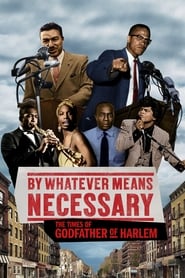
By Whatever Means Necessary: The Times of Godfather of Harlem
Download English Subtitle
Release info
Tags
Download English Subtitle Files for Mobile (4)
English subtitle preview
The first 169 lines.
- We have to realize that the problem begins right here.
We have to elevate our thinking,
not just the thinking of a handful.
That won't do it.
But the thinking of 22 million Black people in this country
must be elevated.
They must be made to see it as we see it.
They must be made to think as we think,
and then they'll be ready to act.
Just like we're ready to act.
- The picket demonstrations in the South
continued to escalate,
and so did the development of the Nation of Islam,
developing particularly in Harlem.
- And in 1840 when they were lynching Negroes,
and in 1950 when they were lynching Negroes,
and then a few weeks ago in Mississippi
they lynched a Negro.
- The Klan is staging a mass rally and cross burning.
- Negro demonstrations resulted in arrest
led to intensified demonstrations
and sporadic acts of violence throughout the city.
- We had this migration coming
from South Carolina, Virginia,
North Carolina, and Georgia into Harlem,
which occurs primarily because people
had been oppressed and suppressed
and couldn't even express themself.
- The '60s were a moment in time
where Black people were trying to really solidify
and gain their freedom.
There was all the pain
from not being able to be who they are,
so that's why Harlem became such a hub,
because you could really be yourself.
Harlem had, you know, elements of real soulful living,
and that's why I really, really adored Harlem at that time.
- I was in Harlem as much as I could growing up,
just come down here, either play basketball
or go to the community center and hang out,
because the vibrancy, the lifestyle, the music,
every place the--the energy,
Harlem was where it was at.
Harlem felt like a continuous block party
in the sense that there was music
coming from people's small radios
or coming from their record players,
which was soul music.
That music would be happening, coming out of those windows
and out of the barber shops the whole time.
So you had doo-wop guys that was on the corner
that were killing it with those harmonies.
And they knew not only
what corners to be at
so they could attract the girls,
they knew what buildings and what courtyards
to be in that gave them the best acoustics
for when they were doing their thing.
- We had all kinds of music in Harlem.
We had music from Gregorian style,
Latin-type music.
- You can get rhythm and blues, reggae, jazz.
You know, you can get the gospel,
so all of it was there.
Just take your choice where you want to hang.
- All of these music in our community,
they were influenced by a beautiful,
close-knit neighborhood of people like Cubans,
West Indians, or people from the South.
- Kids would be out playing stickball,
Johnny on the pony.
The girls would be playing skully, double Dutch.
The old folks would be sitting on the stoop holding court,
going back and forth to the stores.
These things became, like, an ongoing soundtrack for me
as a young man for different aspects of my life.
This is Harlem.
This is 145th Street.
These four ladies are going across the street in the snow,
and I was in the snow with my Leica,
and I put my camera up,
and just as I was about to click the shutter,
this one lady turned and looked at me
and I said, "Boom."
When I got out of the navy,
my wife and I moved to Harlem from Columbus, Ohio.
We had three small rooms in the back
of a nine-room apartment
at 150th Street and Convent Avenue.
I never seen that many Black people in one place.
Everybody was cool. Everybody dressed sharp.
Especially on the holidays, you know?
People in Harlem were beautiful.
In those days, if you walked down the street
and you're in the neighborhood and you're new,
people would ask, "How you doing?"
They would speak to you, "Hello. How are you?"
It felt family.
- New York City is a racial layer cake,
and the bottom layer is Harlem in Manhattan,
where most of the occupants
live behind the double bars of poverty and a black skin.
Here the American dream becomes a nightmare.
- In the press they would talk about the negative aspects
of Black people.
It was never anything refined, you know?
It wasn't about the creative part
or about the beautiful part.
It was always very negative and very racist.
And I just got sick and tired of that--that kind of image.
I wanted to photograph our people as I knew them.
Only we could show the beauty of us.
- Thank you and good evening, ladies and gentlemen,
and welcome to the Apollo Theater.
We would like to get right into the swing of things
by introducing to you three very talented
young ladies of song who'd like to come out
and give you their version of a little thing entitled
"Come and Get These Memories," Martha and the Vandellas!
Hey, baby.
- The best of acts dreamed of playing at the Apollo.
We had a tour, a Motown Revue, the very first ever.
Going to New York had been a big thrill for us anyway,
but to know that we were gonna play the Apollo?
We'd been told, "If you can't perform well,
"they'll throw things at you,
"vegetables and beer bottles and wine bottles,
and everything at you if you're not good."
- We started out with "Come and Get These Memories,"
and the audience was with us.
They got up and started dancing and having a good time,
and it made you just feel good that you were in Harlem.
We were in Atlanta.
We had been singing around town.
They wanted us to come and perform at the Apollo.
"Say what?
In New York?" They said, "Yeah."
We were scared to death.
We didn't know what the Apollo was,
what it looked like, where we went,
how were we gonna do it.
I had my little khaki skirt on.
It was green.
It was an ugly green too.
We always said a prayer
before we went on the stage.
We were so nervous that they would not like us.
The song that we were to sing was "Every Beat of My Heart,"
which was our first recording, and they really applauded.
We were--we were looking at each other like,
"They really liked us."
And they liked us so much that they held us over,
and we ended up doing almost a month,
and that's how we got started in New York
at the Apollo Theater.
I love the Apollo Theater.
My mother took me there when I was probably about 12.
I think about so many different forms of artistry
that could be seen at the Apollo,
not only music but comedians and dancers,
and so for me it was like being able to fly
to a different planet.
It's very difficult to relax in life.
You know, they have a thing called PTSD.
I'd grown up with PTSD.
I remember at 15 this white cop was beating up my brother.
It's that fear
and that kind of
hypervigilant feeling.
Comments
No comments yet. Be the first to leave one.