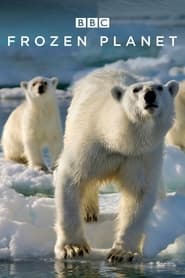
Frozen Planet
Download English Subtitle
Release info
Tags
English subtitle preview
The first 200 lines.
The end of the Arctic summer, and the sun hasn't set for three months.
It's hard to imagine the bitter cold will soon return.
Some will welcome the chills of autumn, but for most,
time is running out before they will have to retreat to the south.
Early autumn in the Canadian Arctic,
and polar bears are gathering on the coastal strip,
waiting for the sea to freeze.
But a life spent alone on the sea ice
is no preparation for a crowded beach.
Such close contact with other bears must be stressful.
Surely tempers will flare.
Over half a tonne of bear slams into the other.
Polar bears will fight to the death over mates,
but not in autumn.
Now these fearsome predators display
a surprisingly tolerant side to their natures.
Being marooned on land means the bears no longer have access
to the seals they usually hunt
and they have to scrape by on whatever they can find.
Like bears the world over, they're not choosy feeders.
They even turn vegetarian,
delicately picking out berries from between the thorns.
There are plenty to go around
so there's no need to squabble over them.
Any fighting is just for fun.
The bears select sparring partners who are well-matched
and they always pull their punches,
no-one wants to get hurt in a play-fight.
Perhaps these bouts are a way of testing rivals
in case they ever meet again out on the sea ice.
One thing's for sure, the famous loners
are revealing a social, playful side we rarely see.
It's all just boisterous fun but with so many big males around,
the females keep their cubs at a safe distance.
The wary mother will lead her young to a quieter beach
along the coast while she waits for the ocean to freeze.
The sea ice is now at its minimum extent.
In the Canadian Arctic, vast stretches of coastline
are now unlocked and ready to receive visitors.
Belugas ... the white whales of the North.
They're relying on open water to reach an ancient rendezvous.
It's a journey they make every year along traditional routes.
Baby belugas ride piggy-back, pulled along by their mother's slip stream.
This one is only a month old,
and won't turn white for another five years.
Thousands of belugas are being drawn to one special estuary
in the Canadian Arctic.
It isn't food that brings them here.
Curiously, it's personal hygiene.
When the tide is low they swim into the shallows
and flail around with great enthusiasm.
They're after a body scrub.
The gravel acts as a loofah
and thrashing their bodies across it
helps to get rid of their old skin.
Presumably the treatment keeps them clean and streamlined,
but it also appears to feel good.
Bliss!
The water in the estuary is warmer and less salty
and that seems to soften the skin making the scrub more effective.
This secluded estuary is only a temporary whale spa,
the ocean will soon freeze again forcing the whales to travel south.
Vast seabird colonies are the jewels of the Arctic.
Brunnich's guillemots have spent the summer months packed together
on vertical cliffs beyond the reach of predators.
They are among the most numerous seabirds in the Northern hemisphere.
This colony alone contains 100,000 birds
and there are many more like it all along the Arctic coastline.
In just a few weeks these cliffs will empty
but before the guillemots can leave, their chicks must fledge.
Their feathers are now fully formed, but their stubby wings
are still too short for them to fly properly ... this will be a challenge.
It's a 150 metre drop and they need to make it all the way to the sea.
Here goes.
He falls short and survives the crash landing.
The chicks are manna from heaven for an Arctic fox.
The next chick is accompanied by a parent.
Failed again.
This looks better!
Success!
Aquatic landings are certainly gentler
and foxes can't reach you out here.
The chicks will stay in their parents' care for another month.
The guillemots are not the only ones preparing to leave,
all across the Arctic millions of summer visitors
are beginning to return south.
The guillemot chicks can't fly yet,
so they and their families must swim to their winter feeding grounds.
It's a journey that will take them a thousand miles south
to the open ocean and away from the approaching ice.
The breeding season is over and silence returns to the Arctic.
But as the first storms of autumn
sweep through the deserted nesting grounds,
they bring an unexpected bonanza for the few that remain.
The discovery doesn't remain secret for long.
It's a huge fin whale carcass.
The polar bears have been drawn from several miles away,
guided by their extraordinary sense of smell.
Bears are arriving all the time,
but there's plenty of room at this 18 metre long dining table.
They're surprisingly relaxed,
but with enough for everyone there's no need to argue.
The tastiest morsels are often underwater.
Others prefer some greens with their dinner.
After a well-balanced meal,
there's nothing better than some good company.
Despite their reputation as loners,
it's surprising just how sociable polar bears can be.
All across the Arctic the temperature is now dropping
and the sea is beginning to freeze.
Every day over 20,000 square miles of ocean
turn to ice as the cold spreads south.
At first, a thin, greasy film appears on the surface
Next, pancakes of ice start to appear.
The pancakes lock together and form a continuous sheet.
The Arctic Ocean is freezing again.
At last the bear family can return to the sea ice where they belong.
It's been six months since the cubs first emerged from the den.
They've survived the hazards of melting sea ice in spring
and lack of food in summer
and now, at last, they are in their element again.
As the north of our planet turns away from the sun,
the big chill travels south.
Temperatures on the tundra start to fall.
The shorter days and colder nights trigger a dramatic change
in the willows and blueberry bushes.
They stop producing green pigment that harnesses the sun's energy
and red and yellow pigments build up in their leaves.
The tundra blazes with colour and the whole landscape is transformed.
A bull musk ox marks his territory with scent from glands on his face.
He's preparing for the breeding season.
He shadows his harem of females as they graze
the last of the summer grasses.
He must be on his guard.
An outsider is arriving,
a large male whose intentions soon become clear.
The newcomer circles the resident bull warily.
The resident must take up the intruder's challenge.
This clash of Polar Titans could easily become a fight to the death.
The impact is like a car crash at 30 miles an hour.
A heavy skull and a helmet of horn four inches thick
provides some protection for the musk ox's brain.
Over the next half hour, the advantage ebbs and flows
as each tries to finish the duel.
If one can turn the other and gore its flank, the fight will be over.
The stakes rise as the risk of injury, or even death, increases.
The rival is out-manoeuvred.
And the champion returns to his females.
By now most animals have migrated south, but the musk oxen,
with their thick coats, will stay and face the approaching winter.
As autumn progresses, the moisture in the air freezes
and hoarfrost decorates the leaves.
Ice crystals grow like diamonds on every twig.
All across the tundra, both the rivers and the ground freeze solid.
Glassy cathedrals form as the remaining water
becomes locked up as ice.
Soon even the largest waterfalls will be motionless.
The tundra has been transformed once again.
It appears deserted.
Caribou on their migration.
Unlike the musk ox, caribou do head south for the winter,
but it's a long and difficult journey.
They use the frozen lakes as ice roads ... these are flat and firm...
but it seems hooves and ice were never really meant to go together.
The frisky males would be well advised to keep
at least one eye on the road as the mating season begins.
A cow is being closely guarded by a mature bull,
with his much larger antlers.
The females are busy feeding-up for the winter,
but the bull has other things on his mind.
The cow is playing hard to get.
She heads off with her admirer in pursuit.
Several other bulls join in the chase.
She's out in front but the amorous males are gaining on her.
The big bull breaks off his chase to deal with a rival.
But now he's fallen behind the other challengers.
The younger bulls, with their lighter antlers,
keep up with the cow more easily,
but as the pace slows, the older bull catches up.
Again he has to stop and fight.
A decisive victory for the big male.
He's earned the respect of the vanquished bulls
and they now trail in his wake.
It's now become a game of Grandma's footsteps,
one look from the boss and the young-bloods freeze in their tracks.
The exhausted bull guards his prize, but he'll need to recover
before he is able to make the most of his victory,
and the herd continues its journey south
to avoid the worst of the advancing cold.
From the ocean to the tundra,
the north of our planet is now completely frozen.
The Antarctic.
In the far south, autumn can be a particularly savage
and unpredictable time.
South Georgia is a splinter of rock in the middle
of the vast Southern Ocean.
It's only a hundred miles long and is battered by the elements.
This ocean generates some of the largest waves on the planet,
they gain size and power as they travel around the globe,
uninterrupted by land for 12,000 miles.
Frozen Planet subtitles in other languages
More English subtitles for Frozen Planet
- BBC: Frozen Planet - Complete Series (2011) · 136 downloads · 2018-07-16
- 07 On Thin Ice 720p HDTV MP4 · 83 downloads · 2014-03-17
- Frozen Planet -Complete Series-720p HDTV x264 YIFY-350mb-Eng · 133 downloads · 2013-07-23
- Frozen Planet 2011 720p BluRay x264-RO4EVA · 167 downloads · 2012-05-09
- BBCFrozen Planet EP01 To The Ends Of The Earth 2011 720p BluRay AC3 x264-HDxT En · 248 downloads · 2012-03-07
- BBC Frozen Planet 2011 1080p BluRay DTS x264 D-Z0N3 · 173 downloads · 2012-01-21
- BBC Frozen Planet E08 The Epic Journey · 81 downloads · 2011-12-30
- frozen planet ep7 Resync for vsenc release · 89 downloads · 2011-12-16
Comments
No comments yet. Be the first to leave one.