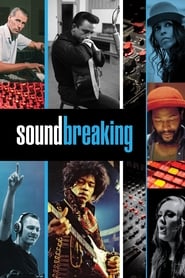
Soundbreaking
Download English Subtitle
English subtitle preview
The first 172 lines.
-I'm in Grandmaster Flash's dressing room,
which is why I'm talking a bit funny,
'cause it's making me actually quite nervous. Aah!
And, um, they're doing things like bodybuilding.
And they're wearing surgical trusses.
So they're obviously ready for the Tube.
Um, how did you get your scratch act together?
-We used to to this out in the parks for free.
And for the way that I mix, I needed vocal entertainment
in between the way that I played.
So what it was is the vocals
had to complement with what I was doing.
So, at the time, throughout the span of maybe 2 1/2 years...
-Hip hop had barely learned to crawl back in 1982.
But it was about to jumpstart a revolution,
made possible by a cutting-edge technique known as sampling.
-When hip hop came into my life,
I became immediately just enamored by it.
-It was so much about taking it and making it
and breaking some rules and telling your own story.
-It was being able to actually make something
that seemed like a live recording with recordings
-They're using music to create new music.
-There's no more important feeling in the world
than that "War of the Worlds" moment.
-They weren't just sampling one sound.
They realized they could sample, you know, dozens of sounds.
We just had the advantage
of hearing all different types of music.
-We created the world we lived in through our music,
through our art, and through our culture
and it all was good.
-I didn't want to make a rap record.
I wanted to create a revolution.
was probably created by pushing the envelope of technology.
-Sampling has gone far beyond hip hop.
New styles have been built on it;
the whole idea of songwriting, changed by it.
For the last 40 years,
no single technique has had a bigger impact on recording.
-Sampling is -- it's -- it's deep.
For people to just write if off as like, "Oh,
you're just stealing people's music,"
like, they don't actually know what they're talking about.
Okay, then. Okay.
It'll be an F for you.
Here we go.
Just one more time.
-Right after I say, "Are you sure?"
Da da da -- yeah.
Oh.
-Hal, here's how I want to do it. Takes like this.
-All right, it's fun time. Fun time.
Here we go.
-Oh, really? -17, take one.
This will be the keeper.
Yeah...turn around and...
-Sampling is basically the ability
to take a piece of a song
and then loop it...
You make it go over and over again,
and then create a new song.
-Which most people equate with stealing other people's music.
This isn't exclusive to hip hop.
This has been going on since the beginning of time.
[ "Mary Had a Little Lamb" plays ]
[ Mid-tempo rock 'n' roll plays ]
-There's really a limited number of notes
and a limited number of chords.
And these have all been replayed throughout history.
-Generally, we just assimilate the information,
or the inspiration, and then disseminate it as our own bag.
-Led Zeppelin, rightly or wrongly,
have taken the very best of the great blues guys
-The goal of sampling is not sampling.
The goal of sampling is creating compelling music.
-My first encounter with hip hop,
for me, was probably,like, 1976.
I was doing it in Brooklyn.
You know, they were doing it up in the Bronx.
South Bronx was an area
that was having many problems at the time.
It was going through a street-gang age.
It also was an area that just came out
of the drug scene that was happening at the time.
And also it was an area that had
good people who was hard workers.
-The one thing that never escaped us, though, was
our love for music and our need to express ourselves.
Even though we didn't have much, we put something together
so that we could have a little bit more self-esteem.
-Hip hop and rap was like the equivalent of --
of folk music -- 'cause folk music was always about,
you know, uh, problems --
social problems, political problems.
And this actually was a voice in a new way.
-The holy trinity of hip hop and rap music
happened to be three deejays --
Kool DJ Herc, Afrika Bambaataa, and Grandmaster Flash.
Two of the three actually have Caribbean roots.
-The art of toasting comes out of the Caribbean,
which is the guy who's the deejay
would speak on top of the microphone
on top of records.
That over-dubbing process is the same reason
they call reggae "dub music."
-Some of the most incredible innovators,
Lee "Scratch" Perry, King Tubby,
they were producers who would do a whole album of one rhythm
and then have different MCs, you know, rhyme over it.
-I often describe hip hop as a kind of
result of the Caribbean-ization of global popular culture.
You had immigrants coming from Latin America,
and particularly from the Caribbean in larger numbers
and very often, they were moving to lower-income neighborhoods,
like the Bronx, in the 1970s.
They also brought their culture to the Bronx.
And in particular, one of the things that they brought --
or Jamaicans brought, in particular --
was the culture of sound systems --
mobile portable sound systems.
-When Kuhar give a party, everybody be there.
If you talk to Kuhar,
or a lot of those guys from the early era,
they were literally drawing on the content
that was around them and just experimenting,
and managed to create something that changed the musical world.
-Is Manhattan in the house? -Yeah!
-Is the Bronx in the house? -Yeah!
-Is everybody in the house? -Yeah!
Everybody kind of knows about the traditional block party.
Growing up, you know, black, the block party involved,
you know, speakers and deejays and party
and party punch and all that stuff.
-When we formulated this whole movement called hip hop,
we was usin' turntables that we would bring
that your mom and pop used to have in the house.
-Rap is about two aspects of music.
It's the deejay and it's the MC.
The deejay is the one that gave birth to the MC.
But it's the MCs that gave popularity to the deejay.
-You had people who would be like, "Yes, indeed,
in the place to be, New York Ci-ty.
You know we cooler than a blade of grass.
And, you know, we showin' up for your ass.
This is what we gonna do tonight.
Everybody's gonna get right.
We gonna make sure that everybody gets up
and get tight to this jam right here."
-I used to pay $20 for a live recording
of African Bambaataa before rap was ever out there.
But we used to rap over James Brown big beats,
because on a James Brown record,
it was always a funky drummer beat for the MC.
You know, James Brown
was called the Godfather of Soul, right?
You know, I used to buy his records
and scratch them all day.
Some of his kicks, some of his snares,
has found its way into all of our music.
You know, if you think of a song like "Funky Drummer":
one, two, three, four...
I mean, we used to cut that up all day
and then rap on it, slow it down, speed it up.
James Brown.
What he played in his role in hip hop --
let's put it this way.
All music would stink if there wasn't no James Brown.
-I thought it was inconceivable in 1978,
and even the beginnings of 1979,
that there ever could be a rap record,
because to me, rap was a big event.
More English subtitles for Soundbreaking
- Soundbreaking E08 I Am My Music · 30 downloads · 2016-11-24
- Soundbreaking E07 Sound and Vision · 25 downloads · 2016-11-24
- Soundbreaking E04 Going Electric · 28 downloads · 2016-11-24
- Soundbreaking E05 Four on the Floor · 26 downloads · 2016-11-24
- Soundbreaking E03 The Human Instrument · 34 downloads · 2016-11-24
- Soundbreaking E02 Painting with Sound · 21 downloads · 2016-11-24
- Soundbreaking E01 The Art of Recording · 25 downloads · 2016-11-24
Comments
No comments yet. Be the first to leave one.