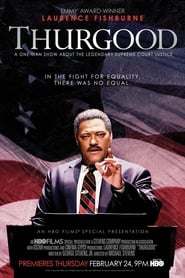
Thurgood
Download English Subtitle
Release info
Tags
English subtitle preview
The first 200 lines.
Well, we might as well get right down to it.
I have given 50 years to the law.
I've seen a lot and I've gotten too old to keep secrets.
Here at Howard University, we were taught one simple idea.
The law is a weapon if you know how to use it.
I was here during the Depression, class of 1933.
I see you've got this fancy auditorium here now.
Yeah, even got these nice upholstered seats.
Well, we had an old three-story brownstone with no heat.
Nobody knew what air conditioning was back then.
I would take the train over from Baltimore every morning, arrive at Union Station.
Some days I'd walk past the United States Capitol on my way to class.
They call Baltimore, "Up South".
That's just below what we used to call the Smith & Wesson line.
Baltimore is where slaves ran to, when they escaped from plantations in the Deep South.
Which may have something to do with why I was born there.
Now, my uncle Fearless, used to tell me about my great-grandfather
who was called Thorney Good.
Seems, as a boy, he was a tracker for a big-game hunter
in the toughest part of the Congo.
And this big-game hunter brought my great-grandfather to eastern Maryland
as a slave. He hated being a slave now.
Thorney Good became so hard to handle. The big-game hunter got fed up.
He said, "Look, I brought you over here myself...
"So I don't guess I can shoot you like you deserve.
"You so ornery to white people. I can't sell you, can't give you away.
"So, I'm going to set you free,
"provided you get the hell off this eastern shore and never come back".
And you know, that was the only time that the big-game hunter
didn't get an argument from Thorney Good.
But, he came back years later. He bought land right next door.
So he could torment the big-game hunter for the rest of his life.
My grandfather's name was Thoroughgood Marshall.
He had a grocery store on the corner of Dolphin and Division.
Grandma Annie Marshall was the lady of the store.
One day the electric company decides to put a power pole right out in front the store.
Well, when the workmen come with a court order,
Annie Marshall takes an old cane-backed kitchen chair out on the sidewalk,
plunks herself right down on the spot.
She sat there for 4 days and 4 nights, 'till she got her way.
They say Grandma Annie's was the first successful sit-down strike
in the history of Maryland.
My mother's father's name was Isaiah Olive Branch Williams.
When he came back from the Merchant Marine and, you know, started a family...
Avon and Avonia,
a boy and a girl named after Shakespeare's river,
Denmedia Marketa, for the family store,
my mother, Norma, for Bellini's opera,
and my uncle, Fearless,
for the way he glared at his daddy right after he was born.
Oh, you see, as a boy, I came to understand that two things marked my family,
distinctive names and extreme stubbornness.
My parents named me after my grandfather, Thoroughgood.
T/H/O/R/O/U/G/H/G/O/O/D.
Well, by second grade, I got tired of writing out all those letters.
I cut it to Thurgood.
I was born in 1908,
the year that William Howard Taft was elected president.
Also the year that Jack Johnson knocked out Tommy Burns.
Oh, yeah.
A negro was the Heavyweight Champion of the World.
You know what happened the very next day?
Well, they went right out looking for the "great white hope" to take back the title.
Yeah. There were race riots in Springfield, Illinois.
The home of Abraham Lincoln. 89 negroes were lynched that year.
And that's when they started the N-A-A-C-P.
The National Association for the Advancement of Colored People.
How many of you have heard of Homer Adolph Plessy?
Anyone? Any... Oh, very good. Yes, yes, very good, very good.
All right now, for those of you that don't know.
After the Civil War,
Homer Plessy and negroes in the South were free to vote,
sit wherever they damn well pleased.
And then in 1890, Louisiana passed a law
that ordered all rail companies to provide separate accommodations
for white people and for colored people.
Do you know what they called it?
"An act to promote the comfort of passengers".
Now Homer Plessy decided to challenge this law by,
taking a seat in a whites-only coach just outside New Orleans.
He refused to move to the colored car.
They arrested him, hauled him down to Criminal District Court.
Homer Plessy said that this segregation law violated his rights
under the Fourteenth Amendment to the Constitution.
Now Judge John H. Ferguson didn't see it that way.
He fined him, $25.
Homer Plessy refused to pay the $25 fine.
He and his lawyer
took it all the way to the Supreme Court of the United States.
The case was called...
Plessy v. Ferguson.
Plessy v. Ferguson. Very good, very good, ladies and gentlemen.
Now the Supreme Court ruled 7-to-1 against Mr. Plessy.
I want you to listen here to what the Justices wrote.
"The Fourteenth Amendment could not have been intended to enforce social equality.
"The feelings of inferiority that come from being segregated
"exists only because the colored race
"chooses to put that construction on it".
Now, what did that mean?
It meant that it was now legal for any state to pass Jim Crow laws
that forced negroes to accept "separate but equal" facilities.
You see, when I was growing up in Baltimore,
we had to use separate park benches,
uh, separate drinking fountains, separate public toilets.
Now if you want to understand my story,
don't forget that name, Homer Adolph Plessy.
My daddy was a Pullman car waiter on The B&O Railroad.
He had blond hair and blue eyes and...
Sometimes people mistook him for a white man. He was the most
insidious of my family of rebels.
He taught me how to argue and debate.
He challenged my logic on every point,
even when we were discussing the weather.
Now he didn't have much schooling.
He was angry, and he was a drinker.
But somehow, he became interested in the law.
His hobby was to go downtown
and sit in the back of the courthouse. Some days he would carry me with him.
And when we came home, he would knock back a few shots of whiskey...
and test me on the cases at the dinner table.
We would have the most violent arguments you ever heard.
Now, the man has his own way of making his points.
He'd say things like, um,
"Oh, that's mighty black of you".
Or, uh, he'd say, "Must be a white man in the wood pile".
Now one day he sat me down.
He said, "Thurgood, anybody ever calls you nigger,
"you have business with them right then and there.
"You either win or lose right then and there".
I got an afterschool job working for Mr. Schoen, a Jewish gentleman,
who ran a fancy dress shop over on Charles Street.
One afternoon,
he sent me to deliver a big pile of hats during the rush hour.
So I go to get on the trolley, a woman pushes past me,
and then I feel a hand grab the back of my collar.
And this white man pulls me off the trolley.
"Sir, I'm just trying to get on the damned car".
He says, "Nigger, don't you push in front of white people!"
So quite naturally, I start swinging.
Well, the man smacked me to the ground,
trampled all over the hats.
A policeman came over, hauled me down to the station.
So, now I have to call Mr. Schoen. He comes over to the jail.
I'm crying by this time. I'm apologizing for the damage to the hats.
He says, uh, "Did that man really call you nigger?"
See yes, sir, he sure did.
"Thurgood, never mind the damn hats, you did the right thing".
You ever hear of Colored High?
Colored High?
Well, that's all right, that's where I went.
Yeah, same place my mother went to school.
I had this habit of always saying whatever was on my mind
and so I would end up in arguments.
And one day, my teacher says, in front of the whole class,
"Thurgood, you are disputatious!"
Then she hands me a copy of the Constitution of the United States,
sends me down to the furnace room to memorize some part of it.
This was her special punishment for me.
I was sent to the furnace room so often,
by my senior year I knew the whole thing by heart.
From our second story classroom window,
I could look right down on the Northwest Baltimore Police Station.
I'd watch the negro prisoners being brought in by the white policemen.
"Black boy, why don't you shut your goddamned mouth".
"Nigger, you're going to talk yourself right into the electric chair!"
To this day, I can't get it out of my mind,
the sound of cops beating the hell out of those prisoners.
Well, anyway, my mother was
dead set on me getting a college education, so I had to earn some money.
My uncle Fearless got me a job as a dining car waiter on the B&O.
They gave me this uniform. The pants was about six inches too short.
Well, I go to the steward to see if I could get a longer pair, you know.
He says,
"Don't you know it's easier for me to find a shorter nigger
"than to find a longer pair of pants? Why don't you scrooch down in them?".
So, you know, I scrooched down in 'em. See?
And I became a pretty good waiter. I bet I'm the only one here
who can bone a trout on a moving train without putting any in the customer's lap.
Well, I arrived at Lincoln College with a comic book in my back pocket
and a highly cultivated interest in the female gender.
I was pinned to seven co-eds, all at the same time.
Yeah, I'd already decided that I was going to become a dentist.
And I was never going to lift anything heavier than a poker chip.
And then one day, we went into town to see a movie and...
after we bought our tickets,
they told us we had to go around the back, up the stairs,
sit in the, uh... colored balcony, the Crow's Nest.
I'll tell you something, if enforcement hadn't been such a problem
they would've made up a rule that said, "White folks get to laugh first".
Anyway, we asked for our quarters back, they refused.
We got angry, tore down a bunch of curtains, broke a door,
ran like hell.
We were, kind of, pleased with ourselves, but that night I could not sleep.
I lay there in bed thinking now,
am I gonna go through life being humiliated...
because of the color of my skin?
One of the boys was named Langston Hughes.
Yes, Langston Hughes.
Oh, he was already writing poetry.
Lincoln was an all-negro college with all white professors.
Thurgood subtitles in other languages
More English subtitles for Thurgood
- Thurgood 2011 DVDRip XviD SLiCK · 21 downloads · 2012-07-31
- Thurgood 2011 BDRip XviD-SPRiNTER · 23 downloads · 2012-01-12
- sprinter-thurgood2011 · 22 downloads · 2012-01-08
- Thurgood 2011 BluRay XviD-mSD · 17 downloads · 2012-01-06
- Thurgood 2011 720p BluRay x264-HD4U · 18 downloads · 2012-01-06
Comments
No comments yet. Be the first to leave one.