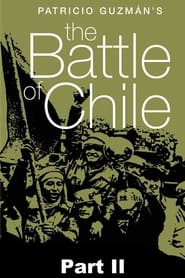
The Battle of Chile: Part II
La batalla de Chile (Parte 2). El Golpe de Estado
Download English Subtitle
Release info
Tags
English subtitle preview
The first 200 lines.
THE BATTLE OF CHILE
THE STRUGGLE OF AN UNARMED PEOPLE
THE COUP
A PATRICIO GUZMAN FILM
IN MEMORY OF JORGE MUELLER SILVA
Santiago de Chile.
June 29, 1973.
Unable to remove President Allende constitutionally,
the U.S. government and the Chilean opposition
opt for the strategy of a coup.
After its defeat in the presidential elections in March, 1973,
the opposition sets the wheels firmly in motion for a planned uprising.
On June 29,
at 09.00 a.m.,
a single regiment attacks the government palace with six tanks.
Shortly after,
an Argentinian journalist films his own death.
He also records, two months before the final coup,
the true face of a sector of the Chilean army.
For an hour,
the tanks exchange fire
with the presidential guard who are inside the La Moneda Palace.
22 people die during these first moments.
Parliament, the Judicial Power,
and the opposition parties are silent.
However,
the rebel troops don't receive support from the rest of the armed forces.
Perhaps thinking that conditions are not yet right for a successful rising,
the other officers don't join in this action.
Meanwhile,
loyal troops begin the first counter-attack to break the siege.
Watch out! Over there!
Don't shoot, bastards!
At 10.30,
more loyal soldiers are mobilized towards the city center.
Advancing on the Panamerican road into the capital
are ten artillery regiment troop transporters
from the city of San Felipe.
The civilian population must stay calm.
After a brief confrontation,
the rebel tanks begin to withdraw.
The Commander-in-Chief of the Army, Gen. Carlos Prats,
directs the operations personally.
At 11.00 a.m., with fighting still going on,
the President of the Republic goes into the palace.
Just then, another column of loyal soldiers arrives,
headed by the Minister of Defense, José Toha.
Young Communists of Chile!
Long live the workers' president!
Fight and create popular power!
Fight and create popular power!
The situation is being controlled,
but some troops have not yet surrendered.
Even as they withdraw, the tanks are still firing.
José Toha, Minister of Defense,
tries to instil calm in the face of possible danger.
He is assisted in this task by Gen. Pickering.
Minister,
if we don't control these people, there'll be a massacre.
Help me, please.
Get out of here, please! Move away!
If you don't move, someone might get killed.
Generals Pickering, Sepulveda and Prats
lead the officers most determined to suppress the rising.
Other commanders, however, merely wait expectantly.
Such is the case with Augusto Pinochet, later Head of the Military Government,
who now joins in with the loyal forces.
At 11.30,
Gen. Carlos Prats assures the Minister of Defense
that the rebels have surrendered,
and shows the positions of his own troops.
On the south side of La Moneda is the Warrant Officers School
and on the north side is the Buin Regiment.
But Gen. Prats will think it essential
to declare a State of Emergency to control the situation.
We must request a State of Emergency at once.
We can't control the situation otherwise.
Allende, Allende,
the people will defend you!
At noon, with the defeat of the rising confirmed,
the Christian Democrats
say that they support the constitutional regime.
The other opposition group, the National Party,
refuses to comment.
The leaders of the fascist group "Homeland and Freedom"
take refuge in the Ecuadorian embassy,
revealing themselves as the authors of the putsch.
Use a heavy hand!
At 6.00 p.m.,
the presidential flag is lowered by the guard who defended the palace.
For two hours, this company, led by Lieut. Perez,
refused to hand over the seat of government.
Along with Gen. Prats, they are the heroes of the day.
The ease with which the attempted coup was crushed
raises many questions.
The rising showed that some officers were sympathetic,
and only the fear of having to face other army units
prevented them from joining the rebellion.
Consequently,
Allende relies on the constitutionalist officers,
rejecting any action which may weaken his government's legality.
We shall make the revolutionary changes
in pluralism, democracy and freedom,
which does not mean
tolerance
of anti-democrats,
tolerance
of subversives,
or tolerance of fascists, comrades!
Close the National Congress!
But you must understand
what the real position of this government is.
I will not, because it would be absurd,
close
the Congress.
I'm not going to do it.
I said...
I said respect.
But if it's necessary...
If it's necessary,
I shall present
a bill to call a plebiscite
and let the people resolve this question!
"Mummies", shits, the street belongs to the left.
"Mummies", shits, the street belongs to the left.
The next day,
Allende asks Congress to declare a State of Emergency.
Meanwhile, from the morning of June 29,
left-wing workers
take control of factories, companies, mines and agricultural centers
throughout Chile.
Let's create popular power!
Comrades,
the conclusions of the 500 workers in the packing factory
are the following.
Strengthen the industrial belts.
Strengthen the communal councils.
Strengthen the neighborhood groups and the COPPs.
Strengthen all the community organizations.
We must take advantage of this opportunity
and go on the offensive
in terms of gaining new sectors
and nationalizing new industries.
We, the workers, are at our battle station,
our workplace,
building the necessary elements
to defend ourselves against any attack by fascism,
or any further attempts by the armed forces
to overthrow the government.
We believe we must strengthen our battle station
which is, firstly, here in the industries.
At the same time,
all forms of popular power are strengthened,
especially the industrial belts.
Each belt is a group of factories and companies
which coordinates the tasks of workers in the same zone.
In the country's main cities,
31 industrial belts have been set up.
Eight of these are in Santiago.
- Who do you represent? - The "Macul" belt.
- And you? - The "Macul" belt.
- And you? - The "Cerrillos-Maipu" belt.
- And you? - The "Cerrillos" belt.
- And you? - The "Vicuna Mackenna" belt.
- And you? - The "Vicuna Mackenna" belt.
- And you? - The "O'Higgins" belt.
- And you? - The Christian Left.
The Radical Party Union.
The Government, with the support of the belts,
puts some strategically important factories
under legal State control.
Comrades,
as we all know,
fascist groups tried to overthrow the Government
and there are still repercussions from that.
There is still a latent danger against a process
which the working class began and has taken in hand.
It has been resolved that,
given that the packaging and aluminium company Alusa
has suspended delivery of its products
which constitutes an obstruction to distribution,
and in view of the Supreme Decree no. 338
and Law no. 16,464, I resolve,
firstly,
the use of the industrial establishment is hereby requisitioned,
along with machines and other elements
necessary for the production and/or distribution of the Alusa factory.
On July 2,
the law on the State of Emergency proposed by Allende
is submitted to Parliament.
This law would grant the President special powers,
enabling him to appoint, transfer and dismiss
whatever military leaders he thought advisable.
The floor is open to speakers.
The debate is over.
During the three previous governments,
the State of Emergency
had been authorized twice.
Those deputies who reject the proposal, raise their hands.
The State of Emergency, the chief legal instrument for extreme situations,
The Battle of Chile: Part II subtitles in other languages
More English subtitles for The Battle of Chile: Part II
- The Battle of Chile - The Coup dEtat part 2 [1976] · 10 downloads · 2026-07-03
- the battle of chile part ii 1976 dvdrip x264-bipolar · 47 downloads · 2020-10-27
Comments
No comments yet. Be the first to leave one.