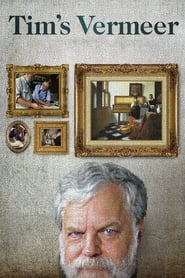
Tim's Vermeer
Download English Subtitle
Release info
Tags
English subtitle preview
The first 200 lines.
You know, sometimes when I'm laying in bed at night
trying to get to sleep,
all I can think about is this goal of trying to paint a Vermeer.
You know, really, I'm gonna try to paint a Vermeer.
And, at the face of it, that seems almost impossible.
And I don't know if I could do it.
You know, it'll be pretty remarkable if I can,
because I'm not a painter.
The Vermeer he's talking about is Johannes Vermeer,
the Dutch artist from the 1600s.
Some consider him the greatest painter of all time.
When you look at a Vermeer, it seems like more than paint on canvas.
It seems to glow like the image on a movie screen.
That magical quality has mystified the world for 350 years.
How did Vermeer do it?
Dutch artists typically learnt by apprenticeship
and they kept written records to prove their training.
But no such documents have ever been found about Vermeer.
And strangely, when you x-ray these intricate images,
you don't find the usual artist's sketches underneath.
It's as if Vermeer were some unfathomable genius
who could just walk up to a canvas and magically paint with light.
It's possible that Vermeer was using technology
to make these beautiful paintings.
If he did that, and, of course, there's no documentation that he did this,
it's possible he could paint some pretty remarkable pictures without a lot of training.
It's possible that he was more of an experimenter,
more of a tinkerer, more of a geek.
And, in that way, I feel a kinship with him, because I'm a computer graphics guy,
and we use technology to make a realistic, beautiful image,
and it's possible that's exactly what Vermeer was doing.
Tim Jenison is not a painter, he's an inventor.
He's always had a talent for figuring out how things work.
When Tim was growing up in lowa, he got a broken player piano,
repaired it, and taught himself to play swing music
by slowing down the piano rolls so he could follow Fats Waller's fingers.
Tim played keyboards in a rock band for a couple of years
and taught himself to fix anything electronic that broke.
The amazing wizard!
He got married, had a family,
and built a business repairing pinball machines and video games.
Then, around 1990, he invented a way to turn personal computers
into TVstudios for live broadcasting.
He called it the Video Toaster, and it won him an Emmy.
That led him to other amazing achievements like LightWave,
a program for rendering 3D images,
which won an Emmy for his company, NewTek, in 2003.
Tim's now based in San Antonio, Texas,
and his company produces the TriCaster,
used in broadcast, web, and live performance.
All this has given Tim the money and free time to make things like this,
Frankie, his lip-syncing duck.
A plane made entirely of stuff from a home improvement store.
It's an electric moth.
His electric moth.
As you raise the light, it comes up off the floor,
and it stays at exactly the same distance under the light.
And this.
Here's the pipe organ Tim put together from four different churches.
Once I got started, you have to have more pipes,
because it's never quite enough, so I've got three pipe organs here,
plus an electronic organ that I'm using for the keyboard.
Tim and I have been friends for a really long time.
If there was an artist, he would draw it, what you see...
We've cried together at space shuttle launches.
We flew his Learjet down to Cabo San Lucas
to see the total eclipse of the sun.
So, the devil's in there.
This is Penn, the last day he was able to see
before he lost God's most precious gift looking at the eclipse.
Tim's been weightless in an astronaut-training plane
and he arranged for me to try it, too.
I vomited into my own hair.
Tim was not and is not a painter.
So I didn't know he had this whole little sub-obsession
with Vermeer.
Tim's Vermeer project started 11 years back, in 2002,
when his daughter gave him a copy of David Hockney's book, Secret Knowledge.
Hockney wrote that when pictures started to look less like this,
and more like this,
that was because artists had found new tools to help them.
In 17th-century Holland, high quality lenses and mirrors were in use everywhere.
Telescopes were all the rage
and science hobbyists were experimenting with ways to project live images.
Hockney challenged conventional wisdom by suggesting
that when artists of Vermeer's day began to paint more accurately,
they were no longer using just their eyes and their imaginations.
They were secretly getting help from optical machines, like the camera obscura.
Camera obscura is Latin for "dark room".
Build a box, any size.
Could be the size of a shoebox,
but let's make this one big enough to stand inside.
It's a dark room.
Drill a little hole in one side of the box and you see something surprising.
The image of whatever is outside the box, in the light,
is projected on the wall opposite the hole, only it's upside down and backwards.
You can make the image brighter and clearer by putting a lens in the hole,
and you can change the size of the image on the wall
by changing the curvature and position of the lens.
Here's David Hockney on a TVspecial.
He's inside a camera obscura,
tracing the image of a live model projected through a lens.
Hockney was mostly focused on
how a painter could have traced images through a lens.
To me, what was most striking about the Vermeers, as a video guy,
I'm looking at this image, and I see a video signal.
I see something that looks like it came out of a video camera.
So I thought about how a painter could actually copy that.
Now, most people that have played with a camera obscura
got the idea that they could take that projected image and somehow paint on it.
Well, I've tried that and a lot of people have tried it, it's impossible.
What happens is it actually fights you, it works against you,
it's worse than nothing at all.
Painting on a projection just doesn't work.
Here's a blue that matches very closely the blue in the projection.
Imagine this is wet paint.
When you put it into the projection, it looks way too dark.
On the other hand, here's a perfect match.
The colour that matches the projected colour just right.
The only colour that'll ever do that is white.
Tim went around the world studying Vermeer.
They called it "painting with light." Vermeer "painted with light."
You can't paint with light, you have to paint with paint.
And so what they're really talking about is this verisimilitude that Vermeer has,
that it just pops.
You see it from across the room and it looks like a slide,
it looks like a colour slide of Kodachrome.
Seeing the Vermeers in person was a revelation.
It reinforced to me that I was on the right track.
That what I was seeing was an accurate representation of the colour in that room.
I just had a hunch that there must be a way to actually get the colours accurate,
with mechanical means.
Some way you could do that in the 17th century.
I remember just having this vague idea of comparing two colours with a mirror,
and it didn't go any farther than that for a long time.
Sitting in the bathtub,
you know, that's I guess where you have your eureka moments,
but, I don't know, there's something about bath water...
It's just very, very relaxing.
And I was just picturing that mirror hanging there in space,
and I pictured what I would see, and there it was.
And so I grabbed a piece of paper, being careful not to get it wet,
made a sketch, and that was where I realised
Vermeer could have used a mirror to paint those paintings.
To test this I propped up a high school photograph of my father-in-law on the table.
I put a piece of Masonite down here to paint on.
I set a small mirror at a 45-degree angle.
And for the first time in my life, I did just what Vermeer may have done.
I picked up some oil paints and a brush.
In Vermeer's camera this would be a projection,
a lens is projecting this image.
But to show the actual mirror painting process,
we're using a photograph here.
You can see that there's a reflection, and then there's my canvas down here.
And right at the edge of the mirror, I can see both things at once.
I'm just going to apply paint
and either darken or lighten the paint until it's the same exact colour.
And at that point, when it's exactly the same colour,
the edge of the mirror will disappear.
All right, and I'm an idiot at this,
I have done this process exactly twice in my life before.
What I'm doing is I'm moving my head up and down
so that I can see first the original and then my canvas.
I'm looking at both things at the same time.
Right on the forehead, you can see that they match,
because you can't really see the edge of the mirror.
That's, that's your clue that you've matched the paint exactly.
It's not subjective, it's objective.
I'm a piece of human photographic film at that point.
What you're doing here is you're essentially blending?
Yep, I am either darkening or lightening the paint that's already on the surface.
You aren't tracing any lines, 'cause there are no lines.
Yeah, that's a characteristic of the Vermeers that makes them unusual,
is that there weren't lines,
and there weren't any lines drawn underneath the paint either.
It looks like there's these blobs that are emerging into a picture.
It doesn't look like...
The order you're doing stuff in is not a...
It's not being done mentally.
No, it's...
And that's what's so nutty about it.
You know, if I was better at this, it may be more systematic,
I may evolve into doing it more systematically, but...
No matter what I've tried,
if I just spend enough time comparing the mirror to the canvas
and stirring the paint around, it ends up looking like a photograph.
And this was the result of Tim's experiment,
it took him five hours.
Not bad for a first oil painting.
The father-in-law picture was proof enough in my mind that Vermeer probably did this.
However, my father-in-law doesn't look like a 17th-century Dutch woman,
so I don't think it would be very convincing evidence for a lot of people.
So, I thought the best way would be to really do a Vermeer.
I had the suspicion that it was exactly the same thing.
If I could do the father-in-law, I could paint a Vermeer.
It seemed to me the most powerful demonstration of the idea.
The reason I chose The Music Lesson is probably because, of all the paintings,
I think The Music Lesson is a great little laboratory,
because it's so complete and so self-contained.
You know where the windows are, you know how big the windows are,
Tim's Vermeer subtitles in other languages
More English subtitles for Tim's Vermeer
- Tims Vermeer 2013 LIMITED DOCU BDRip x264-GECKOS · 58 downloads · 2014-06-01
Comments
No comments yet. Be the first to leave one.