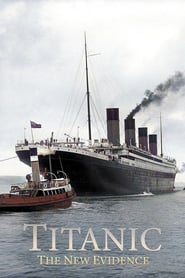
Titanic: The New Evidence
Download English Subtitle
Release info
Tags
English subtitle preview
The first 200 lines.
She was the largest ship ever built...
..and yet her maiden voyage would be her last.
After RMS Titanic struck an iceberg,
1,500 men, women and children drowned,
sending shock waves around the globe
and starting a debate that still rages today.
Why did she steam at full speed into an ice-field?
And why did a supposedly unsinkable ship sink so suddenly?
Now, a treasure trove of long-lost photographs has been unearthed.
This is the Titanic equivalent of King Tutankhamen's tomb!
New evidence of an overlooked incident afflicting the super-ship...
Look at this anomaly on the hull.
Wow. This is completely new.
..a crisis unfolding below decks,
even as the Titanic set sail,
a crisis that would drive the ship to disaster.
They gambled? Yes.
After a century of speculation...
This is amazing.
..the true story behind the sinking of the Titanic can now be told.
When the RMS Titanic was completed in 1912...
..she wasn't just the biggest ship afloat,
she was the largest man-made object on earth.
Over 880 feet long and 100 feet tall,
she could carry 3,500 people.
On the spacious upper decks
mahogany-lined rooms awaited those travelling first class.
Crowding onto the lower decks,
third class passengers dreamed of a new life in America.
Titanic was the wonder of her world.
This is the footprint of those mighty vessels -
the length of four city blocks, you see it here.
And when you look around this dock
you still can imagine that
the waterline was the height of this dock.
Forged here in the docks of Belfast
as an invincible symbol of British industry,
Titanic became instead the byword for catastrophe.
And it's extraordinary even now, a century later,
to think that something this big, this massive,
could sink in the middle of the North Atlantic.
Journalist Senan Molony has spent 30 years researching the disaster.
He believes the real story of why it sank is still to be told.
There are aspects of this amazing saga
that have never been adequately explained.
Why was she going so fast when she had been warned
repeatedly about an ice field in her path?
Why did she not slow down?
Why did she not divert?
Wider questions about why she was an unsinkable ship
that managed to sink in a few hours.
For two hours after the collision
the Titanic looked like she'd stay afloat well into the next day.
But then, suddenly and inexplicably,
the ship plunged beneath the waves.
Something catastrophic happened...
but what?
The answer was surely lost with the ship.
Or so everybody thought.
Now an album of photographs that lay undiscovered
in an attic for over 100 years has come to light.
An album that charts the Titanic's brief life.
This remarkable collection of images,
shown here for the first time on television,
were taken by the Titanic's chief electrical engineer John Kempster.
And using a brand-new graphic process,
the 2D images of the Titanic...
..can now be brought to full-colour three-dimensional life.
Wow. The detail is exquisite.
The album was found at an auction house by Senan's
long-time collaborator and fellow Titanic expert Steve Raffield.
I mean, it's fantastic.
This is the Titanic equivalent of King Tutankhamen's tomb, isn't it?
Then your launch pictures, of course,
are absolutely one of the jewels of the entire collection.
The photographs capture the moment the Titanic was launched into the water,
in a stunning sequence of images.
And I love it that he puts an annotation on each photograph -
going, going, gone.
Using the living stills technique,
we can see the launch as it happened at the time.
But these photographs aren't just a unique window
onto an historic moment.
There's something else.
I kept turning the pages
and I wasn't really quite prepared for what I was about to see,
because as I turned to this section
I spotted what I thought was a very strange mark on Titanic's hull.
And it's just there.
Wow.
It struck me as being very odd.
I thought possibly it could be
a reflection from the water,
but on looking at the photograph in more detail
I realised it couldn't be because the next photograph
following on from there shows the same diagonal black mark,
but the ship is at a different angle, she's moved.
This is the crucial thing.
In the two photographs,
the camera angle and position has changed significantly.
But the mysterious mark, over 30 feet long,
doesn't change position.
And if you blow the image up even more,
and particularly that area,
you will see that the top part of that black diagonal mark
follows the line of the hull plating,
which is very, very strange.
And it just stops there, doesn't it? It just stops completely. Exactly.
What you found is absolutely inexplicable.
We were looking at the exact area where the iceberg struck
and we appear to have a weakness or damage to the hull
in that specific place before she even left Belfast.
If the Titanic had been weakened in the very region where it
would be struck by an iceberg,
it could rewrite history.
But what could lie behind the mark?
The photographs reminded Senan of a fact known generally
only to Titanic historians -
the ship suffered a fire.
It instantaneously jumped into my mind that we had
a fire in this location before she even left Belfast.
The fire took hold in a coalbunker in boiler room six,
and the room is directly behind the place where the dark mark begins.
The question is...
The fire was mentioned in the official inquiry in 1912,
but was judged to have played no role in the disaster.
So I've always known about the fire,
and yet people tend to treat it as an irrelevancy.
I've seen other researchers who tend to discard it because
this fire was played down.
This new evidence sent Senan back to eyewitness accounts
given by people on board.
One description in particular,
reported just days after the disaster in a New York newspaper,
caught his eye.
I found an article by John Dilley - a fireman.
He wasn't brought before the bench in London,
he actually was speaking at the quayside to a journalist.
And he said,
"Unlike an irrelevancy, the Titanic fire was very, very important."
John Dilley was one of a team of firemen and stokers who kept
the hungry Titanic boilers fed with coal.
Dilley describes a serious fire in one of the ship's huge
coal storage bunkers.
It was discovered the day the Titanic prepared to leave Belfast
for Southampton and begin her maiden voyage.
The procedure for coalbunker fires was to dig out
the burning coal before the fire spread.
But the Titanic was the biggest ship ever built -
her coalbunkers were three-stories high.
He said, "My sole duty, together with 11 other men..."
That's how many fought the fire. It's incredible.
If you couldn't have an easily extinguished fire,
that spoke to me of a very major fire,
and this is what Dilley is saying.
Listen to him.
He says, "There were hundreds of tonnes of coal stored there."
"We made no headway against it."
Four days later, and the fire was getting worse.
But still, here is Dilley making serious claims about the fire.
"We didn't get that fire out."
"From the day we sailed the Titanic was on fire."
On 10th April 1912, the Titanic set sail from Southampton.
The upper decks housed dozens of millionaires,
including Benjamin Guggenheim and Lady Astor.
The lower decks held over 2,000 passengers.
Yet no-one was told about the fire raging below.
The men were under strict orders to keep quiet.
"Of course, sir, the passengers knew nothing of the fire."
"The officers told us to keep our mouths shut!"
The mark in the newly discovered photographs has led Senan
to suspect that the fire below decks
played a much more important role in the Titanic disaster
than anyone had ever realised.
Rare photographs of the doomed super-ship Titanic have revealed
a mysterious mark, 30 feet long, on the ship's hull.
They've sparked a new investigation into the sinking.
At her launch Titanic made headlines around the world.
She took nearly 2,500 expectant passengers on her maiden voyage.
Now, Senan Molony has discovered that even as the ship set sail,
the men below decks were fighting a fierce coal-bunker fire.
But was the fire serious enough to have played
a part in the ship's sinking?
That's what draws me into this story.
I can't believe that a fire would have done so much warping and distortion
to have done this seeming damage.
How are you doing? Hi. How are you?
Thanks so much for meeting me.
Look at this.
Is that the location of a coalbunker?
Yeah. That's going into a coalbunker.
Amazing.
Dr Guillermo Rein is one of only a handful of scientists
specialising in the dynamics of coal fires.
This could definitely be because of smouldering fire.
Dr Rein thinks it's likely the coal fire probably started
by itself and burned for some time before it was detected.
The scary part of smouldering coal is that it doesn't need
an ignition even.
It is spontaneous. It is what we call self-heating.
Comments
No comments yet. Be the first to leave one.