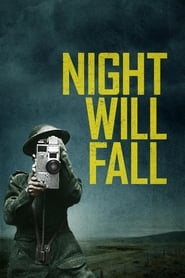
Night Will Fall
Download English Subtitle
Release info
Tags
English subtitle preview
The first 200 lines.
With World War II in Europe drawing to a close,
the three allied armies, British, Soviet and American,
began their move towards Berlin.
Among their ranks were soldiers newly trained as cameramen.
In April 1945, an advancing British unit
halted by the river Aare, Northern Germany.
As events unfolded, they were recorded by the army camera crews.
I think it was about the 12th of April.
Apparently, two German officers approached our front line
with a white flag asking to speak to our General,
and they were ushered through, blindfolded actually,
and taken to our corps headquarters where I happened to be.
And they had a message from their General.
The message was that we were approaching,
or probably going to approach
a large civilian prison camp
where typhus had broken out
and their General wanted to send a message
to say that he didn't think it was a good idea
if we fought through that camp
because those inmates with typhus would get loose
and would get amongst the civilian population
and the German army and the British army.
They pulled us out, up a track,
and we had to hoist a white flag of truce.
This is... Out of nowhere this has happened.
We were sent under the flag of truce,
miles behind enemy lines.
The Germans, in fairness to them,
on the road, they all got off the road
and they were all armed on the sides of the roads as we were driving through.
The more I think about it now,
I'm amazed that none of us opened fire.
But in fairness to the Germans,
not one of them fired and not one of us fired either.
The British camera crews continued to film.
Their footage was to become part of an extraordinary documentary
produced for the Allies by Sidney Bernstein
with a team that included the director Alfred Hitchcock.
This film, called German Concentration Camps Factual Survey,
has been described as a forgotten masterpiece of British documentary cinema.
Yet it was abandoned, unfinished,
until now, 70 years later.
In the spring of 1945,
the Allies advancing into the heart of Germany
came to Bergen-Belsen.
Neat and tidy orchards,
well-stocked farms lined the wayside.
And the British soldier did not fail to admire the place and its inhabitants.
At least, until he began to feel a smell.
Then dawn came up.
And then we could see where the stench was coming from.
I think one of the first things we did
was to line up all the SS men and women
and took them, made them prisoners of war basically.
The SS were still there.
Josef Kramer was still there,
the camp Commandant.
I looked at the tower and the tower was empty.
And there was always a German there with a shotgun
or with whatever he had.
And I started screaming,
"The Germans are gone, I don't see any Germans!"
And some girls ran with me
and we made it to the gate,
and I am behind a barbed wire fence
to witness the first British troop
entering the camp.
We had a loudspeaker van with us.
We went into the camp to see what we could see,
and of course what we could see was
a complete, utter shock,
and I'll never forget it.
Through a loudspeaker, in different languages, they said,
"Be calm, be calm, be calm. Stay where you are.
"Be calm. Help is on the way.
"We are the British soldiers. Help is on the way."
And people went just crazy.
It was an unbelievable moment.
Suddenly you hear English spoken.
"We should remain calm, don't leave the camp, help is on the way,"
you know, that sort of thing.
Yeah, it's very difficult to describe. It was, you know...
You've spent years preparing yourself to die
and suddenly you're still here, you know.
I was 19 when the Liberation came
and, I mean, it was very difficult to actually take on board.
We thought we were dreaming, really,
and every British soldier looked like a God to us.
Yeah. Well, it was, uh...
It was not what we expected, to still be alive, but there we were.
We didn't know what we were going to go into.
We were sent...
Um, and then we drove...
Excuse me.
Sorry about this.
Too painful.
Dead prisoners hurled out and stacked in twisted heaps.
Dead women like marble statues in the mire.
This was what these inmates had to live among,
and die among.
The dead which lay there were not numbered in hundreds,
but in thousands.
Not one or two thousands,
but 30,000.
We drove in and saw a sight
that shook us as nothing
even the sights of war had ever, ever, ever shown us before.
It was pain to look at it,
pain that this could happen to people.
There was hundreds and hundreds of dead bodies
sort of piled up.
There were... There was a stench of death everywhere.
There were pits, containing bodies of people
as large as lawn tennis courts,
containing babies, girls, youths, men, women, old, young,
and how deep, we didn't know.
These half-dead people walking about,
glazed eyes and...
Absolutely...
Dead.
There was hopelessness.
The stare,
the appalling smell,
the whole atmosphere of depression.
Like the end had come.
The bodies... You lost contact with reality.
They were dummies, they were dolls, they were...
I don't know whether we ourselves
withdrew into another
space, time, existence,
but you could never associate what you were seeing
with your own life, if you know what I mean.
This was something completely separate. It was another world.
I don't think... If you had become too involved,
I think you would probably have gone mad.
We were there for about two weeks, filming all these sights,
which no film which I have seen since
really conveys the feeling of despair and horror
that can be done to people
who are Europeans of another faith,
for no other reason.
And I thought as time went by it might leave me.
I wanted to forget.
But it never does leave you.
I find it hard to describe adequately
the horrible things that I've seen and heard.
But here, unadorned, are the facts.
I passed through the barrier and found myself in the world of a nightmare.
Dead bodies, some of them in decay,
lay strewn about the road and along the rutted tracks.
On each side of the road were brown wooden huts.
There were faces at the windows.
The bony emaciated faces
of starving women, too weak to come outside,
propping themselves against the glass
to see the daylight before they die.
And they were dying, every hour and every minute.
It was so horrific that the BBC initially
waited before they broadcast it,
because they had doubts
whether my father had actually
accurately described what he'd seen.
And they checked and then put it out.
It's the moment when he describes,
"People no longer behave like human beings"
that you realize what he's actually saying,
what the implied message of this is.
This isn't just Germany.
This isn't just the people in those camps.
This could be any of you, anywhere,
if civilization breaks down in this way.
The day after the report, Churchill declared,
"No words can express the horror which is felt
"by His Majesty's government and their principal allies
"at the proofs of these frightful crimes
"now daily coming into view."
The success of cinema in the 1930s
had underlined the power of the moving image.
Keen to exploit its potential role in war,
Britain and America set up a joint film department.
Its brief was to produce short propaganda films,
initially to support the war effort,
and later to assist the task
of dealing with a defeated Germany once the war was won.
In Britain, this unit was headed by leading film producer
Sidney Bernstein.
The day following Churchill's statement,
Bernstein set out for Bergen-Belsen.
By the time he arrived, the army film cameramen
had been at work for a week.
The film shot at Bergen-Belsen by the British cameramen
reveal every level of humanity,
to a much greater extent than any other
of the film evidence.
It feels as if the whole
human story is there.
They used the camera in a very specific way.
There was a...
It began to be directed to collect evidence, to gather evidence.
Night Will Fall subtitles in other languages
More English subtitles for Night Will Fall
- Night Will Fall 2014 WEBRip x264-ION10 · 66 downloads · 2020-04-02
- Holocaust Night Will Fall 2014 PROPER HDTV x264-BATV · 73 downloads · 2015-05-08
Comments
No comments yet. Be the first to leave one.